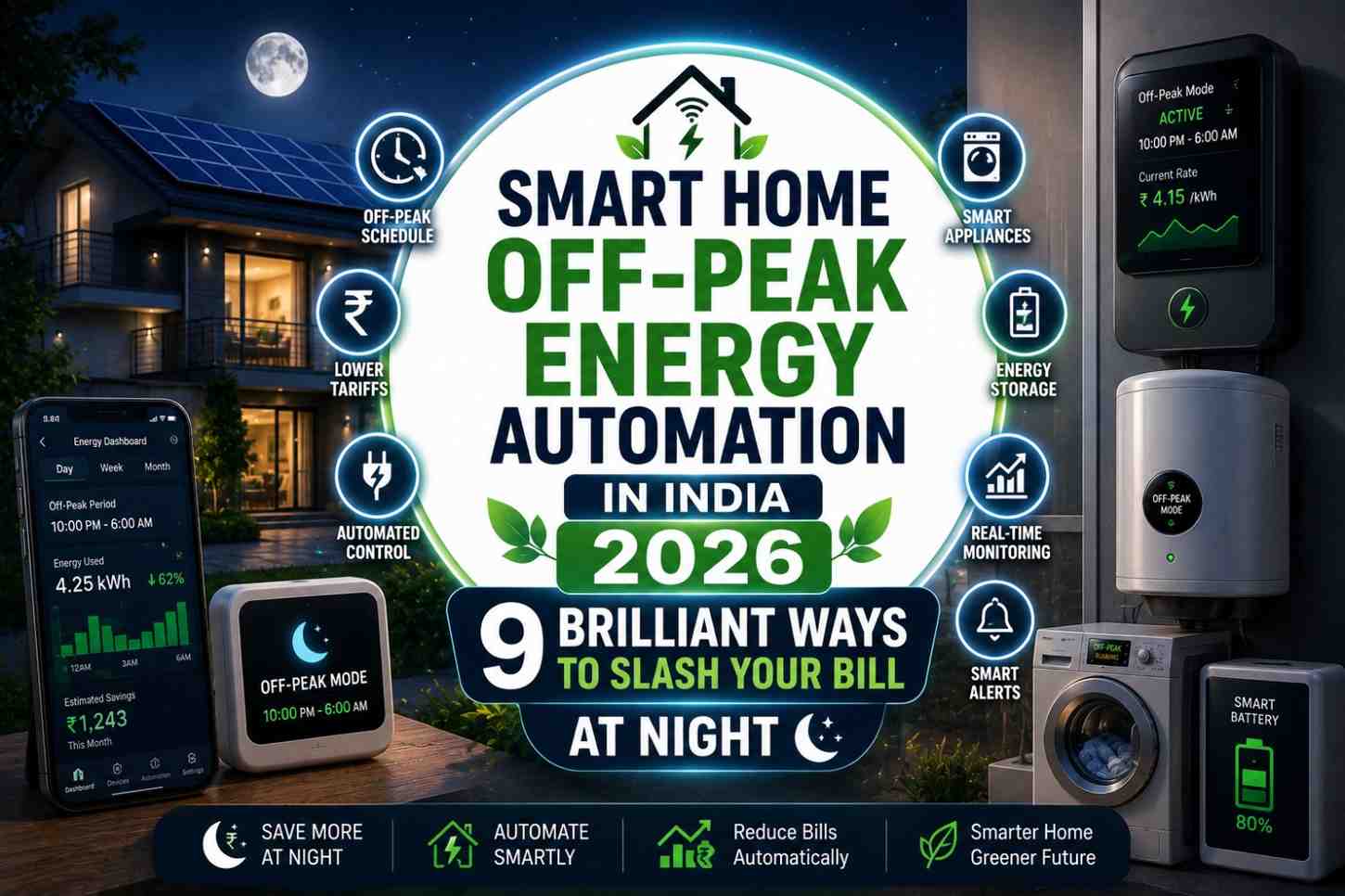
India’s electricity tariff structure contains a powerful money-saving secret that most households are entirely unaware of — and that smart home technology can exploit automatically, every single day, without requiring any ongoing effort or daily decision-making. Smart home off-peak energy automation in India in 2026 is the practice of intelligently shifting high-energy appliances to run during cheaper, low-demand electricity hours—and in 2026, the technology to do this seamlessly has never been more accessible or affordable for Indian households.
This guide explains the complete framework of smart home off-peak energy automation in India 2026—from understanding India’s tariff structures to installing the automation hardware and programming the rules that start saving money from the first night of operation.
Understanding India’s Electricity Tariff Structures in 2026
Effective smart home off-peak energy automation India 2026 strategy begins with understanding how Indian electricity pricing works and where the cost arbitrage opportunities lie.
Time-of-Day (ToD) and Time-of-Use (ToU) Tariffs: Several Indian states, including Maharashtra, Gujarat, Rajasthan, Andhra Pradesh, and Tamil Nadu have implemented or are rapidly rolling out Time-of-day tariffs for domestic consumers—charging different rates per kWh depending on the time of consumption.
Typical Indian ToD tariff structure:
- Peak hours (6–10 AM and 6–10 PM): 1.3–1.8x normal rate
- Normal hours (10 AM–6 PM): Base rate (varies by state: ₹5–₹9 per kWh)
- Off-peak hours (10 PM–6 AM): 0.6–0.8x normal rate (20–40% cheaper)
Multi-slab base tariffs: Even in states without formal ToD pricing, India’s multi-slab consumption tariffs create significant incentives for load shifting. Since Indian tariffs increase steeply with monthly consumption (crossing from ₹4/kWh at low consumption to ₹8–₹12/kWh at high consumption in many states), running high-load appliances at night — when the household’s general consumption is lower — keeps total daily consumption more even, preventing the most expensive slab triggers.
Solar arbitrage: For households with solar panels, smart home off-peak energy automation India 2026 creates a three-window optimization strategy: run the largest loads during peak solar generation (10 AM–2 PM) using free solar power, charge batteries during solar surplus, and use battery power during evening peak—avoiding grid use at the most expensive tariff hours entirely.
Understanding these structures is the foundation of any effective smart home off-peak energy automation India 2026 implementation.
Which Appliances Are Worth Shifting?
Not all appliances are worth scheduling. Smart home off-peak energy automation in India in 2026 delivers maximum value when applied to high-consumption, deferrable loads—appliances with large power draws that do not need to run at a specific time.
Highest-value loads to shift (in order of impact):
| Appliance | Typical Power Draw | Monthly Energy (avg. use) | Monthly Saving Potential* |
|---|---|---|---|
| Electric geyser / water heater | 2,000–3,000 W | 60–90 kWh | ₹300–₹600 |
| Washing machine | 500–2,000 W | 15–40 kWh | ₹75–₹200 |
| Dishwasher | 1,200–1,800 W | 20–35 kWh | ₹100–₹175 |
| Air conditioner (dehumidification) | 800–2,000 W | Variable | ₹200–₹800 |
| EV charger | 3,300–7,200 W | 60–150 kWh | ₹300–₹1,500 |
| Pool/sump pump | 750–1,500 W | 45–90 kWh | ₹225–₹450 |
*Savings based on 30–40% tariff differential between peak and off-peak in ToD states
Together, these shiftable loads represent the core of any smart home off-peak energy automation India 2026 strategy—and for a household with all of these, total monthly savings of ₹1,200–₹3,500 are achievable through scheduling alone.
The 9 Automation Strategies for Off-Peak Energy Savings
Strategy 1: Smart Geyser Scheduling
The electric water heater (geyser) is India’s highest-impact target for smart home off-peak energy automation in India 2026 because of its high power draw (2,000–3,000W), long daily runtime, and complete deferability.
Implementation: Install a smart plug with energy monitoring (TP-Link Kasa EP25, Wipro Smart, or Syska Wi-Fi Smart Plug) on your geyser’s power supply. Set a schedule in the smart plug app or home automation platform to run the geyser from 11:30 PM to 12:30 AM (heating the tank during deep off-peak hours) and again from 4:30 AM to 5:30 AM (ensuring hot water is ready before morning peak usage).
The geyser’s thermal insulation maintains water temperature for 4–6 hours, meaning water heated at 4:30 AM is still comfortably hot at 7–8 AM shower time.
Savings: ₹300–₹600/month for a standard 25-liter geyser in a ToD state. Even in non-ToD states, running the geyser off-peak reduces total daily consumption in peak slab periods, often dropping the household into a lower monthly consumption slab.
This single automation delivers the fastest payback of any smart home off-peak energy automation India 2026 strategy—often recovering the cost of the smart plug in 2–3 months.
Strategy 2: Washing Machine Night Cycle Automation
Modern washing machines from LG, Samsung, IFB, and Whirlpool include built-in delay start features that allow cycle end times to be scheduled. Paired with a smart plug that prevents power entirely until the programmed start time (protecting against unintended machine operation), this creates reliable off-peak laundry automation.
Program your washing machine to begin its cycle at 11 PM, completing by midnight—using off-peak power throughout. For households running 5–7 wash cycles per week, shifting 100% of cycles to off-peak hours saves ₹75–₹200/month in ToD states.
For older machines without delay start: Use a smart plug with precise scheduling to control machine power supply directly, loading clothes in the evening and setting power activation for the desired cycle start time. This is a particularly practical smart home off-peak energy automation India 2026 approach for budget-conscious households with older machines.
Strategy 3: EV Charging Automation
With India’s electric vehicle market growing at 40%+ annually, EV charging automation is becoming one of the most financially significant smart home off-peak energy automation India 2026 use cases.
An EV charger drawing 3.3 kW for 6 hours nightly consumes approximately 20 kWh per charge session. At peak tariff rates, this costs ₹160–₹200 per session in high-tariff states. At off-peak rates, the same charging session costs ₹100–₹130—a saving of ₹1,500–₹3,000/month for daily commuter EV users.
Implementation options for India:
- Smart EV chargers with built-in scheduling: Ather Energy’s home charger and ChargePoint Home Flex support scheduled charging via smartphone app
- Smart plug-controlled Level 1 charging: For cars that support standard plug charging, a 16A smart plug (Havells Smart, Schneider Wiser) provides basic schedule control at ₹2,500–₹4,500
- Home Assistant integration: Advanced EV owners connect their charger to Home Assistant for dynamic scheduling based on grid tariff, solar generation, and battery state simultaneously
Strategy 4: Battery Storage Optimized Charging
For households with home battery storage (as discussed in the Solar Integration article in this series), smart home off-peak energy automation India 2026 includes programming batteries to charge from the grid during off-peak hours when grid rates are lowest.
This strategy—called “time-of-use charging”—ensures batteries are full at the cheapest possible rate and then discharges during peak tariff hours when the grid alternative is most expensive. The arbitrage between off-peak charging cost and peak-hour discharge value can generate ₹500–₹1,500/month in effective savings for a 10 kWh home battery system.
Program this in your Energy Management System (EMS) or Home Assistant with the following logic: “If time is between 11 PM and PM–5 AM AND battery state of charge is below 80% AND grid tariff is off-peak → charge from grid at maximum rate.”
Strategy 5: Dishwasher and Kitchen Appliance Scheduling
Dishwashers are the kitchen appliance most easily shifted to off-peak hours and one of the cleanest implementations of the smart home off-peak energy automation India 2026 principle.
Load dishes in the evening, set a delayed start for 11 PM using the machine’s built-in timer (standard on most modern dishwashers sold in India), and wake to clean dishes that were washed at the cheapest overnight tariff rate.
For households without dishwasher delay start, smart plug scheduling achieves the same result. Additionally, electric ovens, air fryers, and microwave-based cooking during off-peak hours (for meal prepping on weekends, for example) generate meaningful savings when consumption volumes are high.
Strategy 6: Pool and Sump Pump Scheduling
Swimming pool circulation pumps and household sump pumps (common in South Indian and Maharashtrian independent houses) run for 4–8 hours daily and represent significant schedulable loads.
Pool pumps only need to run for sufficient hours to turn over the full pool volume—typically 6–8 hours for a standard residential pool. Shifting this runtime entirely to off-peak hours (10 PM–6 AM) saves ₹225–₹450/month in ToD states without any impact on water quality.
Smart pump controllers—or a simple 16A smart plug with scheduling capability—implement this smart home off-peak energy automation India 2026 strategy at minimal cost.
Strategy 7: Smart Air Conditioning Pre-Cooling
Air conditioning is India’s largest residential electricity consumer but is more time-sensitive than other loads—people need comfort when they are home, not at 3 AM. However, smart home off-peak energy automation in India in 2026 still enables significant AC savings through the pre-cooling strategy.
Program your smart AC controller (Sensibo, Cielo Breez, or Tado) to cool your bedroom to 22°C between 5–6 AM (off-peak hours) before your typical 6:30 AM wake time. The thermal mass of the room retains this cooler temperature for 1–2 hours after the AC switches off—reducing or eliminating the need to run the AC during the more expensive 6–9 AM peak period.
Similarly, pre-cooling living areas from 4 to 6 PM (before evening peak) ensures comfort during the 6 to 10 PM period without peak-rate AC operation. This is one of the more sophisticated strategies in the smart home off-peak energy automation India 2026 framework but delivers meaningful comfort without sacrificing savings.
Strategy 8: Water Pump and Irrigation Automation
The municipal water supply in most Indian cities arrives with pressure at specific hours—typically early morning and early evening. Smart water pump automation ensures sump filling happens during supply availability windows that coincide with off-peak hours where possible, while smart irrigation runs during early morning off-peak windows when both electricity rates and evaporation are lowest.
Strategy 9: Smart Home Grid Tariff Integration with Home Assistant
The most sophisticated implementation of smart home off-peak energy automation in India in 2026 is a fully integrated Home Assistant setup that reads real-time grid tariff data (from your state electricity board’s API or through the OCPI protocol for smart meters) and automatically adjusts all home automation rules based on the current tariff rate.
When the tariff drops to off-peak rates at 10 PM, Home Assistant automatically
- Activates geyser heating
- Starts EV charging
- Begins battery charging cycle
- Sends washing machine start notification to user
When peak rates resume at 6 AM:
- Pauses all non-essential loads
- Switches to battery power for high-consumption devices
- Reduces AC setpoint by 1°C to lower peak load
This level of smart home off-peak energy automation India 2026 integration requires technical knowledge to set up but delivers the maximum possible savings from India’s tariff structure—typically ₹2,000–₹5,000/month for a fully equipped household.
Setting Up Your First Off-Peak Automation: A Beginner’s Guide
Day 1 (₹2,500 investment): Buy one smart plug with scheduling capability (TP-Link Kasa EP25 or Wipro Smart Plug). Install it on your geyser. Set schedule: ON at 4:30 AM, OFF at 6:00 AM. Done — your first off-peak automation is live.
Week 1 (₹5,000–₹8,000 total): Add smart plugs to the washing machine, dishwasher, and any 24-hour devices with standby loads. Set off-peak schedules for each. Review energy monitor data to confirm savings.
Month 1 (₹15,000–₹25,000 total): Install Home Assistant. Connect all smart plugs, integrate with your solar inverter (if applicable), configure ToD tariff rates, and build dynamic automation rules. Your smart home off-peak energy automation India 2026 system is now operating at full intelligence.
5 Frequently Asked Questions (From Google)
Q1: Does India have off-peak electricity tariffs for households? Yes—Maharashtra, Gujarat, Rajasthan, Andhra Pradesh, and Tamil Nadu, among others, have implemented or are rolling out time-of-day tariffs for domestic consumers. Even without formal ToD pricing, India’s multi-slab tariff structure makes off-peak load shifting financially beneficial by keeping daily consumption within lower slabs. Check your state electricity board’s latest tariff schedule.
Q2: What is the easiest way to start off-peak energy automation in an Indian home? The easiest starting point for smart home off-peak energy automation in India in 2026 is a ₹2,500 smart plug with scheduling on your electric geyser. Set it to heat between 4:30 and 6:00 AM. This single change typically saves ₹300–₹600/month in ToD states and requires no technical knowledge.
Q3: Can I automate EV charging to run at night in India? Yes—either through your EV charger’s built-in app scheduling (Ather, Tata, MG, and Hyundai EVs all support this), a smart plug with schedule control for Level 1 charging, or an advanced Home Assistant integration for dynamic solar + tariff-aware charging.
Q4: How much can I save monthly with smart home off-peak automation in India? Depending on household size, appliances, and whether your state has ToD pricing, smart home off-peak energy automation India 2026 typically saves ₹800–₹3,500/month for a medium household. EV owners in ToD states can save an additional ₹1,500–₹3,000/month on charging alone.
Q5: Will running appliances at night disturb my sleep? Modern appliances with properly calibrated night schedules operate without meaningful disturbance. Washing machines on spin cycles can be programmed to finish before midnight. Geysers are essentially silent. EV chargers are inaudible indoors. The only appliance worth checking is older dishwashers—modern units run at under 45 dB, quieter than a normal conversation, but some older models are louder.
Conclusion
Smart home off-peak energy automation in India in 2026 is one of the most financially rewarding smart home upgrades available to Indian households—and unlike many smart home investments, it begins delivering measurable returns from the very first week of operation.
Start with the geyser schedule, add washing machine and EV charging automation next, and build toward a fully integrated Home Assistant system that optimizes every shiftable load against your real-time tariff structure and solar generation simultaneously. The technology is affordable, the savings are real, and the effort required after initial setup is essentially zero.
For current time-of-day tariff information specific to your state, consult your state electricity board’s official website or visit the Ministry of Power India portal for the latest domestic tariff guidelines.