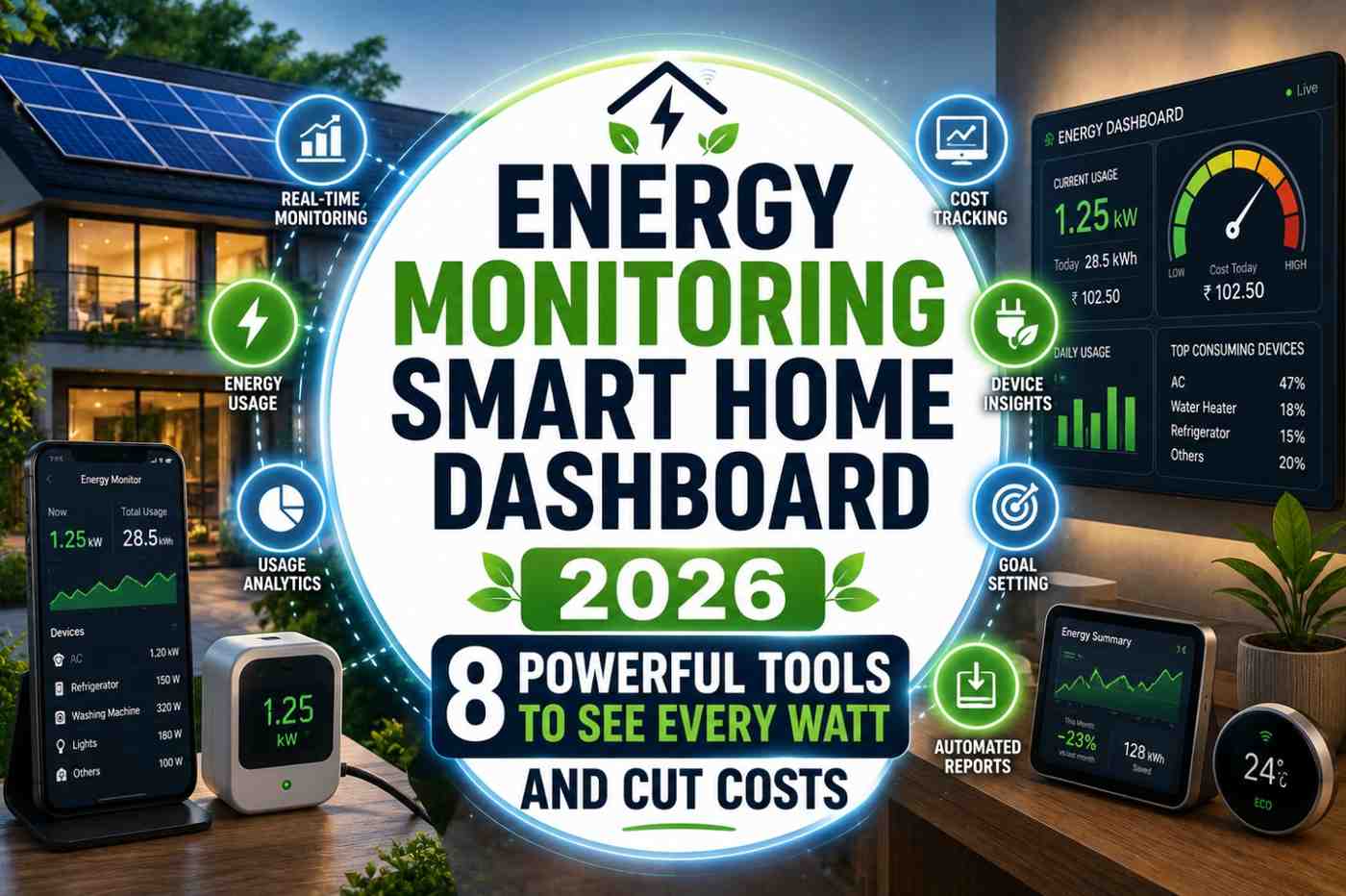
You cannot control what you cannot see. This single principle is why the energy-monitoring smart home dashboard 2026 has become the most important tool in the modern Indian household’s energy management arsenal. While smart thermostats and solar panels generate savings automatically, a well-designed energy dashboard gives you the visibility — down to individual circuits, individual appliances, and individual minutes of the day — to understand exactly where your electricity money goes and precisely what to do about it.
The energy monitoring smart home dashboard 2026 landscape has matured dramatically. What once required expensive proprietary systems and professional electricians is now achievable with affordable hardware, open-source software, and smartphone apps that present your home’s energy data in beautiful, actionable visualizations.
Why Energy Visibility Changes Everything
The science behind energy-monitoring smart home dashboard 2026 technology is rooted in behavioral economics. Multiple peer-reviewed studies—including a landmark 2023 study by Oxford’s Environmental Change Institute—confirm that households with real-time energy displays reduce consumption by 7–15% through behavior change alone, without any additional technology or automation.
The reason is simple: most people have no idea how much electricity their appliances actually use. When an Indian family discovers that their 10-year-old refrigerator draws 280W continuously (not the 150W listed on the label), or that their geyser costs ₹45 every time it heats a full tank, or that their standby electronics collectively consume ₹800 per month in idle power—behavior changes immediately and permanently.
An energy monitoring smart home dashboard in 2026 makes these invisible costs visible, transforming vague awareness of “high electricity bills” into precise, actionable knowledge about specific appliances and behaviors.
The 4 Levels of Energy Monitoring
Understanding what level of monitoring you need is the first step in choosing the right energy monitoring smart home dashboard 2026 setup.
Level 1 — Whole-home monitoring: A single sensor at the main electrical panel measures total household consumption in real time. Simple, inexpensive, and reveals total usage trends and large anomalies (appliances running unexpectedly, unusual overnight consumption).
Level 2—Circuit-level monitoring: Individual sensors on each circuit breaker in your distribution board measure consumption per circuit—so you know how much the kitchen circuit draws versus the bedroom AC circuit versus the water pump circuit. Reveals which room or appliance category dominates your bill.
Level 3 — Appliance-level monitoring: Smart plugs with energy monitoring measure individual appliance consumption. The most granular and actionable level reveals the exact cost of each appliance per day, week, and month.
Level 4 — Integrated multi-source dashboard: Combines solar generation data, battery storage state, grid import/export, and circuit-level consumption into a single unified energy monitoring smart home dashboard in 2026 — giving complete visibility of your entire home energy ecosystem simultaneously.
The 8 Best Energy Monitoring Solutions for Indian Homes in 2026
1. Shelly EM — Best Circuit-Level Monitor for Indian Distribution Boards
The Shelly EM is a Wi-Fi-enabled energy monitor that clamps onto conductors inside your distribution board to measure current draw. With two current transformer clamps, it monitors two circuits simultaneously — and multiple units can monitor an entire distribution board.
Why it leads the Indian market:
- Compact enough to fit inside standard Indian modular distribution boxes
- Supports local API and Home Assistant integration for privacy-conscious homeowners
- Real-time data at 1-second resolution with historical logging
- Cost: approximately ₹3,500–₹4,500 per unit (monitors 2 circuits)
- Full distribution board monitoring (8–12 circuits) achievable for ₹15,000–₹20,000
The Shelly EM forms the backbone of many Indian homeowners’ energy-monitoring smart home dashboard 2026 setups because of its excellent price-to-functionality ratio and local processing capability.
2. Emporia Vue Gen 3 — Best Whole-Home + Circuit Level Combined
The Emporia Vue installs directly in your electrical panel and monitors up to 16 individual circuits simultaneously through a single hub device. Its clean smartphone app displays real-time consumption per circuit, historical usage graphs, cost calculations (at your local electricity rate), and CO₂ equivalent data.
India-specific notes: The Emporia Vue is imported but available through Amazon India at ₹12,000–₹18,000. It requires a licensed electrician for panel installation. Supports integration with Home Assistant for advanced energy monitoring smart home dashboard 2026 builds.
3. Home Assistant Energy Dashboard — Best Free Open-Source Platform
Home Assistant’s built-in Energy Dashboard has become the reference standard for DIY energy monitoring smart home dashboard 2026 implementations globally—and India has one of the most active Home Assistant user communities in Asia.
What it offers:
- Free, open-source, runs locally on a Raspberry Pi or old laptop
- Integrates with virtually every smart meter, energy monitor, solar inverter, and smart plug available in India
- Displays real-time consumption, solar generation, battery state, grid import/export in a single unified dashboard
- Calculates cost in INR against your tariff slab rates (supports multi-slab Indian tariff structures)
- Generates daily, weekly, and monthly energy reports with appliance-level breakdown
The Home Assistant Energy Dashboard is the best energy monitoring smart home dashboard 2026 option for technically inclined homeowners willing to invest 8–10 hours in initial setup in exchange for a lifetime of free, powerful, fully customizable energy intelligence.
Setup guide: Detailed India-specific Home Assistant energy monitoring setup documentation is available at home-assistant.io/docs/energy.
4. TP-Link Kasa Smart Plugs with Energy Monitoring (EP25 / KP125)
For appliance-level monitoring without any electrical panel work, smart plugs with integrated energy monitoring are the simplest and most affordable entry point in the energy monitoring smart home dashboard 2026 ecosystem.
The TP-Link Kasa EP25 and KP125 models measure real-time wattage, track cumulative kWh, and display cost data through the Kasa app. At ₹1,800–₹2,500 per plug, inserting one into each major appliance (geyser, AC portable unit, refrigerator, washing machine, TV + set-top box) builds a comprehensive appliance-level energy profile within days.
High-value discovery example: A typical Indian household installing Kasa plugs commonly discovers that their set-top box draws 22–35W continuously (including when “off”)—costing ₹400–₹600 per year in pure standby waste for a device that could be put on a smart schedule at zero additional cost.
5. Sungrow iSolarCloud — Best Solar + Grid Integration Dashboard
For the growing population of Indian homeowners with rooftop solar, Sungrow iSolarCloud provides the most polished integrated energy monitoring smart home dashboard 2026 experience for Sungrow inverter owners.
The app/web dashboard displays:
- Real-time solar generation (kW)
- Battery state of charge (for hybrid systems)
- Home consumption vs. solar self-consumption
- Grid import/export tracking
- Historical generation and savings reports
- CO₂ offset calculation (running total since installation)
Available free with Sungrow inverter purchase. The equivalent platform from Growatt is ShinePhone; from SMA it is the Sunny Portal. All three are strong options depending on which inverter brand your energy monitoring smart home dashboard 2026 is built around.
6. Enphase Enlighten — Best Microinverter Monitoring System
For homes with Enphase microinverter systems (popular in India because of their panel-level monitoring and shadow tolerance), Enlighten provides panel-by-panel generation data — the most granular solar monitoring available.
Enlighten shows which individual panel is underperforming, when shading is affecting output, and how each panel’s generation has changed over time—invaluable for maintenance and system optimization. This granularity makes it a uniquely powerful energy monitoring smart home dashboard 2026 tool for serious solar homeowners.
7. Sense Energy Monitor — Best AI Appliance Detection
Sense is a remarkable AI-powered energy monitor that learns to identify individual appliances from their unique electrical signatures—without requiring smart plugs on each device. It installs in your electrical panel and, over 2–4 weeks of machine learning, begins reporting “Your refrigerator just turned on” and “Your washing machine used 1.2 kWh in this cycle” automatically.
While currently imported (available through grey market channels and Amazon India at ₹15,000–₹22,000), Sense represents the future direction of energy monitoring smart home dashboard 2026 technology—zero-friction, appliance-level visibility with no per-device sensors required.
8. Custom Dashboard with Grafana + InfluxDB
For homeowners who want a fully customized, visually stunning energy monitoring smart home dashboard in 2026 on a wall-mounted tablet or large monitor, the Grafana + InfluxDB combination is the professional standard.
InfluxDB stores time-series energy data from Home Assistant or direct MQTT sensors. Grafana creates beautiful, fully customizable visual dashboards displaying exactly the data points most relevant to your home. Indian home automation enthusiasts share complete dashboard templates on the Home Assistant community forums, making this approach more accessible than it might initially appear.
Cost: ₹0 (open-source software) + cost of data collection hardware + a ₹3,000–₹8,000 Android tablet for wall display.
Building Your First Energy Dashboard: A Step-by-Step Guide
Week 1—Baseline measurement: Install smart plugs with energy monitoring on your top 5 appliances by suspected consumption (typically geyser, AC, refrigerator, washing machine, TV + set-top box). Run for 7 days to establish a baseline consumption profile.
Week 2 — Analysis and quick wins: Review the data. Identify standby loads greater than 10W and devices running outside expected hours. Implement schedules on wasteful standby devices. Most households find ₹200–₹600/month in quick-win savings at this stage.
Week 3 — Circuit-level expansion: Install a Shelly EM or equivalent in your distribution board to add circuit-level visibility. Compare circuit-level data against appliance-level data to identify any unmonitored consumption.
Month 2 — Dashboard integration: Connect all monitoring data to a central platform (Home Assistant Energy Dashboard or Grafana). Configure alerts for anomalous consumption — useful for detecting appliance faults, leaking geysers, and unexpected standby draws. This completes your functional energy monitoring smart home dashboard 2026 setup.
Understanding Indian Electricity Tariff Slabs in Your Dashboard
India’s multi-slab electricity tariff structure means the cost of each additional kWh increases significantly as you cross consumption thresholds. Most Indian states have 3–5 tariff slabs, with the marginal rate for heavy consumers (above 500 kWh/month) being 2–3 times the rate for the first slab.
Configuring your energy monitoring smart home dashboard 2026 with your specific state tariff structure (rather than a flat average rate) dramatically improves cost calculation accuracy and reveals the true financial cost of high-consumption periods.
Home Assistant’s energy cost calculation supports multi-slab tariff entry for this purpose. Consult your state electricity board’s published tariff schedule and enter the exact slab rates for your connection type and voltage category.
5 Frequently Asked Questions (From Google)
Q1: What is the best energy monitoring system for Indian homes in 2026? For DIY enthusiasts, Home Assistant with Shelly EM clamps and TP-Link Kasa plugs provides the best combination of capability, cost, and customization. For simpler setups, Emporia Vue or manufacturer solar apps (Sungrow iSolarCloud) provide excellent out-of-the-box energy monitoring smart home dashboard 2026 experiences.
Q2: How much does a home energy monitoring system cost in India? Basic whole-home monitoring with a single Shelly EM costs ₹3,500–₹4,500. A comprehensive circuit-level and appliance-level system using Shelly EM + smart plugs costs ₹15,000–₹30,000. Advanced setups with Emporia Vue and Home Assistant integration run ₹25,000–₹50,000—but typically deliver savings of ₹3,000–₹8,000/month, paying back in 3–8 months.
Q3: Can energy monitoring work with Indian three-phase electrical connections? Yes. Shelly 3EM is specifically designed for three-phase monitoring and is available in India. For three-phase solar systems, Sungrow’s three-phase hybrid inverters include full three-phase monitoring natively. Three-phase monitoring is important for large Indian homes and any property with 3-phase air conditioning.
Q4: Do I need an electrician to install an energy monitoring system? For panel-installed devices (Shelly EM, Emporia Vue), yes—a licensed electrician should perform the installation since it requires working inside your live distribution board. Smart plugs (TP-Link Kasa and Wipro Smart) require no professional installation and are the safest starting point for most homeowners.
Q5: How does an energy monitoring dashboard help reduce electricity bills? An energy monitoring smart home dashboard in 2026 reduces bills through three mechanisms: behavioral change (visibility of consumption drives reduction), anomaly detection (finding expensive hidden waste like standby loads and phantom draws), and optimization (revealing opportunities to shift consumption to lower-tariff periods or solar hours).
Conclusion
A 2026 energy-monitoring smart home dashboard is the foundation of every other smart home energy strategy. Without visibility, you are making changes blindly. With a well-configured dashboard showing real-time, circuit-level, and appliance-level data, every other optimization becomes more targeted, more effective, and more financially rewarding.
Start with a ₹2,500 smart plug on your geyser and ₹0 Home Assistant software—and within one week you will have more actionable data about your home’s energy use than most households collect in a lifetime of bill-paying. For comprehensive Home Assistant energy monitoring documentation, visit home-assistant.io/docs/energy.