India is facing a water crisis that is no longer a distant warning — it is a daily reality for millions of households across the country. Cities like Chennai, Bengaluru, and Delhi already experience severe water stress for significant portions of the year. Against this backdrop, smart water-saving devices for the home in India in 2026 represent not just a convenience upgrade but a genuine civic and household necessity.
The good news is that in 2026, smart water-saving devices for homes in India (2026) have reached a maturity and affordability level that makes them accessible to middle-class Indian households—not just luxury smart homes. The average Indian household wastes 30–40% of its water through leaks, inefficient use, and absent monitoring. Smart devices eliminate this waste systematically, automatically, and often at surprisingly low cost.
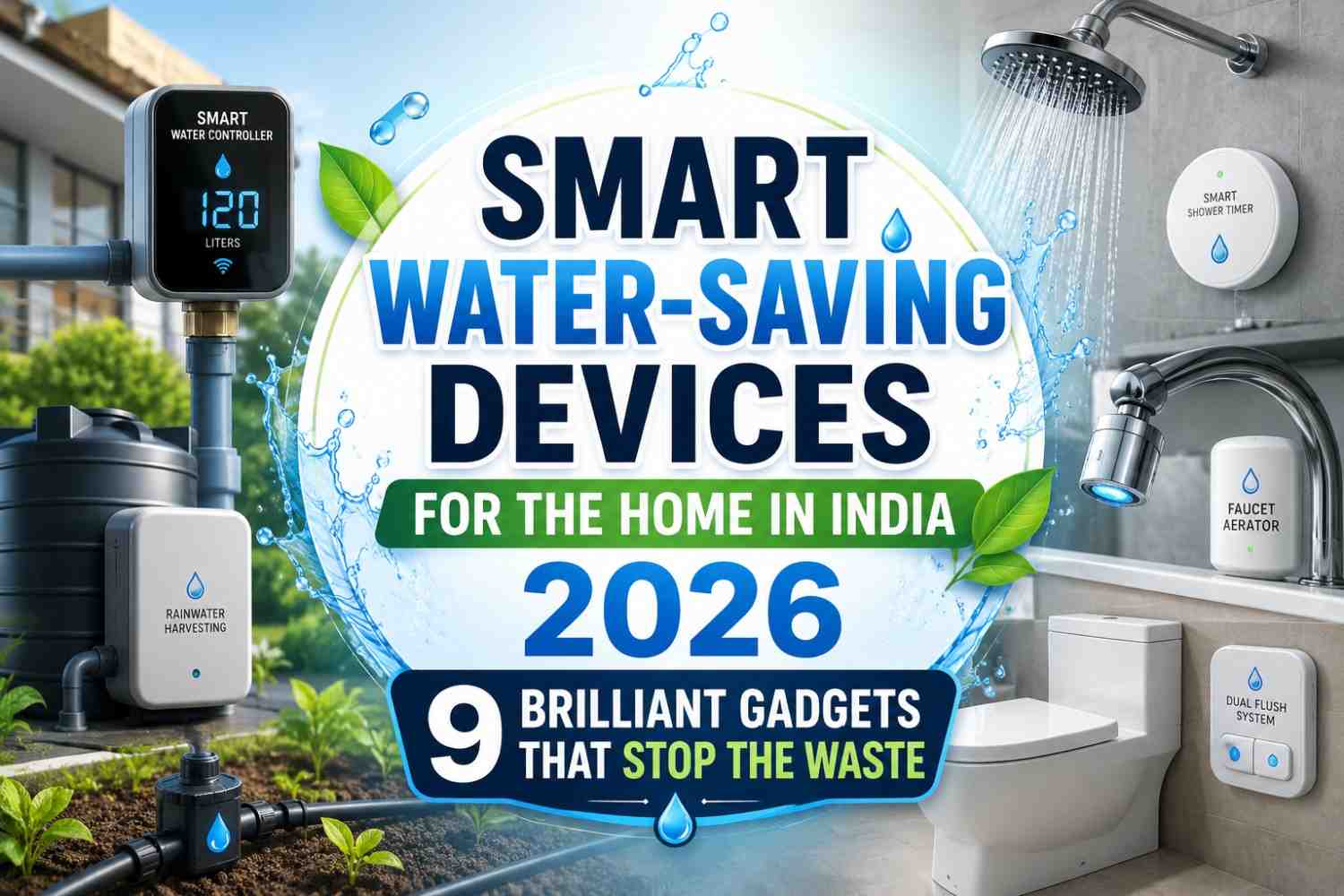
This guide covers the 9 most impactful smart water-saving devices for the home India 2026 market offers, with real specifications, Indian pricing, and installation guidance.
The Scale of Household Water Waste in India
Before exploring specific smart water-saving devices for home India 2026 solutions, the context demands attention.
India’s per capita water availability has declined from approximately 5,177 cubic meters in 1951 to under 1,500 cubic meters in 2026—below the international water stress threshold of 1,700 cubic meters per person per year, according to data from the Central Water Commission India.
At the household level:
- A dripping tap wastes 15–20 litres per day—up to 7,000 litres annually
- A running toilet wastes 200 litres per day—73,000 liters annually
- Undetected underground pipe leaks can waste 500–1,000 litres per day in older Indian properties
- Unmanaged overhead tank overflow is one of the largest single sources of household water waste in Indian apartments
Smart water-saving devices for the home in India 2026 technology address every one of these waste sources with real-time monitoring, automatic shutoffs, and intelligent scheduling—making meaningful water conservation achievable without requiring daily mindfulness or behavioral change.
Related Post: How to Use Smart Home to Reduce Carbon Footprint 2026 — 8 Proven Strategies With Real Numbers
Device 1: Smart Flow Meters and Leak Detection Systems
Water savings potential: 15–40% of total household consumption
A smart flow meter installed at your home’s main water inlet line monitors real-time water flow and detects anomalies—the invisible leaks and running fixtures that can waste thousands of liters before being discovered manually.
Top options for Indian homes in 2026:
Flume Water Monitor (imported, available online): Attaches to your existing water meter without any plumbing cuts. Sends real-time consumption data and leak alerts to your smartphone. Detects drips as small as 0.1 liters per minute.
Honeywell Home Water Leak Detectors: Wireless sensors placed under sinks, near geysers, around washing machines, and at sump pump areas. Alert instantly when moisture is detected. Available at ₹2,500–₹4,500 per sensor.
DIY solutions using ESP32 + water flow sensor: For technically inclined homeowners, an ESP8266/ESP32 microcontroller connected to a YF-S201 Hall effect flow sensor and integrated with Home Assistant provides comprehensive flow monitoring for under ₹800 in components.
Leak detection alone can prevent water waste worth ₹2,000–₹8,000 per year for the average Indian household—making these the highest-ROI entries in the smart water-saving devices for home India 2026 category.
Related Post: How to Use Smart Home to Reduce Carbon Footprint 2026 — 8 Proven Strategies With Real Numbers
Device 2: Smart Motorised Sump and Overhead Tank Controllers
Water savings potential: 10–25% of total consumption (by eliminating overflow)
In the majority of Indian apartment buildings and independent houses, overhead tanks overflow regularly because the submersible pump runs on a fixed timer or requires manual switching. Each overflow episode wastes 100–400 liters depending on tank size.
Smart tank controller systems automatically manage pump operation based on real-time water level sensors, eliminating overflow entirely while ensuring the tank is never run dry.
Best options for India:
Venus Smart Water Controller WS-01: Indian-made, widely available, supports float sensors, a motorized valve, and app control. Automatically stops pump when tank is full. ₹3,500–₹5,500.
Aprimatic Aqua Smart Level Controller: SMS alert-based system with motor protection features — particularly valuable in areas with voltage fluctuations. ₹4,000–₹7,000.
DIY with Sonoff Basic + float sensors: A Sonoff Basic Wi-Fi relay switch paired with two float sensors (high and low level) and programmed via eWeLink provides fully automatic tank control for under ₹1,200.
For multi-story buildings, smart tank controllers combined with pressure monitoring sensors form the core of any serious smart water-saving devices for home India 2026 installation—and this single device can eliminate hundreds of thousands of liters of annual overflow waste across a housing society.
Related Post: How to Use Smart Home to Reduce Carbon Footprint 2026 — 8 Proven Strategies With Real Numbers
Device 3: Smart Irrigation Controllers
Water savings potential: 30–50% of garden water use
Garden irrigation is one of the most wasteful water end-uses in Indian independent houses and villa communities. Manually timed irrigation systems run regardless of recent rainfall, soil moisture, or evapotranspiration—routinely overwatering by 40–60%.
Smart irrigation controllers replace manual or basic timer systems with weather-aware, soil-data-driven automation.
Best options for Indian gardens in 2026:
Rachio 3 Smart Sprinkler Controller (imported): Integrates with local weather data to automatically skip irrigation after rainfall or before predicted rain. Reduces garden water use by an average of 50% compared to manual systems. Available through Amazon India at ₹18,000–₹22,000 for the 8-zone model.
Hunter HC Wi-Fi Irrigation Controller: More affordable alternative with solid weather integration. Available at ₹8,000–₹12,000.
DIY Smart Drip with NodeMCU + Soil Moisture Sensors: For small kitchen gardens and terrace setups, a NodeMCU microcontroller reading capacitive soil moisture sensors and controlling a 12V solenoid valve provides precision smart irrigation for under ₹1,500. This is the most affordable entry in the smart water-saving devices for home in India in 2026 category for gardeners.
Device 4: Smart Bathroom Fixtures
Water savings potential: 20–35% of bathroom water use
Indian bathrooms are significant water consumers — particularly older showers and taps that deliver higher-than-necessary flow rates. Smart bathroom devices bring precision and control to water use without requiring fixture replacement.
Smart shower timers and flow restrictors: Devices like the Altered: Nozzle — a tap aerator that reduces flow by up to 98% when set to mist mode while maintaining the sensation of adequate coverage — can be fitted to any standard Indian tap in minutes. Available online at ₹2,500–₹4,000.
Touchless smart taps: Infrared-sensor taps automatically shut off when hands are withdrawn, eliminating the “tap left running” waste that is extremely common in Indian family bathrooms and contributes to significant daily water loss. Available from Jaquar, Hindware Smart, and imported brands starting at ₹3,500.
Smart shower heads with temperature displays: These show real-time water temperature and volume used during a shower—the visual feedback effect alone typically reduces shower duration by 15–20% in household trials, making them one of the most behavior-effective smart water-saving devices for home India 2026 options.
Related Post: Smart Home Solar Panel Integration 2026 — 7 Powerful Ways to Automate Real Savings
Device 5: Smart Washing Machine Water Optimizers
Water savings potential: 15–30% of laundry water use
Modern smart washing machines from brands like LG TurboWash AI, Samsung EcoBubble, and IFB Aqua Energie already include AI-driven water optimization. However, for households with older machines, smart external controllers can retrofit intelligence.
Smart load-sensing adapters detect actual load weight and automatically adjust water fill levels accordingly—preventing the common Indian washing habit of running full water cycles for small loads.
For new purchases in 2026, the LG F4V5RYP2T (a top-rated AI DD washing machine available in India) uses AI Direct Drive technology to optimize wash parameters, including water volume, reducing per-cycle water use by up to 30% compared to conventional machines.
Device 6: Greywater Recycling Smart Controllers
Water savings potential: 25–40% of total household water use
Greywater — the relatively clean wastewater from sinks, showers, and washing machines (but not toilets) — represents 50–80% of household wastewater volume. Smart greywater recycling systems filter and redirect this water for toilet flushing, garden irrigation, and floor washing.
Indian options in 2026:
Ecosphere Greywater Recycling Units: Indian-manufactured systems designed for apartments, with smart level control and basic filtration. Price range: ₹45,000–₹85,000 for full installation—significant upfront cost but payback in 3–5 years in water-scarce cities like Chennai and Bengaluru, where supplementary water (tanker supply) costs are high.
Simple DIY first flush diverters: For roof rainwater harvesting integration, first flush diverters (available for ₹800–₹2,000) automatically discard the first contaminated portion of any rain event before directing cleaner subsequent rainfall to storage tanks—significantly improving stored water quality without electronic complexity.
Related Post: Smart Home Solar Panel Integration 2026 — 7 Powerful Ways to Automate Real Savings
Device 7: Smart Water Quality Monitors
Practical impact: Prevents wasteful re-use decisions and health risks
Smart water quality monitors like the Lishtot TestDrop Pro or AquaMonitor TDS Smart Sensor continuously measure TDS (total dissolved solids), pH, chlorine levels, and temperature in your stored water, sending real-time readings to a smartphone.
For Indian households dependent on borewell water, municipal supply, or rooftop rainwater harvesting, knowing real-time water quality prevents both health risks from poor-quality water and the wasteful practice of discarding usable water unnecessarily. These practical devices are an increasingly popular category in the smart water-saving devices for the home India 2026 ecosystem.
Device 8: Smart RO Reject Water Recovery Systems
Water savings potential: 50–75% of RO reject water—up to 40 litres per day
Standard reverse osmosis (RO) water purifiers installed in the vast majority of Indian kitchens waste 2–3 liters of reject water for every liter of purified water produced. For a family consuming 10 liters of purified water per day, this means 20–30 liters daily of reject water going directly to the drain—7,000–11,000 liters per year.
Smart RO reject water recovery systems collect this reject water in a secondary tank and automatically direct it to toilet flush tanks, garden irrigation systems, or floor mopping supplies.
Products available in India: Several Indian RO manufacturers, including Kent and Aquaguard, now offer built-in reject water recovery systems on their 2026 models. Retrofittable collection kits are available for older RO units at ₹800–₹2,500 from plumbing supply stores and online marketplaces.
This single change prevents thousands of liters of daily waste and is one of the most affordable and impactful smart water-saving devices for home India 2026 upgrades available.
Related Post: Smart Home Solar Panel Integration 2026 — 7 Powerful Ways to Automate Real Savings
Device 9: Smart Community Water Management Systems for Housing Societies
Water savings potential: 20–35% of total society consumption
For apartment complexes and housing societies, building-level smart water management systems monitor consumption per flat, detect common area leaks, manage booster pump operations intelligently, and provide granular consumption data to facility managers.
Systems available for Indian housing societies in 2026:
WEGoT Utility Solutions (Bengaluru-based): An IoT-enabled water metering and monitoring system specifically designed for Indian apartment complexes. Currently deployed in multiple large residential societies across India. Provides per-flat consumption dashboards, leak alerts, and society-wide efficiency reporting.
Grundfos iSOLUTIONS Smart Pumping: Intelligent variable-speed pump controllers for society booster pumps that reduce both electricity consumption and pump-induced pressure surge stress on building pipework. Available through Grundfos India’s authorized dealer network.
Community-level smart water-saving devices for homes in India, 2026 deployments in housing societies, typically achieve a 20–30% reduction in per-capita water consumption within the first year of operation.
Building Your Smart Water Saving Strategy: A Priority Framework
Not every household needs every device simultaneously. Here is a prioritized implementation framework based on the most common Indian household water waste patterns:
Priority 1 (Immediate, under ₹3,000): Leak detectors under sinks and near geysers + smart tank overflow controller. These two measures address the two largest waste sources in most Indian homes.
Priority 2 (Month 1–3, ₹3,000–₹15,000): Smart flow meter at main inlet + RO reject water recovery kit + touchless bathroom taps. Monitoring and recovery before investing in more complex automation.
Priority 3 (Month 3–12, ₹15,000+): Smart irrigation controller + greywater recycling assessment + community-level smart metering.
5 Frequently Asked Questions (From Google)
Q1: What is the best smart water leak detector for Indian homes in 2026? Honeywell Home water leak sensors are the most widely recommended standalone detectors. For whole-home flow monitoring, Flume Water Monitor provides the most comprehensive leak detection capability. For budget-conscious installations, DIY ESP32-based systems cost under ₹1,000 and integrate beautifully with Home Assistant.
Q2: How much water does a smart tank controller save in Indian apartments? A smart tank controller that eliminates overhead tank overflow saves 100–400 liters per overflow event. In apartments experiencing daily overflow (a very common situation), this translates to 3,000–12,000 liters of water saved per month—one of the highest single-device impacts in the smart water-saving devices for home India 2026 category.
Q3: Are smart irrigation systems worth buying for Indian home gardens? Yes, particularly during India’s dry summer season when manual irrigation tends toward overwatering. Smart controllers that integrate weather data reduce garden water use by 30–50% and pay for themselves within 2–3 watering seasons in areas where water costs are rising.
Q4: How can I reduce RO water waste in my Indian home? Install an RO reject water recovery kit (₹800–₹2,500) to redirect reject water to toilet flush tanks or garden irrigation. Upgrade to a newer RO unit with built-in recovery systems (Kent and Aquaguard 2026 models). These practical steps are among the most affordable smart water-saving devices for home India 2026 solutions available.
Q5: Can smart water devices work in areas with low or intermittent water pressure? Yes. Most smart controllers and flow meters are designed to function across a wide pressure range (0.5–6 bar), accommodating India’s highly variable municipal supply pressure. Battery-powered wireless leak detectors function entirely independently of water pressure and are ideal for all Indian supply conditions.
Conclusion
India’s water crisis demands household-level action—and smart water-saving devices for home. India 2026 makes that action practical, affordable, and automated. From simple leak detectors that prevent thousands of liters of invisible waste, to intelligent tank controllers that eliminate overflow, to smart irrigation systems that apply exactly the water your plants need and nothing more, the technology available today is mature, accessible, and financially justified.
Start with the two highest-impact devices for your specific situation — leak detection and tank control — and build from there. Every liter saved is a meaningful contribution to a problem that is growing more urgent every year.
For further guidance on household water conservation measures and government rebate programs, visit the Central Water Commission India.