
Climate action does not require moving to a farm or installing a wind turbine on your roof. For most urban Indian households in 2026, the most powerful and immediate step available is right inside the home — in the thermostats, the light switches, the appliances, and the automation systems that govern how your home consumes energy every single day. Understanding how to use smart home to reduce carbon footprint 2026 is about combining intelligent technology with behavioural insight to achieve measurable, verified emissions reductions.
This guide provides real emissions numbers, proven strategies, and specific product recommendations for Indian households serious about understanding how to use smart home to reduce carbon footprint 2026 in a practical, cost-effective way.
The Carbon Reality of Indian Household Energy Use
Before exploring how to use smart home to reduce carbon footprint 2026, it is essential to understand the scale of household emissions in India.
India’s electricity grid had an average emission factor of approximately 0.71 kg CO2 per kWh in 2025, according to data from the Central Electricity Authority of India. This means that for every kilowatt-hour of electricity a typical Indian household consumes, roughly 710 grams of CO2 are released into the atmosphere.
A medium Indian urban household (3–4 BHK apartment in a metro city) consumes approximately 400–600 kWh of electricity per month — generating 3,400–5,100 kg of CO2 annually from electricity alone. Add cooking gas (LPG), water heating, and transportation, and the average Indian urban household carbon footprint reaches 6–9 tonnes of CO2 per year.
Smart home technology, when properly implemented, can reduce the electricity component of this footprint by 25–45% — making it one of the most accessible and scalable carbon reduction strategies available to Indian households. Understanding how to use smart home to reduce carbon footprint 2026 is therefore both a financial and an environmental imperative.
Strategy 1: Smart Thermostats and AC Automation
Potential CO2 reduction: 400–900 kg per year
Air conditioning accounts for 40–60% of electricity consumption in Indian urban homes during summer months. This makes it the single highest-impact target in any strategy for how to use smart home to reduce carbon footprint 2026.
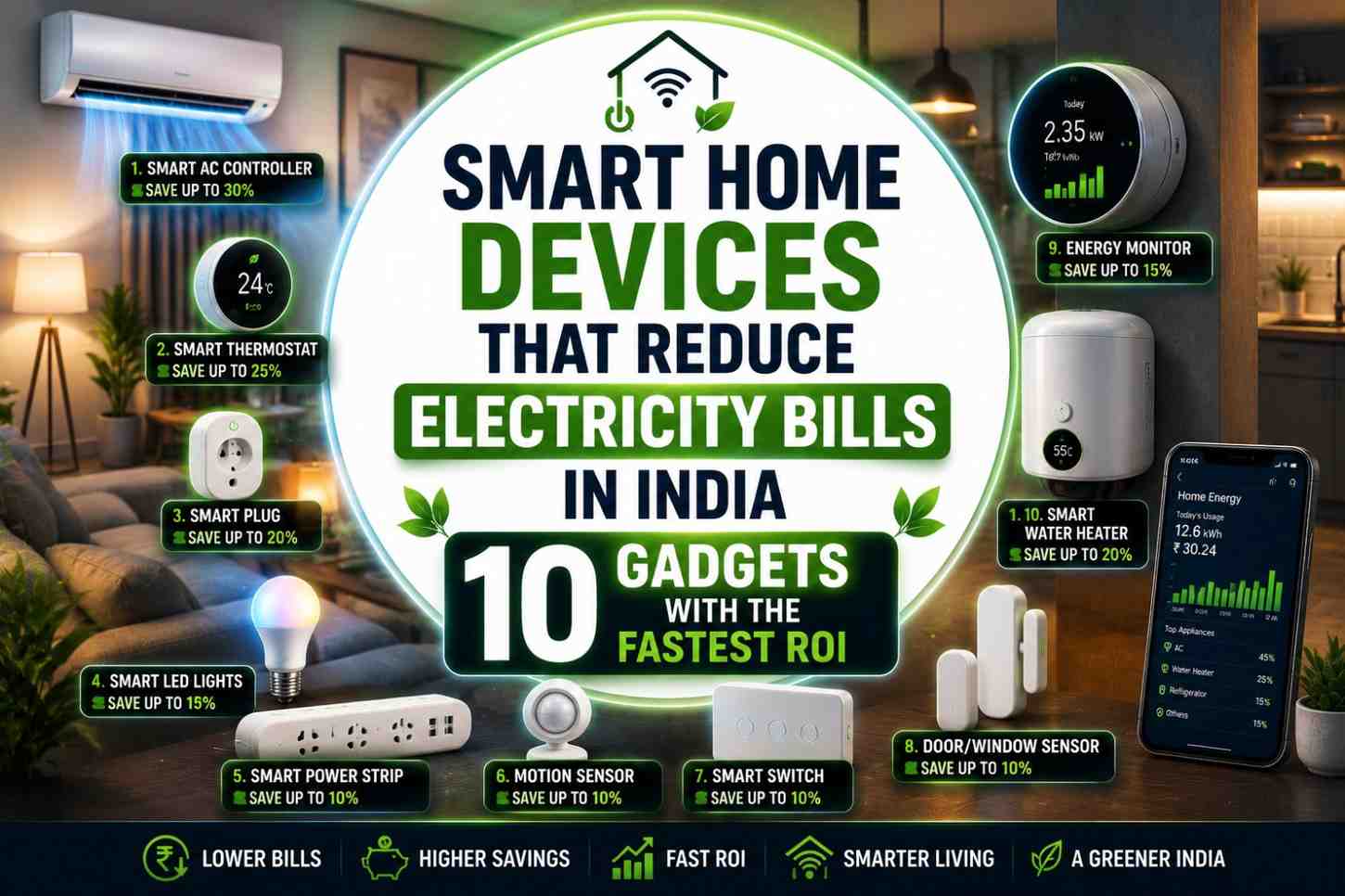
A smart thermostat or smart AC controller (IR blaster type — works with any existing AC) like the Sensibo Sky, Tado Smart AC, or Cielo Breez Plus learns your usage patterns, automatically adjusts temperature based on occupancy, and prevents the two most wasteful AC behaviours common in Indian homes: running air conditioning in empty rooms and setting unnecessarily low temperatures.
Real numbers from Indian smart home deployments:
- Automatic temperature increase of 1°C saves approximately 6–8% of AC energy
- Occupancy-based auto-shutoff reduces AC runtime by an average of 2.3 hours per day
- Combined smart AC management reduces annual AC energy use by 28–35%
For a household running 2 ACs averaging 1.5 tonnes each, smart control prevents approximately 600–900 kg of CO2 per year. This is one of the fastest-return strategies in the how to use smart home to reduce carbon footprint 2026 toolkit.
Strategy 2: Smart Lighting with Occupancy Sensing
Potential CO2 reduction: 80–200 kg per year
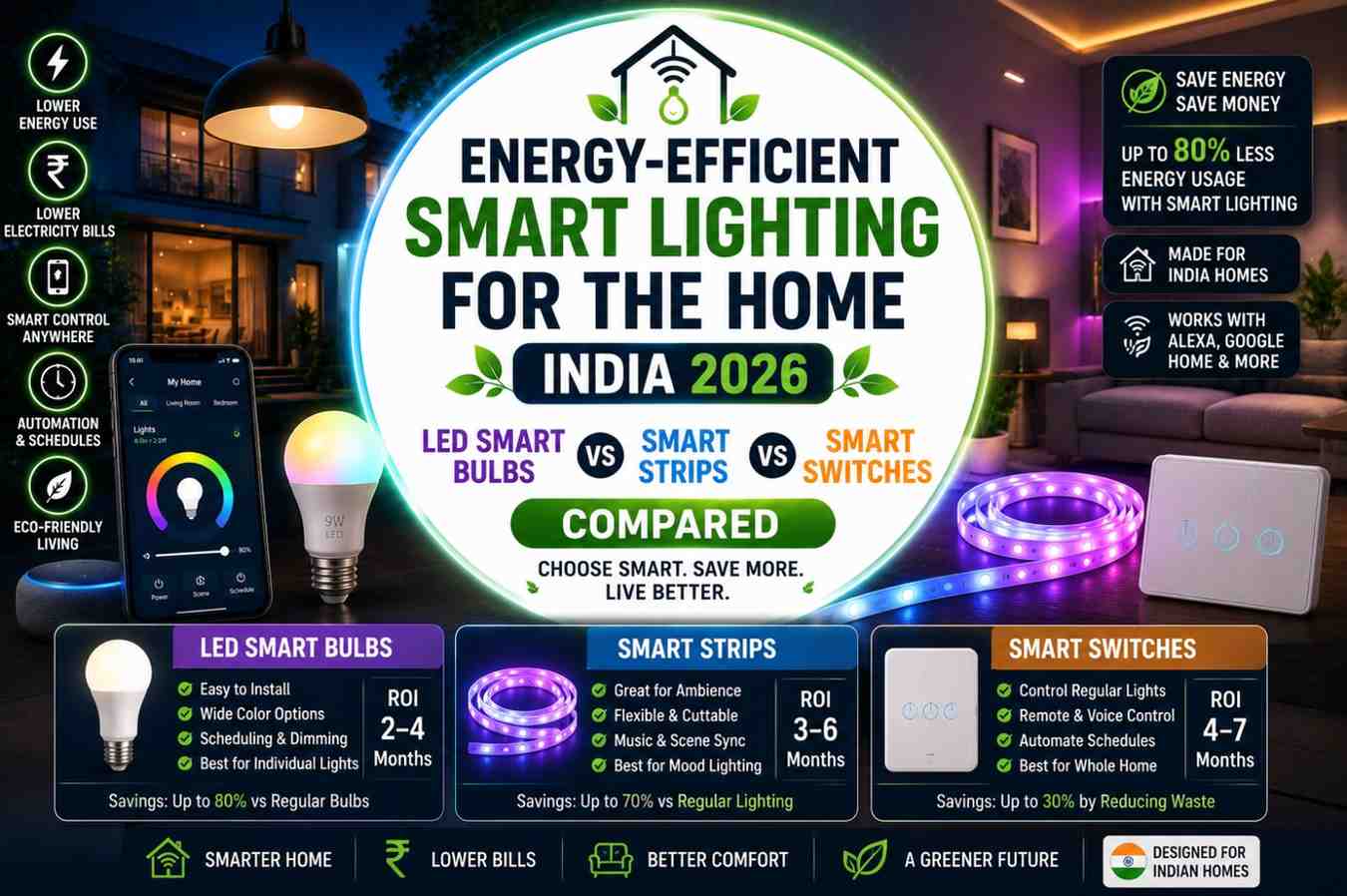
India has made enormous progress in LED adoption, but smart lighting goes further by eliminating phantom energy waste through occupancy sensing and daylight harvesting.
Smart bulbs (Philips Hue, Wipro Smart, Syska Connected) paired with motion sensors ensure lights turn off automatically in unoccupied rooms — ending the extremely common Indian household behaviour of leaving lights on throughout the home during evening hours.
Daylight harvesting — automatically dimming artificial lights when sufficient natural light is available — reduces daytime lighting energy by 30–50% in well-windowed Indian apartments.
Calculated impact: Assuming a household with 20 smart bulbs (9W each) reducing average daily ON-time from 8 hours to 5.5 hours, annual energy savings reach 985 kWh — preventing approximately 700 kg of CO2. This is a surprisingly significant contribution to how to use smart home to reduce carbon footprint 2026 goals.
Strategy 3: Solar Panel Integration with Smart Load Management
Potential CO2 reduction: 2,000–4,000 kg per year
The single largest carbon reduction available through understanding how to use smart home to reduce carbon footprint 2026 comes from rooftop solar combined with smart load management.
A 5 kW rooftop solar system in India generates approximately 6,500–7,500 kWh per year depending on location. At India’s grid emission factor of 0.71 kg CO2/kWh, this displaces 4,600–5,300 kg of CO2 annually.
Smart load management — automatically running high-consumption appliances (water heaters, washing machines, dishwashers) during peak solar generation hours — increases self-consumption from 35–40% to 70–85%, effectively doubling the carbon displacement value of the same solar array.
Strategy 4: Smart Water Heating Automation
Potential CO2 reduction: 150–400 kg per year
Electric water heaters (geysers) in Indian homes often run for 2–3 hours per day regardless of actual hot water need. A standard 2000W geyser running 2.5 hours daily consumes 1,825 kWh annually — generating approximately 1,300 kg of CO2.
Smart geyser controllers — either smart plugs with scheduling capability or dedicated devices like Enerjoy Smart Geyser Controller — bring intelligence to water heating by:
- Scheduling heating for off-peak grid hours (lower carbon intensity periods)
- Syncing with solar generation to heat water during peak solar hours instead of using grid power
- Using occupancy data to skip heating on days when the household is away
- Providing usage monitoring that reveals wasteful heating patterns
Households implementing smart water heating as part of their how to use smart home to reduce carbon footprint 2026 strategy typically reduce geyser energy by 35–50%, saving 200–350 kg of CO2 per year.
Strategy 5: Smart Power Strips to Eliminate Standby Consumption
Potential CO2 reduction: 60–150 kg per year
Standby power — electricity consumed by devices in standby or idle mode — accounts for 5–10% of total household electricity consumption in Indian homes. Televisions, set-top boxes, routers, chargers, computers, and home theatre systems all draw continuous phantom loads even when ostensibly “off.”
Smart power strips automatically cut power to peripheral devices when a primary device (TV, computer) is switched off. Smart plugs with energy monitoring (Wipro Smart Plug, TP-Link Kasa EP25) reveal which devices draw standby current and allow scheduling of complete power cutoffs during night hours.
For a typical Indian household with 8–10 entertainment and computing devices, eliminating standby loads saves 150–250 kWh per year — preventing 105–175 kg of CO2. Small individually, standby elimination is an important component of how to use smart home to reduce carbon footprint 2026 strategies when combined with other measures.
Strategy 6: Smart Appliance Scheduling (Off-Peak and Solar Hours)
Potential CO2 reduction: 100–300 kg per year
India’s electricity grid has significantly higher carbon intensity during peak demand hours (6–9 AM and 6–10 PM) when coal-heavy baseload plants are supplemented by less efficient peaker plants. During off-peak hours (11 PM–5 AM) and midday solar surplus hours, grid carbon intensity is lower.
Scheduling dishwashers, washing machines, pool pumps, and EV chargers for low-carbon-intensity periods using smart plugs and home automation platforms reduces the carbon footprint of each unit of electricity consumed — even when total consumption remains unchanged.
This strategy of grid-aware scheduling is an increasingly important component of how to use smart home to reduce carbon footprint 2026 thinking, particularly as India’s grid operator POSOCO begins publishing more granular carbon intensity data.
Strategy 7: Smart Irrigation and Water Pump Control
Potential CO2 reduction: 50–150 kg per year
Garden irrigation pumps and overhead water supply motors in Indian homes with sumps are significant but overlooked energy consumers. Running motors during peak solar hours and scheduling irrigation based on soil moisture sensor data (rather than fixed timers) reduces both energy consumption and water waste simultaneously.
Smart irrigation controllers like the Rachio 3 or DIY solutions using Home Assistant with soil moisture sensors reduce pump runtime by 20–40% compared to timer-based systems — contributing meaningfully to how to use smart home to reduce carbon footprint 2026 goals for households with gardens or large roof areas.
Strategy 8: Energy Monitoring Dashboards for Behaviour Change
Potential CO2 reduction: 100–300 kg per year (behaviour-driven)
Multiple peer-reviewed studies confirm that real-time energy monitoring — simply showing households how much electricity they are using and how much CO2 it represents — drives consumption reductions of 7–15% through behaviour change alone, with no additional technology changes.
Smart energy monitors (Emporia Vue, Shelly EM, or the monitoring built into most smart inverters) display real-time consumption and carbon equivalent data on a dashboard. When household members can see the live carbon cost of turning on the second AC or running the tumble dryer at peak hours, behaviour changes measurably.
This visibility-driven component of how to use smart home to reduce carbon footprint 2026 implementation is low-cost and delivers sustained impact — making it one of the highest return-on-investment strategies in the entire framework.
Combined Impact: Real Annual CO2 Reductions for an Indian Smart Home
Here is a realistic combined annual CO2 reduction scenario for an Indian urban household implementing all eight strategies:
| Strategy | Annual CO2 Reduction |
|---|---|
| Smart AC control | 650 kg |
| Smart lighting | 150 kg |
| Solar + smart load management | 3,000 kg |
| Smart water heating | 280 kg |
| Standby elimination | 120 kg |
| Grid-aware appliance scheduling | 180 kg |
| Smart irrigation | 80 kg |
| Energy monitoring behaviour change | 200 kg |
| Total | ~4,660 kg CO2/year |
This represents a 50–75% reduction in a typical Indian urban household’s electricity-related carbon footprint — transforming an average Indian home from a significant emissions source into a near-carbon-neutral energy consumer. This is the genuine, measurable promise of understanding how to use smart home to reduce carbon footprint 2026.
5 Frequently Asked Questions (From Google)
Q1: How much CO2 does a smart home save compared to a regular home? Research and real-world data from Indian deployments suggest that a fully optimised smart home saves 3,000–6,000 kg of CO2 per year compared to an equivalent non-smart home, depending on whether solar panels are included. Even without solar, smart appliance management and automation typically reduce emissions by 800–1,500 kg annually.
Q2: What is the most impactful smart home device for reducing carbon footprint in India? Smart AC controllers deliver the highest single-device impact because air conditioning represents 40–60% of Indian household electricity use. However, the highest overall impact comes from solar integration with smart load management, which is why understanding how to use smart home to reduce carbon footprint 2026 comprehensively requires addressing both.
Q3: Does smart home automation actually reduce energy use or just shift it? Both — and both matter. Smart automation reduces total consumption by eliminating waste (standby power, empty-room conditioning, over-scheduled heating). It also shifts consumption to low-carbon periods or to times when renewable energy is available, reducing the carbon intensity of each unit consumed.
Q4: Which smart home platform is best for carbon tracking in India? Home Assistant with the CO2 Signal integration (which maps local grid carbon intensity in real time) is the most capable platform for granular carbon tracking. Simpler alternatives include the Emporia Vue app (which calculates approximate CO2 for monitored circuits) and Sungrow iSolarCloud (which shows real-time carbon offset from solar generation).
Q5: Is it worth investing in a smart home just to reduce my carbon footprint? Yes — because the financial savings from smart home energy management almost always cover the technology investment within 2–4 years, meaning the carbon reduction comes at effectively zero net cost or positive financial return. Understanding how to use smart home to reduce carbon footprint 2026 is one of the few environmental actions that simultaneously saves money rather than requiring ongoing sacrifice.
Conclusion
The numbers are clear: understanding and implementing how to use smart home to reduce carbon footprint 2026 strategies can reduce an average Indian household’s electricity-related emissions by 50–75% annually — the equivalent of taking a small car off the road permanently.
This is not a distant future technology. Every device and platform discussed in this guide is available in India today. The investment is recoverable through energy savings. The carbon impact is immediate and measurable. Start with a smart AC controller and an energy monitor — two affordable devices that deliver both visibility and control — and build from there.
For India’s national climate commitments and current household energy efficiency programmes, visit CEA India and explore state-level incentive schemes for smart home energy upgrades.