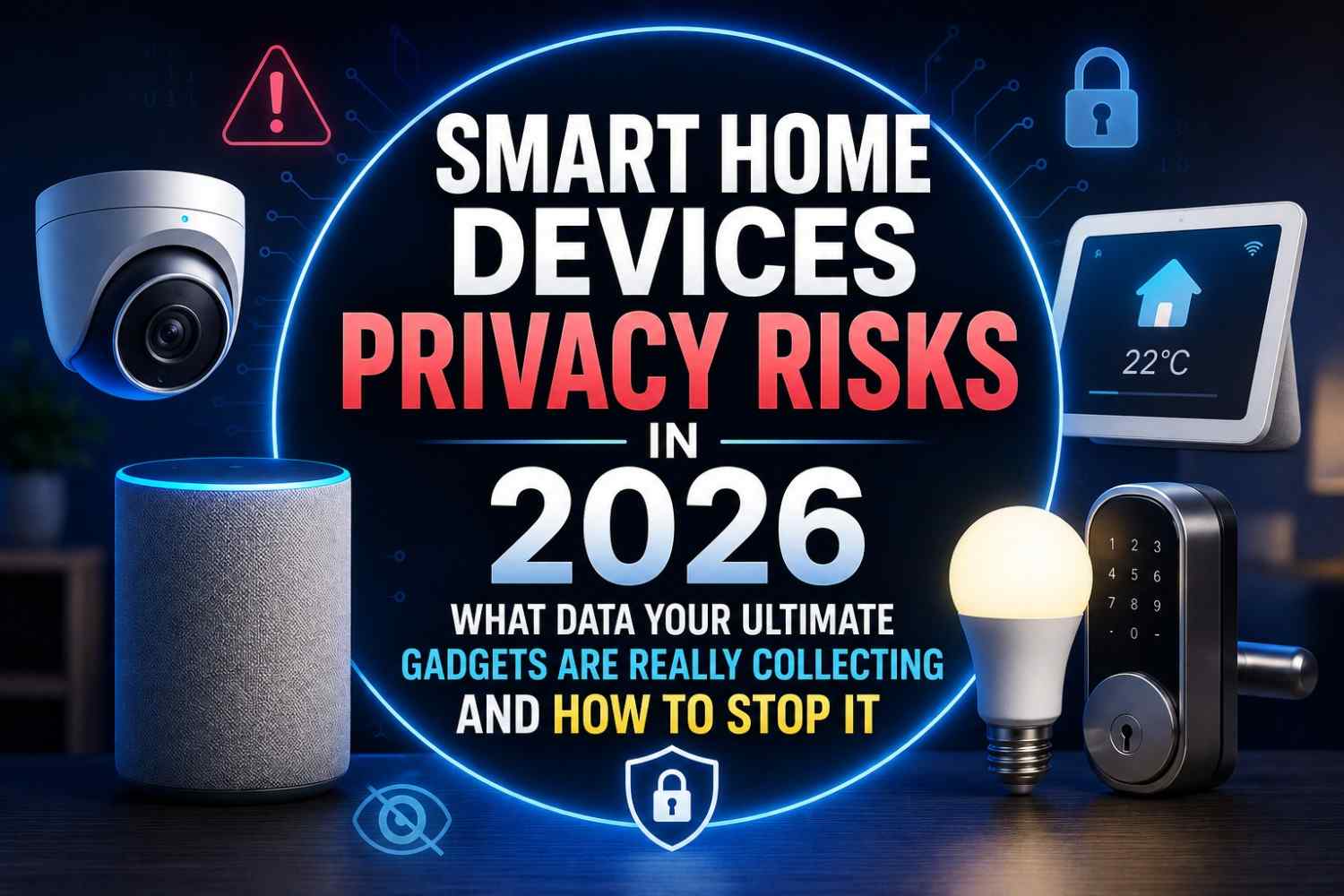
Smart home devices have transformed daily life in India—controlling lights by voice, monitoring front doors remotely, and scheduling appliances automatically. But alongside every convenience sits a question that deserves an honest answer: what is your smart home actually collecting about you?
Smart home devices’ privacy risks in 2026 are real, documented, and often underestimated by everyday users. The devices in your home — smart speakers, cameras, plugs, sensors, and doorbells — are continuously generating data. Some of that data is necessary for the devices to function. Some of it is collected for reasons you may not be fully aware of.
This article gives you a clear, factual account of what different types of smart home devices actually collect, what companies do with that data, what the specific risks are, and — most importantly — practical steps you can take to protect your privacy without abandoning your smart home.
Why Smart Home Privacy Matters More in 2026
Smart home devices’ privacy risks in 2026 are more significant than in previous years for several reasons.
Density of data: The average Indian smart home now contains more connected devices than it did three years ago — not just a smart speaker, but cameras, bulbs, plugs, sensors, doorbells, and locks. Each device adds to the density of data being generated about who is home, when, where they move, what they watch, and how they live.
AI integration: As AI platforms (Gemini, Alexa+, Apple Intelligence) become more integrated into smart home ecosystems, they process richer contextual data to provide personalized features. Richer AI requires richer data input.
Regulatory gap in India: India’s Personal Data Protection Bill (PDPB) is now law, but enforcement mechanisms for consumer IoT data are still maturing. Indian consumers have fewer legal protections against smart home data misuse than consumers in the EU (GDPR) or California (CCPA).
Third-party data sharing: Many smart home manufacturers share or sell anonymized (and sometimes less-anonymized) user data with advertising networks, data brokers, and analytics companies.
Understanding smart home devices’ privacy risks in 2026 is the first step toward managing them intelligently.
What Each Type of Smart Home Device Actually Collects
Smart Speakers (Alexa Echo, Google Nest Mini, HomePod)
What they collect:
- Voice recordings: by default, most smart speakers retain audio clips of commands sent to cloud servers for processing
- Device usage patterns: what commands you give, when, and how frequently
- Smart home activity data: which devices you control and at what times
- Account data: linked accounts (Amazon, Google), purchase history, music preferences
What companies say they do with it: Amazon and Google use voice clips (which employees can review in some circumstances) to improve speech recognition accuracy. This practice became public knowledge through news investigations, and both companies subsequently added clearer controls. Amazon’s Alexa Privacy Dashboard allows you to review and delete recordings. Google’s My Activity tool does the same.
Actual risk: Voice recordings captured by always-on microphones represent the most sensitive data category in a smart home. The risk is not primarily from hacking (communications are encrypted) but from company access to your conversations, accidental activations capturing private discussions, and data retention policies that may keep recordings for years unless manually deleted.
Smart Cameras and Video Doorbells
What they collect:
- Continuous or motion-triggered video footage of your home’s interior or exterior
- Facial recognition data (opt-in on some platforms)
- Motion event timestamps and frequency
- Two-way audio recordings (conversations at your door)
What companies say they do with it: Cloud storage providers retain footage on their servers for subscription periods (typically 7–30 days). Some companies use anonymized footage to train computer vision AI models, though this requires separate consent in theory.
Actual risk: Smart cameras represent the highest-stakes smart home device privacy risk in 2026. Cases of camera hacks—particularly on budget, poorly secured devices from unknown manufacturers—are documented globally. Beyond hacking, cloud-stored footage is potentially accessible by company employees, law enforcement with a legal order, and, in the event of a data breach.
Specific risk in India: Several low-cost Chinese-manufactured cameras sold on Indian e-commerce platforms route video streams through servers outside India, with unclear data retention and access policies. This is a documented concern that Indian cybersecurity researchers have flagged.
Smart Plugs and Smart Switches
What they collect:
- On/off state and timing data (when each appliance is used and for how long)
- Energy consumption data (on plugs with energy monitoring)
- Home occupancy inference (your activity patterns can be inferred from appliance usage—when you wake up, when you are home, when you sleep)
What companies say they do with it: Usage data is primarily used to power scheduling features and energy reports. Some companies use aggregated data for grid management research. Energy consumption data may be shared with advertising partners in some cases.
Actual risk: Lower than cameras or speakers but not zero. Your appliance usage pattern is a detailed map of your daily routine. If this data is compromised or improperly shared, it reveals when your home is unoccupied — useful information for burglars and potentially for insurers or advertisers.
Smart Bulbs
What they collect:
- On/off state, brightness level, and color change with timestamps
- App usage patterns
- Room-level occupancy inference
What companies say they do with it: Primarily used to restore device state after power loss and support scheduling features. Aggregated data may be used for product improvement.
Actual risk: Lower than other device types. Smart bulb data is primarily binary (on/off), and while it does reveal occupancy patterns, it is the least sensitive category in the smart home devices privacy risks 2026 landscape.
Smart Locks and Door Sensors
What they collect:
- Every lock and unlock event with timestamp and method used (PIN, fingerprint, app, voice)
- Who entered (if user-specific codes are set)
- Door open/close events
What companies say they do with it: Access logs are primarily for user security monitoring. Smart lock companies vary significantly in their cloud data retention policies.
Actual risk: Smart lock data is sensitive — it is a precise record of every time your home is entered or exited. A compromised smart lock account or a data breach at the lock manufacturer could expose this access history. Additionally, some smart lock manufacturers have been acquired or shut down, leaving users’ access logs in uncertain custody.
The Specific Risk of Budget Devices from Unknown Manufacturers
Smart home device privacy risks in 2026 are significantly higher for devices purchased from unknown brands—particularly on platforms like Amazon India and Flipkart, where third-party sellers list products from manufacturers with no established privacy policies.
The risk profile of a budget unknown-brand camera or smart plug includes the following:
- No encryption or weak encryption on device-to-cloud communication
- Hard-coded passwords that cannot be changed, making remote hacking trivial
- Data routing through foreign servers with no transparency about storage location or access
- No firmware updates once the device is sold, leaving known vulnerabilities unpatched
- No privacy policy or an unenforceable policy from a company with no Indian presence
Recommendation: For any smart home device with a camera or microphone, buy only from established brands with documented privacy policies — Amazon, Google, Apple, TP-Link, Qubo, Wipro, or Asus. The slight price premium is worth it.
How Smart Home Data Is Used for Advertising
This is the most commonly misunderstood dimension of smart home devices’ privacy risks in 2026.
Amazon’s Alexa ecosystem is deeply integrated with Amazon’s advertising business. While Amazon does not sell your voice recordings to advertisers, it uses smart home usage data to inform its broader advertising profile of you. If you frequently ask Alexa about recipes, Amazon’s advertising system notes your interest in cooking-related products.
Google Home is part of Google’s data ecosystem. Smart home activity contributes to your Google advertising profile. Google has faced regulatory scrutiny in the EU for combining home device data with search and browsing data for advertising targeting.
Apple HomeKit data is explicitly not used for advertising. Apple’s business model is hardware-based, and the company has made on-device processing and advertising-free data use a central brand commitment.
10 Practical Steps to Protect Your Privacy in a Smart Home
Understanding smart home devices’ privacy risks in 2026 is only valuable if it leads to action. Here are ten specific steps you can take right now.
1. Delete voice recordings regularly. In the Alexa app: More → Settings → Alexa Privacy → Review Voice History → Delete All. Enable auto-deletion on a 3-month cycle. In Google: myactivity.google.com → Filter by Google Assistant → Delete.
2. Mute smart speakers when having private conversations. Every Echo and Nest device has a hardware mute button that physically disconnects the microphone from the processor. Use it during sensitive conversations. The device cannot listen when muted at the hardware level.
3. Place cameras only in non-private spaces. Never place smart cameras in bedrooms or bathrooms. Cameras in living rooms and kitchens are reasonable. Exterior cameras (front door, driveway) carry the lowest privacy risk.
4. Enable two-factor authentication on all smart home accounts. Your Amazon, Google, and Apple accounts control your entire smart home. A compromised account is a compromised home. Enable 2FA on all of them immediately.
5. Use a separate Wi-Fi network (VLAN or guest network) for smart home devices. Many modern routers allow you to create a separate guest network. Place all smart home devices on this network, isolated from your primary computers and phones. This limits the damage if a smart device is compromised.
6. Keep firmware updated on all devices. Security vulnerabilities in smart home devices are regularly discovered and patched via firmware updates. Enable automatic updates in each device’s app. A device running old firmware is a known security risk.
7. Avoid unknown-brand devices with cameras or microphones. Buy cameras and speakers only from brands with documented privacy policies and active security update programs. Avoid budget devices from unknown manufacturers regardless of how attractive the price appears.
8. Review app permissions. Every smart home app on your phone requests permissions. Review and revoke permissions you do not need—particularly “always on” location access for apps that do not need it for geofencing automations.
9. Opt out of data collection where possible. Amazon: Settings → Alexa Privacy → Manage Your Alexa Data → turn off “Use of Voice Recordings.” Google: My Activity → Activity Controls → disable relevant data types. These opt-outs reduce (but do not eliminate) data collection.
10. Read the privacy policy of new devices before buying. This is the step nobody does, but it matters. The privacy policy tells you what a company collects, how long they retain it, and with whom they share it. Even a five-minute review of the privacy policy of a new camera or smart speaker tells you a great deal about the risk you are accepting.
Privacy Risk Comparison by Device Type
| Device Type | Data Sensitivity | Hacking Risk | Ad Use Risk | Overall Risk |
|---|---|---|---|---|
| Smart Speaker | High (voice) | Low-Medium | Medium | Medium-High |
| Smart Camera (known brand) | High (video) | Low | Low | Medium |
| Smart Camera (unknown brand) | High (video) | High | Unknown | Very High |
| Smart Plug | Low-Medium | Low | Low | Low |
| Smart Bulb | Low | Very Low | Very Low | Very Low |
| Smart Lock | Medium-High (access log) | Low-Medium | Low | Medium |
| Smart Doorbell | High (video+audio) | Low-Medium | Low | Medium |
| Motion Sensor | Medium (occupancy) | Very Low | Low | Low |
The India-Specific Privacy Context
Smart home devices’ privacy risks in 2026 in India have some country-specific dimensions worth noting.
Personal Data Protection Act (PDPB): India’s data protection law now requires companies to obtain explicit consent for data collection and gives users rights to access and delete their data. However, enforcement for international smart home companies operating in India is still developing.
No CERT-In-mandated smart home security standards: India’s Computer Emergency Response Team has issued guidelines for IoT security, but mandatory security certification for consumer smart home devices does not yet exist. This creates an uneven market where secure and insecure devices sit side by side on the same e-commerce shelves.
Cloud data routing: Many smart home devices sold in India route user data through servers in the US, Singapore, or China. Indian users have limited visibility into the legal jurisdictions governing their data.
Suggested Image Placements
Image 1: Place after the introduction.
- Description: A graphic showing a stylized home silhouette with data streams flowing out from smart devices (speaker, camera, bulb, plug) into a cloud—visually representing data collection.
- ALT text: “Smart home devices privacy risks 2026—data collection from smart speakers, cameras, and plugs visualised”
Image 2: Place after the 10 practical steps section.
- Description: A smartphone showing the Amazon Alexa Privacy Dashboard with voice history settings visible — representing the user actively managing their data.
- ALT text: “Managing smart home devices’ privacy risks 2026 — Alexa privacy dashboard on smartphone”
Authority Outbound Links
- Amazon Alexa Privacy Dashboard — https://www.amazon.in/alexaprivacy — Manage, review, and delete your Alexa voice recordings and data.
- Google My Activity — https://myactivity.google.com — Review and delete Google Assistant and Google Home activity data.
- Apple Privacy — Home Data — https://www.apple.com/in/privacy/ — Apple’s official privacy commitment and HomeKit data practices.
- India CERT-In IoT Security Guidelines — https://www.cert-in.org.in — India’s official cybersecurity agency with IoT and smart device security guidance.
- Electronic Frontier Foundation — Smart Home Privacy — https://www.eff.org/issues/privacy — Independent digital rights organization covering smart home privacy risks in depth.
FAQs: Smart Home Devices Privacy Risks 2026
Q1. Can smart home devices record conversations without my knowledge? Smart speakers are designed to activate only when they detect a wake word (“Alexa” or “Hey Google”). However, false activations do occur—the device mishears ambient sound as its wake word and records the following audio. Reviewing and deleting voice history regularly and using the hardware mute button during sensitive conversations mitigates this risk.
Q2. Is it safe to have a smart camera inside my home? Yes, if you buy from established brands (Google, Amazon, TP-Link, and Qubo) and configure it correctly—a strong unique password, 2FA on your account, up-to-date firmware, and placement in non-private spaces. Unknown-brand cameras carry significantly higher risks and should be avoided for indoor use.
Q3. Can the government or police access my smart home data in India? Under Indian law, law enforcement can request data from companies with a valid court order. Amazon, Google, and Apple publish transparency reports showing how many government data requests they receive and how they respond. These reports are publicly available and give a factual picture of the legal access risk.
Q4. Is Apple HomeKit genuinely more private than Alexa or Google Home? Yes, meaningfully so. Apple HomeKit data is processed on-device where possible, is end-to-end encrypted, and is explicitly not used for advertising. Apple’s business model is hardware-based, giving them less financial incentive to monetize your smart home data than Amazon (advertising + retail) or Google (advertising).
Q5. What should I do if I think my smart home camera has been hacked? Immediately disconnect the camera from power. Change your account password and enable 2FA. Reset the camera to factory settings before reconnecting. Report the incident to CERT-In (cert-in.org.in). If the camera is from an unknown brand, do not reconnect it—replace it with a device from a reputable manufacturer.
Conclusion
Smart home devices’ privacy risks in 2026 are real—but they are manageable. The answer is not to avoid smart home technology. The answer is to make informed purchasing decisions, configure your devices securely, and actively manage your data using the tools that major platforms provide.
The most impactful things you can do right now: delete your Alexa and Google voice history, enable 2FA on your smart home accounts, mute your smart speaker during private conversations, and replace any unknown-brand camera with a device from a verified manufacturer.
A smart home that respects your privacy is not a contradiction—it is the smart home you should be building. The controls exist. Use them.
Take five minutes today to review your Alexa or Google privacy settings. Delete stored recordings. Enable 2FA. These small actions significantly reduce your real-world privacy exposure — and your smart home remains as useful as ever.