If you have spent any time shopping for smart home devices, you have likely encountered the frustration of compatibility. Does this bulb work with Alexa? Does this lock support Google Home? Does this sensor work with Apple HomeKit? For years, this confusion has been the single biggest barrier to smart home adoption worldwide, including in India.
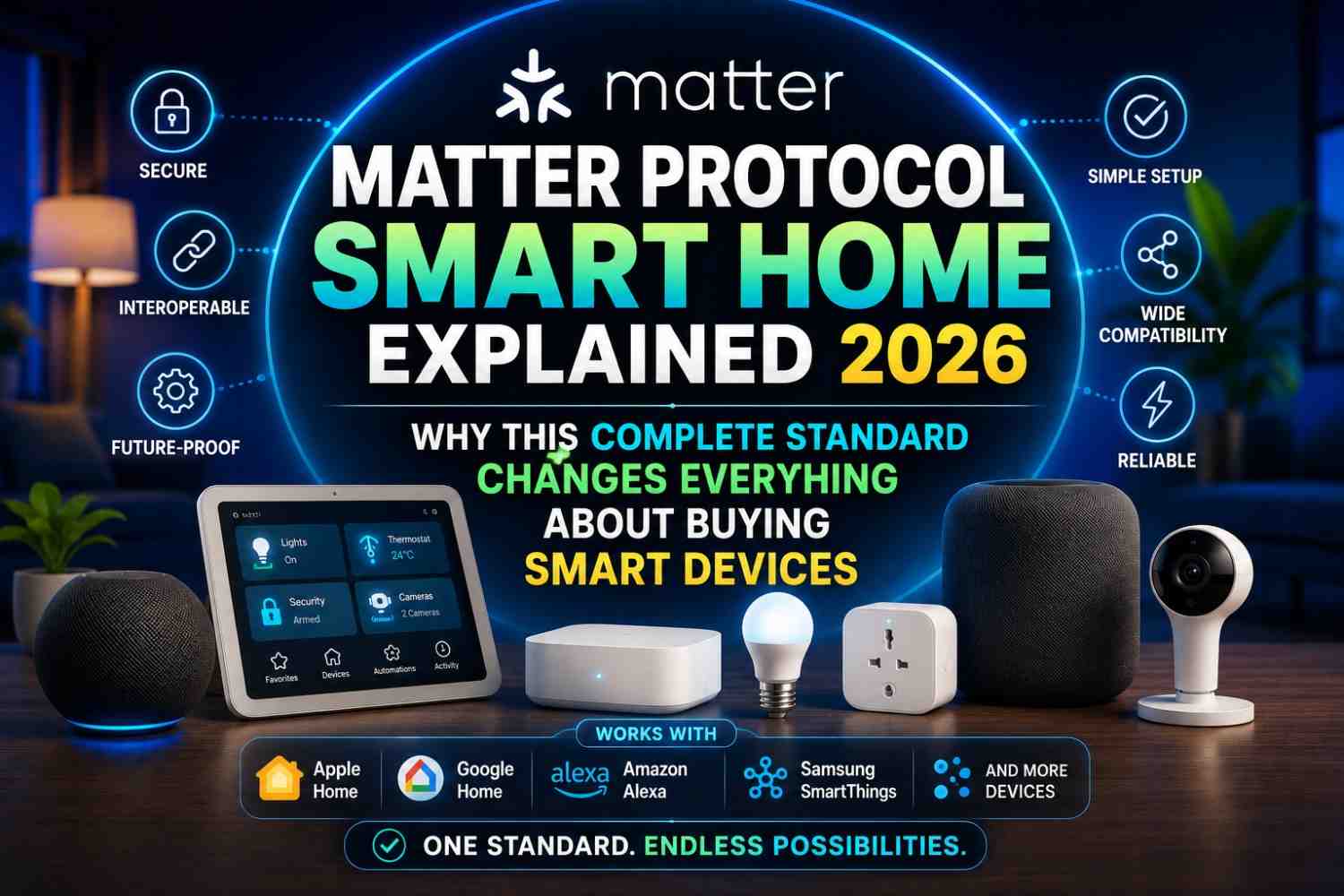
The Matter protocol smart home explained 2026 is the answer the industry finally agreed on. Matter is a universal smart home connectivity standard developed by some of the world’s largest technology companies—Apple, Google, Amazon, and Samsung among them—to ensure that smart devices work together regardless of brand or ecosystem.
This article explains what Matter is, how it works, why it matters specifically for Indian consumers, and what you should look for when buying Matter-compatible devices in 2026.
What Exactly Is the Matter Protocol?
Matter is an open-source, royalty-free connectivity standard for smart home devices. It was developed by the Connectivity Standards Alliance (CSA) — formerly the Zigbee Alliance — and officially launched in late 2022. By 2026, it will have become the dominant compatibility framework for new smart home devices globally.
To understand the Matter protocol smart home, explained in 2026 in simple terms: think of Matter as a universal language that all smart devices can speak. Before Matter, devices spoke different dialects—some spoke Zigbee, some spoke Z-Wave, and some spoke proprietary Wi-Fi protocols. They could not understand each other unless a brand-specific hub translated between them.
Matter eliminates that need for translation.
A Matter-certified device can be set up and controlled through any Matter-compatible platform—whether that is Google Home, Amazon Alexa, Apple HomeKit, or Samsung SmartThings—without any special configuration or compatibility workarounds.
Who Created Matter and Why Should You Trust It?
Matter was not created by a single company trying to lock you into their ecosystem. It was developed collaboratively by over 550 member companies, including:
- Apple (HomeKit)
- Google (Google Home / Nest)
- Amazon (Alexa / Echo)
- Samsung (SmartThings)
- Philips Hue
- IKEA
- Signify
- Eve Systems
- TP-Link / Tapo
When this many competing companies agree on a shared standard, it reflects a genuine industry commitment rather than a marketing exercise. The Matter protocol smart home explained 2026 represents the most significant step toward a truly open smart home ecosystem that the industry has ever taken.
How Does Matter Work Technically?
For the non-technical reader, here is a simplified breakdown.
Matter operates over your existing home Wi-Fi and Thread networks. Thread is a low-power wireless mesh protocol—think of it as a more efficient version of Wi-Fi designed specifically for small IoT devices like sensors and bulbs.
Matter uses IPv6 networking, which means every Matter device gets its own IP address on your local home network. This enables direct device-to-device communication without relying on cloud servers. Your smart light can respond to your smart motion sensor even if your internet is down—because they are talking directly to each other on your local network.
The key components of the Matter protocol smart home explained for 2026 are:
- Thread — Low-power mesh network for sensors, locks, and small devices
- Wi-Fi — For higher-bandwidth devices like cameras and speakers
- Bluetooth Low Energy (BLE) — Used only during the initial device setup/pairing
- Thread Border Router — A hub device (like Google Nest Hub or Apple HomePod) that bridges Thread devices to your Wi-Fi network
What Problem Does Matter Solve for Indian Consumers?
The Indian smart home market has historically been fragmented. Devices from Indian brands like Syska, Wipro, and Anchor have used proprietary apps with limited cross-platform compatibility. International devices like Philips Hue require separate hubs. And Indian consumers who switch between Android and iOS — or between Alexa and Google Home ecosystems — often find that their devices do not follow them.
The Matter protocol smart home explained that 2026 changes this in several important ways for Indian buyers.
1. Buy once, use anywhere. A Matter-certified Wipro bulb purchased today will work with Google Home, Alexa, and Apple HomeKit simultaneously. If you switch from an Android phone to an iPhone next year, your devices will not become obsolete.
2. No hub dependency. Most Indian consumers do not own Zigbee or Z-Wave hubs. Matter primarily uses Wi-Fi and Thread, which means setup requires no additional hub hardware for most device types.
3. Local control without cloud dependency. Matter devices communicate locally, which means they respond faster and continue working during internet outages. This is particularly relevant in Indian cities where broadband outages — though less frequent than before — do still occur.
4. Longer device lifespan. Because Matter is an open standard with broad industry backing, Matter-certified devices are less likely to become obsolete if a company discontinues its proprietary app or cloud service.
Matter in India 2026 — Which Devices and Brands Are Certified?
By 2026, Matter certification has reached a significant number of devices available in India. Here is the current landscape.
Smart Lighting:
- Philips Hue (full Matter support via firmware update)
- Wipro Smart Bulbs (Matter-certified new generation)
- Syska Smart LED (Matter rollout underway)
Smart Plugs and Switches:
- TP-Link Tapo P125M (Matter-certified smart plug)
- Eve Energy (Matter-certified, available via import)
Smart Displays and Hubs (Thread Border Routers):
- Google Nest Hub (2nd gen and later)—acts as Thread border router
- Apple HomePod Mini and HomePod (2nd gen) — Thread border router
- Amazon Echo (4th gen and later) — Thread border router
Smart Locks:
- Yale Assure Lock 2 (Matter-certified, available through select India retailers)
- Schlage Encode Plus (import only)
Smart Sensors:
- Eve Motion, Eve Door & Window (Matter-certified, import)
- Aqara sensors (Matter support added via firmware)
The Matter protocol smart home explained 2026 is the most mature in the lighting and plug categories. Cameras, thermostats, and video doorbells are still working through the certification pipeline, though significant progress has been made since 2024.
Multi-Admin: The Most Underrated Matter Feature
One of the least-discussed but most important features of Matter is multi-admin support. This means a single Matter device can be simultaneously controlled by multiple platforms.
Your Matter-certified smart bulb can be
- Added to Google Home for voice control via Google Assistant
- Added to Apple HomeKit for Siri control on your iPhone
- Added to Amazon Alexa for Echo speaker control
All three platforms control the same bulb at the same time. No need to choose. No need to compromise. This is a capability that simply did not exist in the pre-Matter smart home world.
For Indian households with mixed device ecosystems—perhaps an Android TV with Google Home and an iPhone with HomeKit—the Matter protocol smart home, explained in 2026, makes the previously impossible now effortless.
Matter vs. Zigbee vs. Z-Wave vs. Wi-Fi: What Is the Difference?
This comparison helps clarify what role Matter plays relative to older protocols.
| Protocol | Type | Range | Requires Hub | Cloud-dependent | India Availability |
|---|---|---|---|---|---|
| Matter (Wi-Fi) | Universal Standard | Home-wide | No | No (local) | Growing |
| Matter (Thread) | Universal Standard | Mesh/home-wide | Border router | No (local) | Growing |
| Zigbee | Proprietary mesh | Mesh/home-wide | Yes | Varies | Limited |
| Z-Wave | Proprietary mesh | Mesh/home-wide | Yes | Varies | Very limited |
| Wi-Fi (proprietary) | Brand-specific | Home-wide | No | Yes (cloud) | Very common |
| Bluetooth | Short range | ~10 metres | No | No | Common |
Matter supersedes proprietary Wi-Fi protocols in terms of interoperability while matching them in ease of setup. It provides the local control benefits of Zigbee and Z-Wave without requiring dedicated hub hardware.
Should You Wait for Matter or Buy Non-Matter Devices Now?
This is the most practical question for anyone reading about the Matter protocol smart home explained in 2026.
Buy Matter-certified devices if:
- You are starting fresh and want maximum future flexibility
- You use multiple ecosystems (e.g., Alexa and Google Home)
- You plan to build a comprehensive smart home over several years
- You value local control and reduced cloud dependency
Non-matter devices are still fine if:
- You are already committed to one ecosystem (e.g., all-in on Alexa)
- The device category you need (e.g., affordable IR blasters) does not yet have Matter-certified options
- Price is your primary constraint—some Matter devices carry a slight premium
The honest answer is, if a Matter-certified version of the device you want is available at a reasonable price in India, buy it. If not, a good non-Matter device from a reputable brand is still a solid choice—especially for categories like cameras and IR blasters, where Matter support is still limited.
How to Check If a Device Is Matter-Certified
The most reliable way is to look for the Matter logo on the product packaging or listing page. You can also search the official CSA Matter product database at https://csa-iot.org/csa-iot_products/ to verify certification before purchasing.
Amazon India and Flipkart listings for Matter-compatible devices typically mention “Works with Matter” or display the Matter badge in product descriptions.
Suggested Image Placements
Image 1: Place after the “What Exactly Is the Matter Protocol?” section.
- Description: A clean infographic showing logos of Apple, Google, Amazon, and Samsung connected by lines to a central Matter logo, with smart home device icons surrounding it.
- ALT text: “Matter protocol smart home explained 2026—how Apple, Google, Amazon, and Samsung connect through a single standard”
Image 2: Place after the comparison table.
- Description: A diagram showing a home network with a Thread border router (Nest Hub), Thread devices (sensors, locks), and Wi-Fi devices (cameras, speakers) all communicating locally without cloud dependency.
- ALT text: “Matter protocol smart home explained: 2026 local network diagram with Thread and Wi-Fi devices”
Authority Outbound Links
- Connectivity Standards Alliance — Matter — https://csa-iot.org/all-solutions/matter/ — Official Matter standard documentation and certified product database.
- Google Home Matter Setup Guide — https://support.google.com/googlenest/answer/12391458 — Step-by-step guide to adding Matter devices to Google Home.
- Apple HomeKit Matter Support — https://support.apple.com/guide/iphone/home — Official Apple documentation on using Matter devices with HomeKit.
- Amazon Alexa Matter Compatibility — https://www.amazon.com/alexa-matter — Amazon’s official page on Matter device support through Alexa.
- Thread Group — https://www.threadgroup.org — Technical details on Thread networking protocol that underpins Matter for low-power devices.
FAQs: Matter Protocol Smart Home Explained 2026
Q1. Do I need to buy all new devices to use Matter? Not necessarily. Many existing smart home devices have received Matter support through firmware updates, including Philips Hue, some Aqara products, and select Eve devices. Check your device’s app for a Matter firmware update before buying replacements.
Q2. Does Matter work in India with Indian broadband and routers? Yes. Matter operates over standard Wi-Fi (2.4 GHz and 5 GHz) and Thread, both of which work with any modern router, including those provided by Jio, Airtel, and BSNL. No special ISP configuration is required.
Q3. Do I need a Thread border router for Matter to work? Only for Thread-based Matter devices (sensors, locks, some bulbs). Wi-Fi-based Matter devices (plugs, cameras) connect directly to your router without a border router. A Google Nest Hub 2nd gen, an Apple HomePod Mini, or an Amazon Echo 4th gen can serve as a Thread border router.
Q4. Is Matter available on budget devices in India? Yes, increasingly so. TP-Link Tapo’s P125M smart plug is Matter-certified and priced affordably. Wipro’s newer smart bulb generation includes Matter support. As the standard matures, Matter certification is spreading to more budget-tier products.
Q5. Can Matter devices work without the internet? Yes — this is one of Matter’s key advantages. Automations, schedules, and device-to-device rules run locally on your home network without requiring cloud servers. An internet outage will disable remote access from outside your home but will not affect in-home automation.
Conclusion
The Matter protocol smart home explained 2026 represents a genuine turning point in how smart homes are built and used. For too long, consumers were forced to pick an ecosystem and stay locked into it—with compatibility anxiety following every purchase decision. Matter eliminates that anxiety.
For Indian consumers in particular, Matter delivers meaningful benefits: local control that works during internet outages, device longevity that survives company shutdowns, and true interoperability across Alexa, Google Home, and Apple HomeKit.
When buying your next smart home device, look for the Matter badge. It is the single most future-proof purchasing decision you can make in 2026 — and increasingly, it does not even cost you extra.