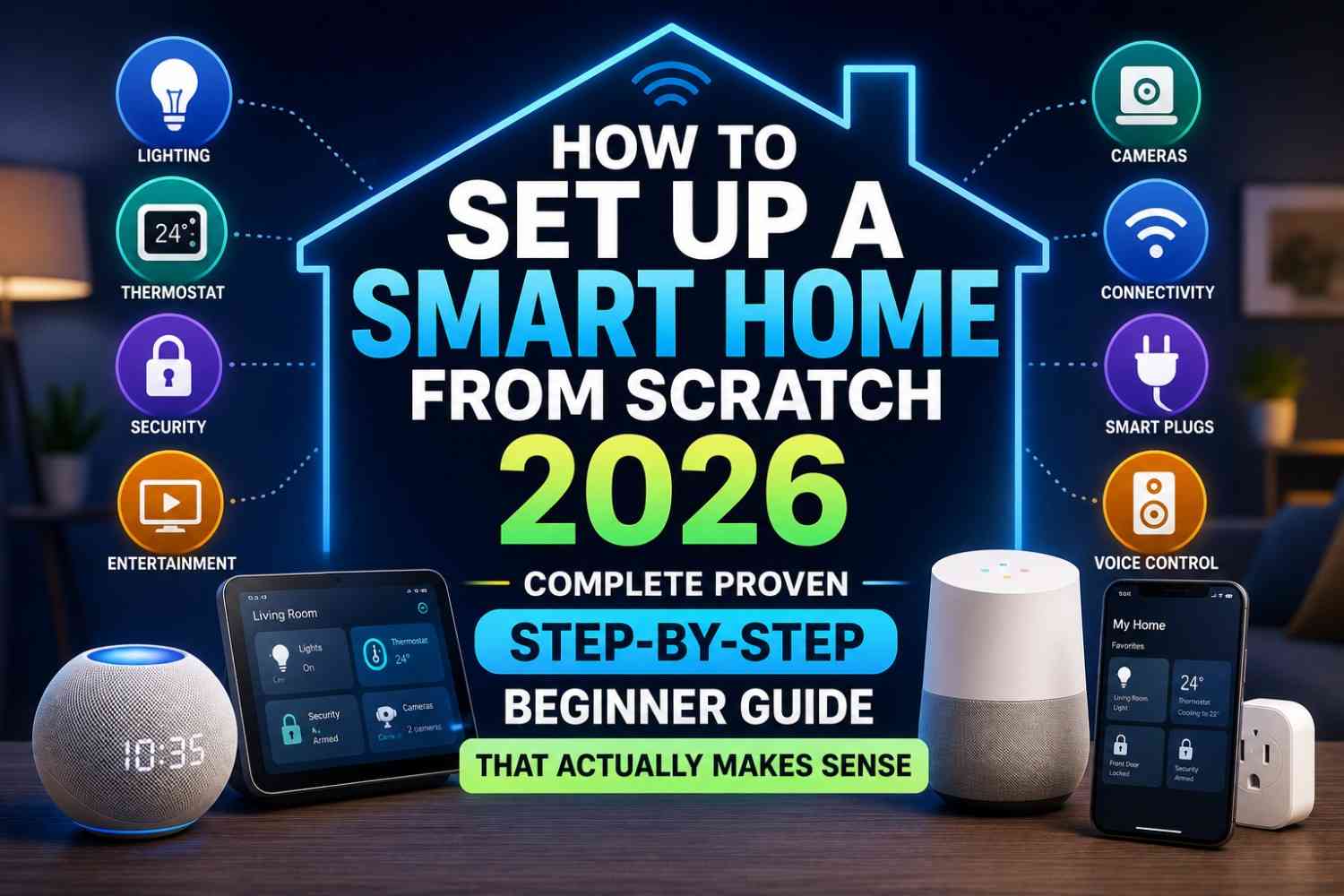

The smart home was already changing how we live. But in 2026, something fundamentally different is happening. Artificial intelligence — specifically large language models like Google Gemini and OpenAI’s ChatGPT — has begun integrating directly into smart home platforms and devices. The result is a generation of AI-powered smart home devices in 2026 that do not simply respond to commands. They anticipate needs, learn preferences, reason through ambiguous instructions, and manage entire home systems with a level of contextual intelligence that older voice assistants could never approach.
This article covers what AI integration actually means for smart home devices in practical terms, which platforms and devices are leading this shift, what is available in India right now, and what you should realistically expect from AI-powered smart home devices in 2026 versus the near future.
From Rule-Based Automation to Genuine AI: What Changed?
Traditional smart home automation works on simple rules. “If time is 10 PM, turn off all lights.” “If the motion sensor triggers, send a notification.” These rules are powerful but rigid. They do exactly what you tell them — nothing more.
AI-powered smart home devices in 2026 work differently. They use large language models (LLMs) and on-device machine learning to understand context, history, and intent — not just explicit commands.
Consider the difference:
Traditional smart home: “Turn on the AC.” AI-powered smart home: “It’s getting warm in here.” → The system understands this is an indirect request, checks the current temperature sensor reading, compares it to your historical preferences, and sets the AC to the temperature you typically prefer at this time of day.
This shift from explicit commands to contextual understanding is what makes AI-powered smart home devices in 2026 fundamentally different from what came before.
Google Gemini in the Smart Home: What It Does in 2026
Google integrated Gemini—its most capable AI model—into Google Home and Nest devices through a phased rollout that began in late 2024 and has matured significantly by 2026.
Gemini in Google Home App
The Google Home app now includes a Gemini-powered natural language interface. Instead of navigating menus to create automations, you can describe what you want in plain language:
“Set up a routine that turns the bedroom lights to warm white at 20% brightness 30 minutes before my usual bedtime, but only on weekdays.”
Gemini parses this, identifies the relevant devices, builds the automation, and asks for confirmation before activating it. Complex multi-step automations that previously required technical knowledge can now be created conversationally.
Gemini in Google Assistant on Nest Hub
The Nest Hub Max and Nest Hub 2nd Gen now run Gemini-enhanced Google Assistant. The practical difference:
- You can ask follow-up questions without repeating context: “Turn on the bedroom light. Make it blue. Actually, make it purple.”
- The assistant remembers in-conversation context across multi-step interactions.
- Ambiguous instructions are handled more intelligently: “Make it cozy in here” → evaluates current lighting color and temperature and adjusts to warm amber tones.
Gemini’s Awareness of Your Home State
Gemini-enhanced Google Home can now reason about your home’s current state. “Is everything off before I leave?” triggers a home-state summary—Gemini checks which lights, plugs, and devices are active and summarizes them conversationally, not as a raw device list.
Amazon Alexa AI (Alexa+): The LLM-Powered Upgrade
Amazon launched Alexa+ — its LLM-enhanced version of Alexa — in 2024 and has continued developing it through 2026. Alexa+ is powered by a combination of Amazon’s own AI models and a partnership with Anthropic’s Claude.
What Alexa+ Changes
Conversational follow-up: Alexa+ maintains conversation context. “Turn off the living room light. Keep the lamp on, though. — The system understands the implicit reference to “the lamp” as distinct from the overhead light without you specifying device names explicitly.
Proactive suggestions: Alexa+ can notice patterns and make suggestions. If you always ask for the weather before leaving home between 8 and 9 AM, it may proactively offer the forecast during that window without being asked.
Complex routine building via voice: “Create a routine for when my daughter gets home from school that turns on her bedroom light, starts her playlist, and sets the thermostat to 22 degrees.” Alexa+ builds this in one conversational exchange.
Reasoning about ambiguity: Older Alexa would fail on “turn on the light” if you had multiple unnamed lights. Alexa+ asks a clarifying question or infers from context which light you most likely mean based on your location in the home (if you have presence sensing) or your recent activity.
Alexa+ Availability in India
Alexa+ with full LLM capabilities has a tiered rollout. As of 2026, the core LLM-enhanced conversational features are available in India on Echo devices, 4th Gen and later. Some advanced features (like proactive suggestions based on household pattern recognition) are still rolling out regionally.
Apple Intelligence in HomeKit: Siri Gets Smarter
Apple’s on-device AI initiative — Apple Intelligence — has brought significant improvements to Siri’s smart home capabilities on devices running iOS 18 and later.
What Apple Intelligence Adds to HomeKit
On-device processing: Apple Intelligence processes smart home commands on-device using the Neural Engine in A17 Pro and later chips (iPhone 15 Pro and beyond). This means faster response times and no cloud dependency for routine HomeKit commands.
Natural language HomeKit scenes: You can create or describe HomeKit scenes in natural language via Siri: “Set up a movie scene with the lights at 10%, warm white, and close the smart blinds. ” Siri interprets this and creates the scene in HomeKit.
Personal context awareness: Because Apple Intelligence understands your calendar, messages, and habits (all processed on-device), it can bring more relevant smart home suggestions. If your calendar shows an early meeting, Siri may prompt you to set an earlier wake-up routine.
Privacy advantage: All of this intelligence runs on your device. No cloud server receives your home’s data, your schedule, or your preferences. This is Apple Intelligence’s defining differentiation from Google and Amazon’s cloud-based AI approaches.
AI-Powered Smart Home Devices 2026: Hardware That Thinks
Beyond platform-level AI, several hardware devices now include on-device AI processing that makes them meaningfully smarter.
AI Smart Cameras
Google Nest Cam (2024 and later) These cameras use on-device AI to distinguish between people, animals, vehicles, and packages—sending you specific, filtered alerts rather than generic “motion detected” notifications. “A person is at your front door” rather than “motion detected.”
Arlo Ultra 4K, Arlo’s flagship camera, uses AI to detect specific activity types—someone crouching near your car, a package being left, or an unfamiliar vehicle parked on your driveway. These intelligent alerts reduce notification fatigue significantly.
Amazon Blink (AI-enhanced models): Amazon’s AI-enhanced Blink cameras in 2026 now distinguish between known household members and strangers using optional on-device face detection. This is opt-in with explicit consent.
AI Smart Thermostats
Google Nest Thermostat (Learning Thermostat): The Nest Learning Thermostat has used AI for years, but its 2024 integration with Gemini adds a conversational interface and better reasoning about energy efficiency tradeoffs. “What’s the most efficient temperature setting for this weekend?” now gets a reasoned, contextualized response.
AI Smart Displays
Amazon Echo Show (Alexa+) With Alexa+ integration, Echo Show displays now show proactive contextual information—not just weather and calendar, but inferred information like “you usually leave for work around this time; here is today’s commute” displayed automatically without setup.
Google Nest Hub Max (Gemini): The Gemini-enhanced Nest Hub Max now shows AI-generated summaries of your day, home state, and upcoming events in a single glance view that is dynamically generated based on your actual data.
AI-Powered Smart Homes in India: What Is Available Now
The AI integration in AI-powered smart home devices in 2026 is primarily a software feature—which means existing compatible hardware can receive it through app and firmware updates. Here is what Indian users can access in 2026:
| Feature | Platform | India Availability |
|---|---|---|
| Gemini in Google Home app | Google Home | ✅ Available |
| Gemini on Nest Hub (enhanced Assistant) | Google Home | ✅ Available |
| Alexa+ conversational AI | Amazon Alexa | ✅ Partial rollout |
| Apple Intelligence for HomeKit | Apple HomeKit | ✅ iOS 18+ (iPhone 15 Pro+) |
| Nest Cam AI person/vehicle detection | Google Nest | ✅ Available |
| Arlo AI cameras | Arlo | Limited India availability |
| Nest Learning Thermostat | ✅ India compatible |
Practical Limitations of AI Smart Home Devices in 2026
A fair assessment requires acknowledging what AI-powered smart home devices in 2026 cannot yet do reliably.
AI hallucination in home control: LLMs can occasionally misinterpret ambiguous home commands. Asking “make everything comfortable” may produce unexpected results if the AI’s interpretation of “comfortable” does not match yours. Specific commands still outperform vague ones.
Latency: Cloud-based AI processing adds response latency compared to simple rule-based commands. Apple Intelligence’s on-device processing mitigates this for HomeKit users, but Google and Amazon still have occasional cloud-processing delays.
India-specific AI training: Most AI models powering smart home features are trained predominantly on English-language data. Hindi and Hinglish command accuracy are improving but still lag behind English for complex natural language requests.
Privacy tradeoffs: Richer AI requires more data. Cloud-based AI platforms (Alexa+, Gemini on Nest) require sharing more home activity data with Amazon and Google servers. Users should review privacy settings proactively.
Suggested Image Placements
Image 1: Place after the introduction.
- Description: A modern home interior showing a Nest Hub Max displaying a Gemini AI chat interface, with smart lights active in the background and a smartphone showing the Google Home AI automation builder.
- ALT text: “AI-powered smart home devices 2026—Gemini on Google Nest Hub Max controlling smart home via natural language”
Image 2: Place after the AI hardware section.
- Description: A comparison grid showing four devices — Nest Cam, Arlo Ultra, Echo Show with Alexa+, and Nest Hub Max with Gemini — each with AI feature highlights.
- ALT text: “AI-powered smart home devices 2026 hardware comparison—smart cameras, displays, and voice assistants”
Authority Outbound Links
- Google Home Gemini Features — https://home.google.com/intl/en_in/ — Google’s official page on AI-enhanced Google Home features.
- Amazon Alexa+ AI Features — https://www.amazon.in/alexa-plus — Amazon’s official Alexa+ AI capability page for India.
- Apple Intelligence Overview — https://www.apple.com/in/apple-intelligence/ — Apple’s official Apple Intelligence feature page for India.
- Google Nest Cam India — https://store.google.com/in/category/cameras — Google Nest camera lineup with AI features available in India.
- MIT Technology Review — AI in Smart Homes — https://www.technologyreview.com/topic/smart-home/ — Independent analysis of AI integration trends in smart home technology.
FAQs: AI-Powered Smart Home Devices 2026
Q1. Do I need to buy new devices to get AI features in my smart home? Not always. Most AI features in 2026 are delivered through app and firmware updates to existing compatible hardware. If you own a Nest Hub (2nd gen or later), Echo (4th gen or later), or Apple HomeKit devices on iOS 18, you likely already have access to AI-enhanced features.
Q2. Is Gemini AI available for Google Home in India? Yes. The Gemini-powered natural language automation builder in the Google Home app is available in India as of 2026. Some advanced features continue to roll out regionally, but core conversational home control is functional.
Q3. Does AI in smart home devices work in Hindi? English remains the strongest language for AI-powered smart home commands. Hindi support is improving, particularly in Google Assistant (which has the deepest Hindi training data). Alexa+ Hindi support is functional for common commands but less capable for complex natural language requests.
Q4. How does on-device AI (Apple Intelligence) differ from cloud AI (Gemini, Alexa+)? On-device AI processes commands locally on your phone or HomePod without sending data to external servers. This means faster responses and stronger privacy. Cloud AI can access more powerful models but requires internet connectivity and shares data with the company’s servers.
Q5. Will AI make smart home automation easier for non-technical users? Yes, this is the most significant practical benefit of AI integration. Creating automations via natural language conversation is dramatically more accessible than the traditional menu-based automation builders. Users who found previous smart home setups too technical are finding AI-powered platforms more approachable.
Conclusion
The era of AI-powered smart home devices, 2026, marks a genuine step change in what a smart home can be. Google Gemini, Amazon’s Alexa+, and Apple Intelligence are each bringing large language model intelligence to home automation—reducing the technical barrier, improving the conversational experience, and making smart homes more responsive to how people actually speak and think.
For Indian users, Gemini on Nest Hub and Alexa+ on Echo devices represent the most accessible entry points into AI-enhanced smart home control in 2026. Apple Intelligence offers the most privacy-respecting option for iPhone users.
If you own a compatible device, check for app updates today—your smart home may already be significantly smarter than you realize. And if you are buying new, prioritize platforms with active AI development: Google Home, Amazon Alexa, and Apple HomeKit are all investing heavily in making your home genuinely intelligent.