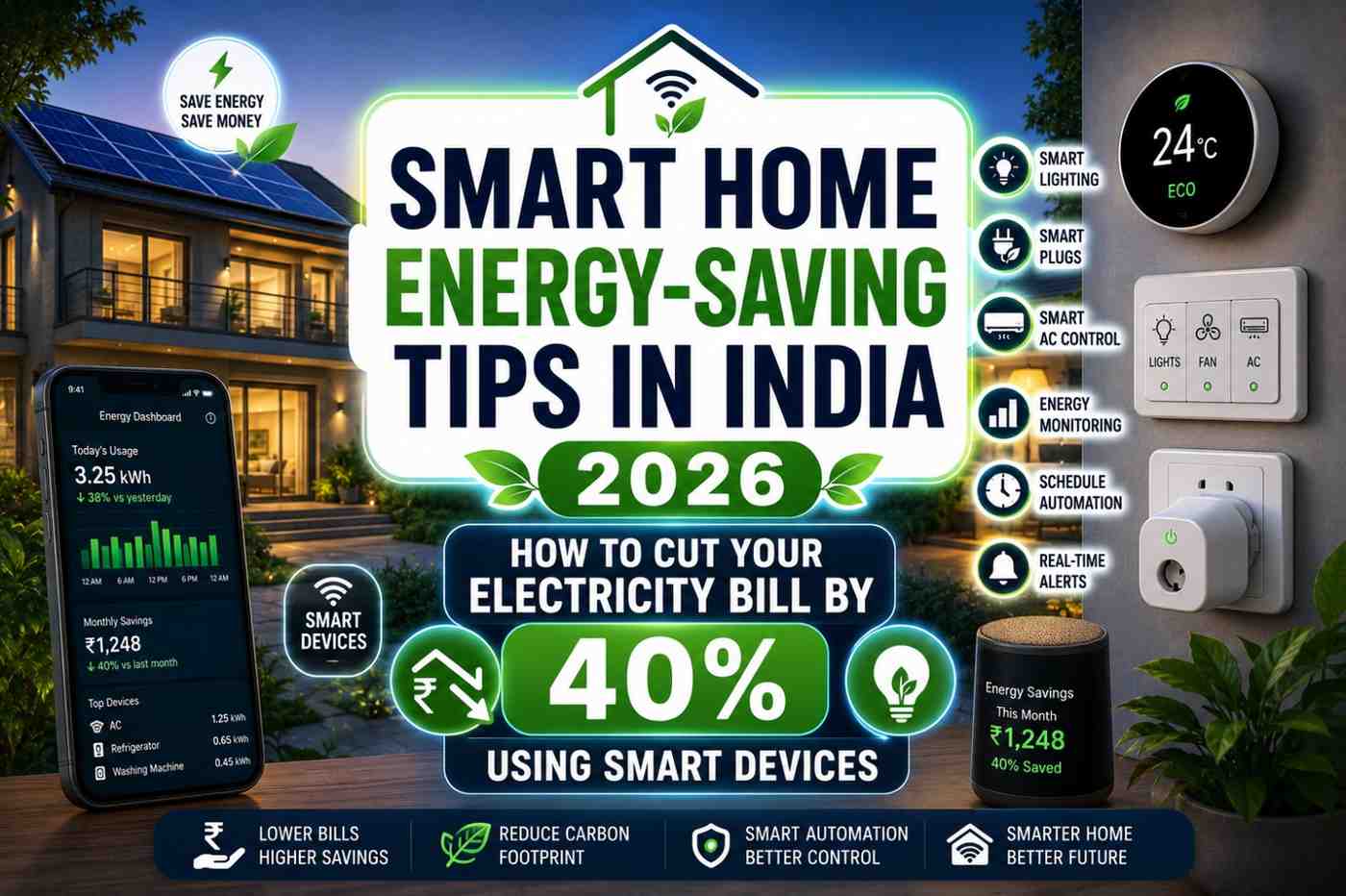
Every Indian household knows the feeling — opening the monthly electricity bill and wondering where all that power actually went. The good news is that with the right strategy, smart home energy-saving tips in India 2026 can help you slash that bill by as much as 40%—without sacrificing comfort. In fact, you will likely be more comfortable than before.
Smart home energy-saving tips in India 2026 are not about dimming lights and sweating through summer. They are about using intelligent devices — smart plugs, smart ACs, LED automation, and energy monitoring systems — to stop wasting power you are already paying for. India’s electricity tariffs have been rising steadily, and 2026 is the year to fight back with technology.
This guide covers the most practical, proven, and affordable smart home energy-saving tips for India in 2026 for every type of home—from a 1BHK apartment to a large independent house.
Bureau of Energy Efficiency India — BEE Official
Ministry of Power India — Energy Conservation
Why Smart Home Energy-Saving Tips India 2026 Matter More Than Ever
India’s average residential electricity tariff rose by 6–9% in most states between 2024 and 2026. At the same time, Indian households are using more power than ever—air conditioners, water heaters, washing machines, and multiple screens running simultaneously in every room.
The smart home energy-saving tips India 2026 approach attacks this problem at the source—not by reducing convenience, but by eliminating waste. Research consistently shows that the average Indian home wastes 25–40% of the electricity it consumes through the following:
- Standby power drain — appliances left in standby mode (TVs, chargers, set-top boxes)
- Inefficient AC usage — wrong temperature settings and poor scheduling
- Lighting waste — lights left on in unoccupied rooms
- Unmonitored appliances — water heaters and geysers running longer than needed
- Peak hour consumption — using heavy appliances during high-tariff time-of-use periods
Smart home energy-saving tips for India in 2026 address every single one of these waste categories using technology that is now affordable, easy to install, and designed for Indian conditions.
Bureau of Energy Efficiency India — BEE Official
Smart Home Energy Saving Tip 1 — Install Smart Plugs with Energy Monitoring
The first and most foundational of all smart home energy-saving tips in India 2026 is to understand what is actually consuming your power. You cannot manage what you cannot measure.
Smart plugs with built-in energy monitoring — like the Wipro 16A Smart Plug, TP-Link Tapo P110, or Qubo Smart Plug — show you exactly how many units of electricity each appliance is consuming in real time.
What you typically discover:
- Your old refrigerator is consuming 3–4 units per day (₹30–₹40 daily waste)
- Your set-top box uses 18W in standby—24 hours a day
- Your water heater runs 2 hours longer than needed after your shower
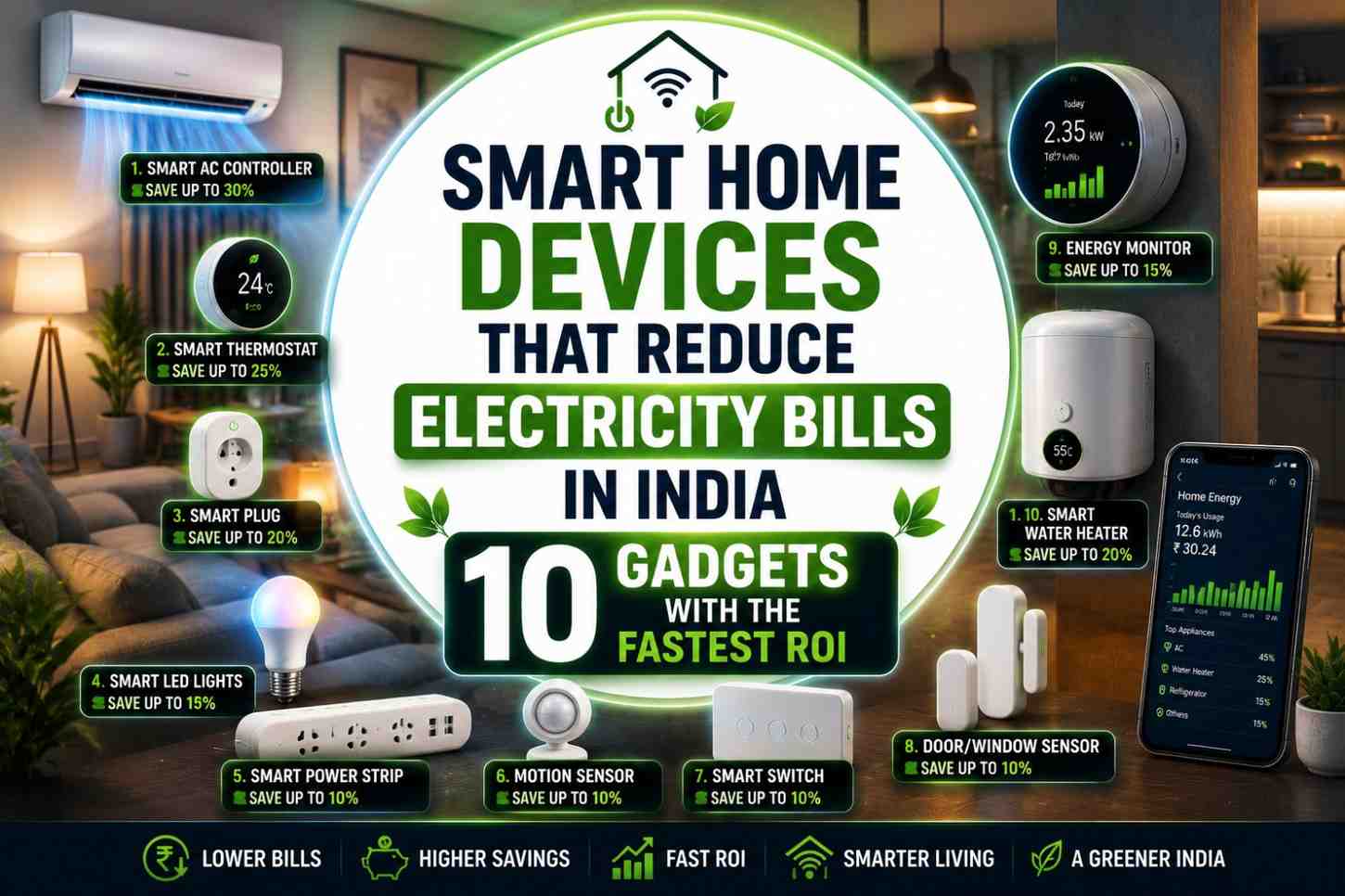
Once you have this data, you can set auto-off schedules, eliminate standby drain, and replace energy-hungry appliances strategically. Smart plugs implementing smart home energy-saving tips in India in 2026 cost just ₹800–₹2,000 each and often pay for themselves within 60 days.
Estimated saving: 8–15% of monthly bill from standby elimination alone.
Bureau of Energy Efficiency India — BEE Official
Smart Home Energy Saving Tip 2 — Automate Your AC with a Smart Thermostat or IR Controller
Air conditioning accounts for 40–60% of the electricity bill in Indian homes during summer months. This makes AC automation the single highest-impact area for smart home energy-saving tips in India 2026.
Key strategies:
- Set your AC to 24°C instead of 18°C—every degree below 24°C increases energy consumption by approximately 6%. Most people sleep perfectly at 24–26°C with a fan.
- Use a smart IR controller (Sensibo, Cielo Breez, or Qubo Smart Remote) to schedule your AC to automatically switch off 30 minutes after you fall asleep and restart before you wake up.
- Enable presence detection — smart thermostats can detect when no one is home and automatically adjust or switch off the AC.
- Create zone-based cooling — only cool the rooms that are occupied.
Indian homes following these smart home energy-saving tips in India 2026 around AC usage reports save ₹800–₹2,500 per month during peak summer months.
Estimated saving: 20–30% reduction in AC-related electricity cost.
Sensibo Smart AC Controller India
Smart Home Energy Saving Tip 3 — Switch to Smart LED Lighting with Motion and Schedule Control
Lighting is responsible for approximately 15–20% of the average Indian household’s electricity bill. Applying smart home energy saving tips India 2026 to your lighting system is fast, affordable, and immediately impactful.
The smart lighting approach:
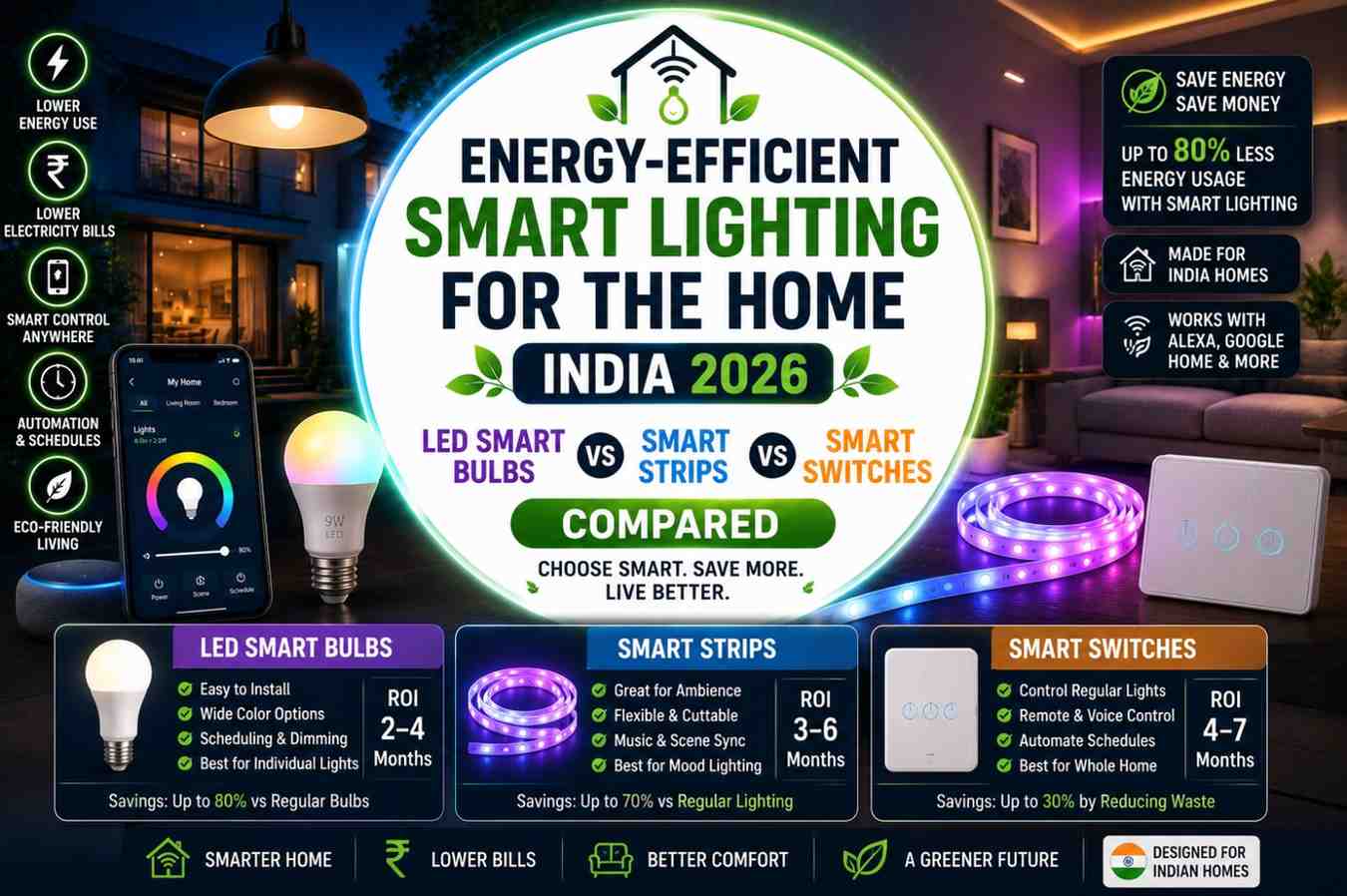
- Replace all bulbs with smart LED bulbs — a 9W smart LED produces the same brightness as a 60W traditional bulb, saving 85% energy per bulb.
- Add motion sensors to bathrooms, corridors, and storerooms — lights that automatically turn off when no one is present.
- Use smart switches with scheduling—porch lights and common area lights on automatic sunset-to-10pm schedules.
- Set brightness automation — lights at 40% brightness during the day and 100% only when needed.
Smart home energy-saving tips in India around lighting in 2026 can save an average household ₹200–₹500 per month at very low installation cost.
Estimated saving: 10–18% reduction in lighting-related electricity cost.
Sensibo Smart AC Controller India
Smart Home Energy Saving Tip 4 — Use Smart Scheduling for High-Consumption Appliances
Your water heater (geyser), washing machine, dishwasher, and iron are among the most power-hungry appliances in any Indian home. Applying smart home energy-saving tips in India in 2026 to these appliances through smart scheduling can significantly reduce their impact.
Practical strategies:
- Geyser automation — set a smart plug to power your geyser only for 20 minutes before your usual shower time. Most Indians heat their geysers for 60–90 minutes when 20 minutes is sufficient.
- Off-peak scheduling—in states with time-of-use tariffs, schedule heavy appliances to run during cheaper off-peak hours (typically 11pm–6am).
- Washing machine smart plug — set it to run only during specific hours and auto-cut power after the cycle completes to prevent wasted standby time.
These smart home energy-saving tips for India in 2026 around scheduling cost almost nothing to implement if you already have smart plugs installed.
Estimated savings: 5–12% of monthly bill from appliance scheduling.
Smart Home Energy Saving Tip 5 — Monitor Your Total Energy Consumption with a Smart Energy Meter
A whole-home energy monitor — installed at your distribution board — gives you a real-time dashboard of your entire home’s electricity consumption. Devices like the Schneider Electric Wiser Energy Monitor or Havells Smart Energy Meter bring professional energy management to Indian homes.
Smart home energy-saving tips in India 2026 around energy monitoring allow you to:
- See which appliance is consuming the most power at any given moment
- Track daily, weekly, and monthly consumption trends
- Set consumption alerts — get notified when you cross a daily unit threshold
- Identify the exact moment you are likely to cross your tariff slab threshold
This is one of the most underused smart home energy-saving tips in India in 2026—and one of the most powerful. Homeowners who monitor their energy consumption typically reduce their bills by 10–15% through awareness alone.
Estimated saving: 10–15% from awareness-driven behavior change.
Smart Home Energy Saving Tips India 2026 — Total Savings Summary
| Strategy | Device Needed | Monthly Saving (Estimate) | Cost of Device |
|---|---|---|---|
| Smart plugs (standby elimination) | Smart plug ₹800–₹2,000 | ₹200–₹600 | ₹800–₹2,000 |
| AC automation | Smart IR controller ₹2,000–₹5,000 | ₹800–₹2,500 | ₹2,000–₹5,000 |
| Smart LED lighting | Smart bulbs ₹300–₹800 each | ₹200–₹500 | ₹3,000–₹8,000 (full home) |
| Appliance scheduling | Smart plugs (existing) | ₹150–₹400 | ₹0 (if plugs installed) |
| Whole-home energy monitor | Smart meter ₹3,000–₹8,000 | ₹300–₹800 | ₹3,000–₹8,000 |
| Total Combined Saving | ₹1,650–₹4,800/month |
For a typical Indian household spending ₹3,000–₹8,000 per month on electricity, these smart home energy-saving tips in India 2026 represent a genuine 25–40% reduction—often within the first two to three months of implementation.
Additional Smart Home Energy Saving Tips India 2026 — Quick Wins
Beyond the main strategies, these quick wins are easy to implement immediately:
- Enable auto-brightness on all TVs and monitors—screens at full brightness waste 30–40% more energy
- Use smart power strips for entertainment centers—one switch kills power to TV, set-top box, soundbar, and gaming console simultaneously
- Set refrigerator temperature correctly—3–4°C for the fridge, -18°C for the freezer. Many Indian households keep fridges too cold.
- Seal AC room gaps—smart temperature management is wasted if cool air escapes under doors and around windows
- Enable Eco mode on your inverter AC—this feature alone can reduce AC power consumption by 10–15%
Every one of these smart home energy-saving tips for India in 2026 costs little to nothing to implement and delivers immediate results.
FAQs — Smart Home Energy Saving Tips India 2026
Q1. How much can I realistically save using smart home energy-saving tips in India in 2026? Most Indian households can save 25–40% on their monthly electricity bill by implementing smart plugs, AC automation, smart lighting, and energy monitoring together. The exact saving depends on your current consumption patterns and bill amount.
Q2. What is the single most impactful smart home energy-saving tip for Indian homes? AC automation and scheduling — since air conditioning accounts for 40–60% of the summer electricity bill in India, even a 20% improvement in AC efficiency delivers the largest absolute saving.
Q3. How long does it take for smart home devices to pay for themselves? Smart plugs typically pay for themselves in 30–60 days. Smart lighting in 3–6 months. AC controllers in 1–3 months (during summer). Smart energy meters in 4–8 months.
Q4. Do smart home energy-saving devices work with old wiring in Indian homes? Yes. Smart plugs, smart bulbs, and IR controllers are all plug-and-play and do not require rewiring. Smart switches may require a neutral wire — check before purchasing.
Q5. Are there any government incentives in India for smart home energy efficiency in 2026? Yes, the Bureau of Energy Efficiency (BEE) runs various schemes. Additionally, many state electricity boards offer rebates for replacing old appliances with 5-star rated energy-efficient models. Check your state electricity board’s website for current incentives.
Conclusion
Smart home energy-saving tips in India 2026 are not about deprivation—they are about intelligence. Every rupee you invest in a smart plug, an LED bulb, or an AC scheduler returns multiple rupees in electricity savings within months. The technology is affordable, the savings are real, and the impact is cumulative.
Start with one smart plug on your biggest energy guzzler. Add AC scheduling next. Then upgrade your lighting. Within three months, you will see the difference on your electricity bill — and you will wonder why you waited this long.
Ready to start saving? Tell us in the comments which tip you are trying first — and share your before/after electricity bill results!