India’s rooftop solar revolution is accelerating — but most homeowners are leaving enormous value on the table. Installing panels is only half the equation. The real savings, the real control, and the real intelligence come from smart home solar panel integration 2026 systems that connect your solar generation directly to your home automation, battery storage, and appliance scheduling—turning a passive energy system into an active, self-optimizing household engine.
In 2026, smart home solar panel integration technology will have matured to the point where a typical Indian household with a 5 kW rooftop solar system and a properly integrated smart home setup can reduce grid electricity dependency by 70–85% and cut monthly electricity bills to near zero during peak solar months. This guide explains exactly how.
Why Most Indian Solar Installations Are Underperforming
Understanding the gap between basic and integrated solar is essential before exploring smart home solar panel integration 2026 solutions.
A standard grid-tied solar installation in India generates power during daylight hours, exports surplus to the grid for credits, and draws from the grid at night. This model works — but it is entirely passive. The homeowner has no visibility into real-time generation, no ability to automatically shift high-consumption appliances to solar hours, and no intelligence governing when stored battery energy is used versus grid power.
The result is a system that generates significant electricity but does not maximize self-consumption—the single most important metric for reducing bills. Smart home solar panel integration 2026 solves this by making every component of your energy ecosystem talk to each other.
The 4 Core Components of a Smart Solar Home in 2026
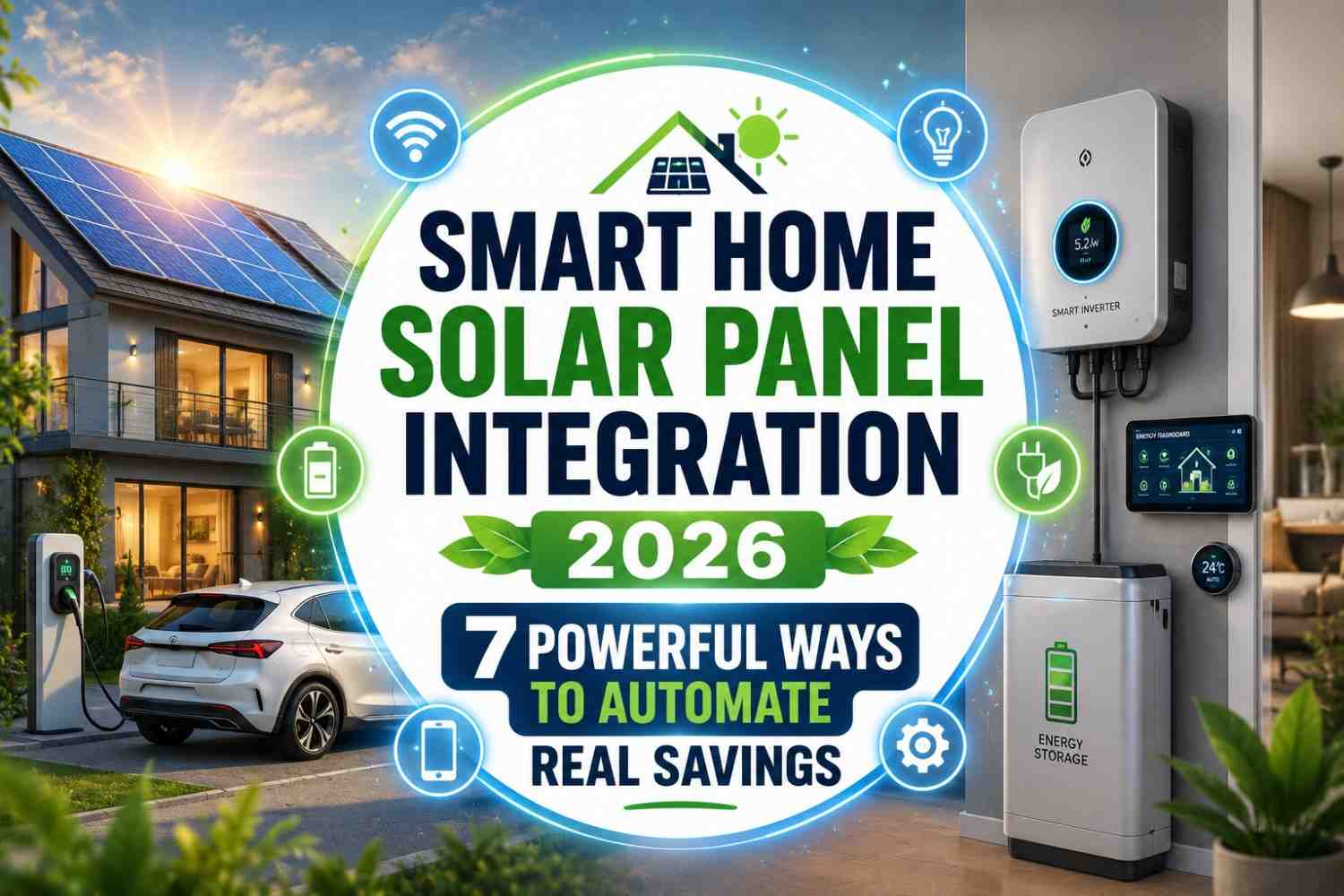
Every effective smart home solar panel integration 2026 system is built on four interconnected components:
1. Smart Inverter with Real-Time Monitoring
The inverter is the brain of any solar system, converting DC power from panels into AC power for home use. In a smart integration context, the inverter must support real-time data export via Wi-Fi or Ethernet to a home automation platform.
Best options for India in 2026:
- Sungrow SG Series — India’s most widely deployed hybrid smart inverter; supports SolarEdge monitoring integration and third-party home automation APIs
- Growatt MIN TL-X Series — Affordable, widely available in India, excellent app monitoring and smart load control features
- SMA Sunny Home Manager 2.0—Premium European option with outstanding automation capabilities, available through authorised Indian distributors
A smart inverter in a smart home solar panel integration 2026 setup provides second-by-second generation data, consumption tracking, and export/import metering and can directly control priority loads based on available solar power.
2. Battery Energy Storage System (BESS)
A battery storage system is what transforms a daytime-only solar installation into a 24-hour energy solution. In 2026, lithium iron phosphate (LiFePO₄) batteries have become the dominant storage technology for Indian residential smart home solar panel integration 2026 installations because of their excellent thermal stability (critical in India’s climate), long cycle life (4,000–6,000 cycles), and falling prices.
Recommended systems for India in 2026:
- Luminous Li-ON 1250—Indian-made, widely serviced, 1.25 kWh modular units that can be stacked for larger capacity
- Nexus by Exide — Affordable entry-level LiFePO4 suitable for 1–3 kW solar systems
- BYD Battery-Box Premium LVS — Premium imported option with seamless home automation integration via CAN bus protocol
For a typical Indian 3–4 bedroom apartment or villa, a 5–10 kWh battery bank paired with a 5 kW solar array forms the foundation of a truly effective smart home solar panel integration 2026 setup.
3. Smart Energy Management System (EMS)
The Energy Management System is the automation intelligence layer that makes smart home solar panel integration 2026 genuinely powerful. The EMS monitors real-time solar generation, battery state of charge, grid tariff rates, and household consumption simultaneously—then automatically makes decisions like
- “Solar generation is 3.2 kW and current home load is 1.1 kW—begin charging batteries with surplus.”
- “Battery is at 85% and solar is strong—activate the water heater and washing machine now.”
- “Solar generation is dropping (cloud cover)—reduce air conditioner load by 20% to stay within solar budget.”
- “It is 11 PM, grid is on off-peak tariff—charge batteries from grid to prepare for morning peak.”
Leading EMS platforms for Indian installations in 2026:
- Home Assistant with SolarEdge integration—open-source, highly customisable, large Indian user community
- Loxone Energy Monitor — Premium European system with outstanding India-specific documentation
- Enphase IQ System Controller 3 — Seamlessly integrates with Enphase microinverter systems
4. Smart Plugs, Switches, and Appliance Controllers
The final layer of smart home solar panel integration 2026 connects individual appliances to the EMS, enabling automated load scheduling based on solar availability.
Install smart plugs (Wipro Smart, Anchor Roma Smart, or Syska Wi-Fi plugs) on high-consumption appliances—water heaters, washing machines, dishwashers, and pool pumps—and connect them to your EMS automation rules. When solar generation exceeds a threshold, the EMS automatically activates these loads without any manual intervention.
Step-by-Step Guide to Smart Home Solar Integration in India
Step 1: Audit Your Current Energy Profile
Before implementing any smart home solar panel integration 2026 system, spend 2 weeks monitoring your household energy consumption using a temporary smart energy monitor (discussed in detail in the Energy Monitoring Dashboard article in this series).
Map out:
- Total daily consumption in kWh
- Peak consumption hours (typically 6–9 AM and 6–10 PM in Indian households)
- Appliances consuming more than 500W
- Current solar generation data (if already installed)
This audit forms the specifications for your smart home solar panel integration 2026 design.
Step 2: Select and Install a Smart Hybrid Inverter
Replace or upgrade to a hybrid smart inverter that supports battery integration and home automation API access. For new installations in India, the Sungrow SH series (hybrid) is the most recommended option in 2026 for its combination of local support, robust app, and third-party integration capabilities.
Step 3: Install Battery Storage
Size your battery storage based on your average evening and night consumption—typically 5–8 kWh for a medium Indian household. Install in a well-ventilated, shaded location away from direct sun exposure (critical for battery longevity in India’s heat).
Step 4: Connect to a Home Automation Platform
Link your inverter, battery system, and smart plugs to a central home automation platform. Home Assistant running on a Raspberry Pi or a dedicated NUC computer is the most popular choice for technically inclined Indian homeowners implementing smart home solar panel integration 2026 systems because of its extensive plugin library and zero subscription cost.
Alternatively, manufacturer-specific platforms like Sungrow iSolarCloud or Enphase Enlighten offer simpler setup with fewer customization options.
Step 5: Program Solar-Priority Automation Rules
Create automation rules that maximize solar self-consumption:
Rule example 1—Solar water heating: “If solar generation > 2.5 kW AND battery charge > 60% AND time is between 10 AM and 2 PM, then Turn on water heater.”
Rule example 2—Battery protection: “If battery charge < 20% AND solar generation < 0.5 kW AND grid tariff is peak rate, → Reduce AC setpoint by 2°C and defer washing machine.”
Rule example 3 — Export management: “If solar generation exceeds home load + battery charging rate → Activate EV charger / pool pump / second water heater”
These rules are the core value delivery of smart home solar panel integration 2026 automation—saving money without requiring any daily manual decisions.
Step 6: Monitor, Optimise, and Expand
Review your system’s performance data weekly for the first 3 months. Most homeowners discover 2–3 optimization opportunities—appliances running at peak tariff times that can be shifted, battery discharge patterns that can be refined, or new automation rules that further reduce grid dependency.
Real Savings: What Indian Homeowners Are Achieving in 2026
The financial case for smart home solar panel integration in 2026 is compelling. Based on reported data from Indian solar homeowners using integrated smart systems in 2026:
- Average grid electricity reduction: 72–84% annually
- Monthly bill reduction: ₹3,500–₹8,000 for a 5 kW system with 10 kWh storage in metro cities
- Payback period: 4.5–6 years (down from 7–9 years for non-integrated systems) because of superior self-consumption rates
- Carbon offset: 6–8 tonnes of CO₂ per year for an average integrated Indian solar home
The government’s PM Surya Ghar Muft Bijli Yojana scheme (which provides subsidies for residential solar in India) has further reduced upfront costs—making smart home solar panel integration in 2026 financially accessible to a much broader segment of Indian households than ever before. Details of current subsidy amounts are available at MNRE India’s official portal.
Common Integration Mistakes to Avoid
Mistake 1 — Buying a non-hybrid inverter: String inverters without hybrid capability cannot be upgraded to battery storage without expensive replacement. Always specify a hybrid inverter if smart home solar panel integration 2026 is the goal.
Mistake 2 — Undersizing battery storage: Indian households with multiple air conditioners need more storage than basic calculators suggest. Add 20% to your calculated requirement to account for inefficiencies and seasonal variation.
Mistake 3 — Using incompatible protocols: Ensure your inverter, battery, EMS, and smart devices all support compatible communication protocols (Modbus, SunSpec, or manufacturer API). Incompatible systems cannot share data, making automation impossible.
Mistake 4 — Ignoring monsoon generation drops: Indian solar generation can drop 40–60% during heavy monsoon months (July–August in most regions). Program battery management rules that account for extended low-generation periods rather than assuming peak summer performance year-round.
5 Frequently Asked Questions (From Google)
Q1: Can I add smart home integration to an existing solar system in India? Yes, in most cases. If your existing inverter is a hybrid model from a major brand (Sungrow, Growatt, SMA, Fronius), it likely supports smart home integration via its existing API or a firmware update. Non-hybrid inverters are more difficult to integrate but can still connect to smart energy monitors for basic automation.
Q2: What is the best smart home platform for solar integration in India? Home Assistant is the most popular choice for Indian homeowners pursuing smart home solar panel integration in 2026 because of its open-source nature, zero subscription cost, and extensive plugin library for Indian solar inverter brands. For simpler setups, manufacturer apps like Sungrow iSolarCloud or Enphase Enlightenment is an excellent starting point.
Q3: How much does a smart home solar integration system cost in India in 2026? A complete smart home solar panel integration 2026 system—5 kW panels, 10 kWh battery, smart inverter, basic EMS, and smart plugs—costs approximately ₹5–₹8 lakhs before government subsidies. After applicable MNRE subsidies, costs typically reduce to ₹3.5–₹6 lakhs depending on the state and system size.
Q4: Do I need an internet connection for solar home automation to work? Core automation functions (solar charging, load shifting, and battery management) work locally without internet. Cloud features — remote monitoring, firmware updates, and app notifications — require internet connectivity. Most smart home solar panel integration 2026 setups are designed to function fully offline if the internet is interrupted.
Q5: Is battery storage worth adding to an existing solar installation in India? Yes, especially in cities with unreliable grid supply or high peak tariff rates. Adding a 5–10 kWh battery to an existing solar installation increases self-consumption from roughly 35–40% to 70–85%, dramatically accelerating the financial return and making the overall smart home solar panel integration 2026 system far more effective.
Conclusion
Smart home solar panel integration 2026 represents the single most impactful upgrade any Indian homeowner with a rooftop solar system can make. By connecting generation, storage, automation, and appliance control into a unified intelligent system, you move from passively generating solar power to actively managing every unit of energy your home produces and consumes.
The technology is mature, the costs are falling, and the government subsidies are substantial. 2026 is the ideal moment to move beyond a basic solar installation and build a truly intelligent solar home. Begin by exploring India’s MNRE subsidy program at mnre.gov.in and consult a certified solar integrator for a personalized system design.