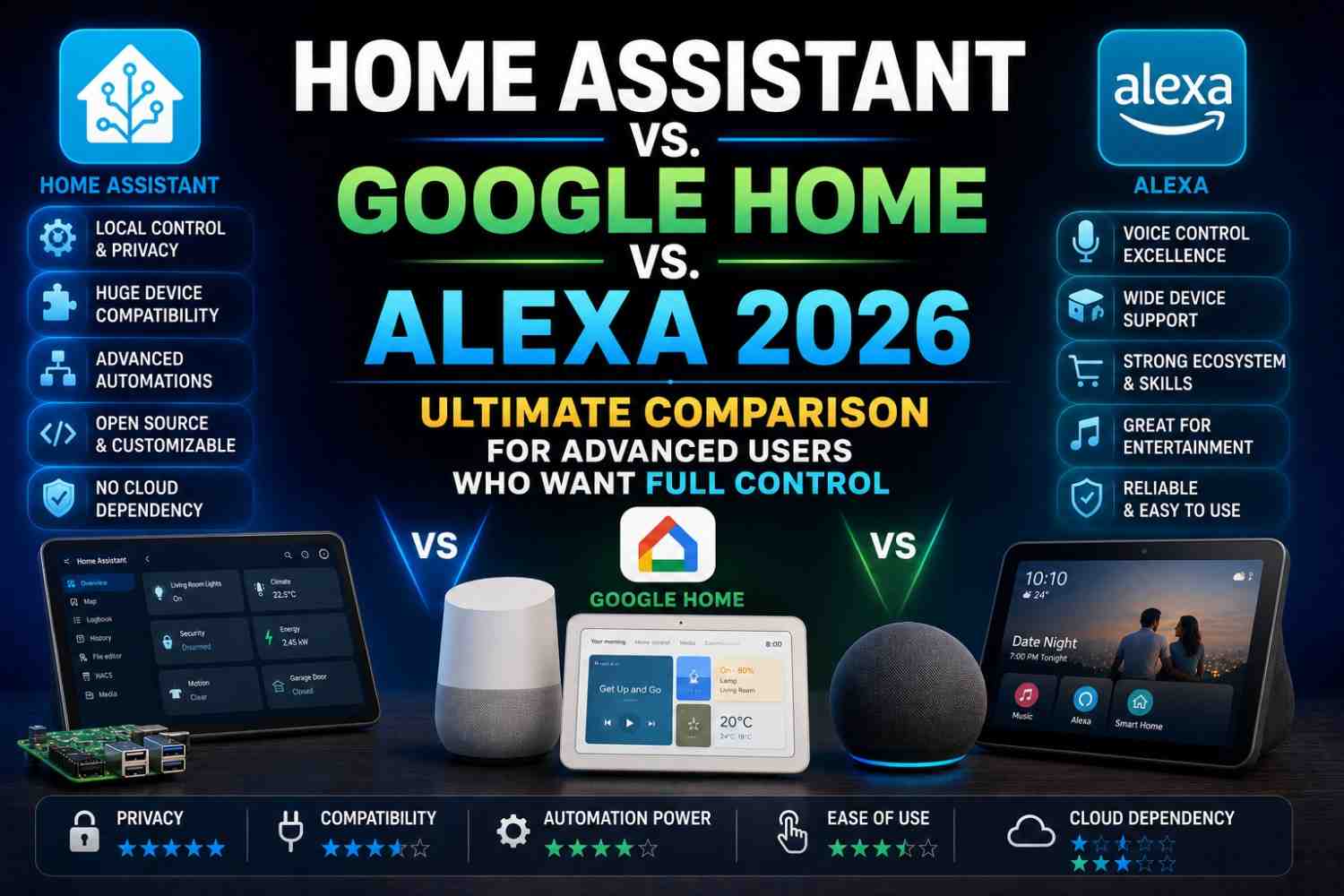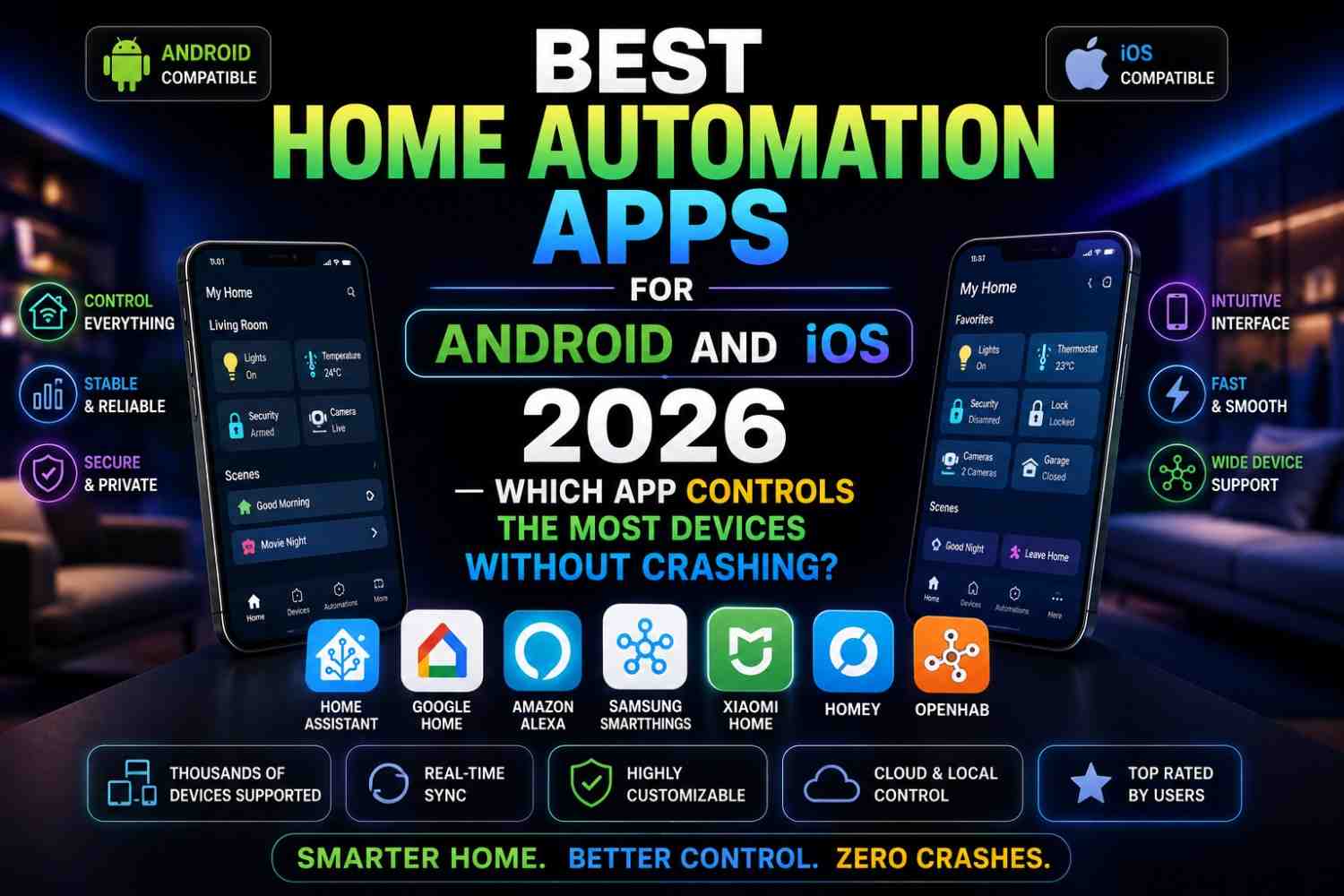
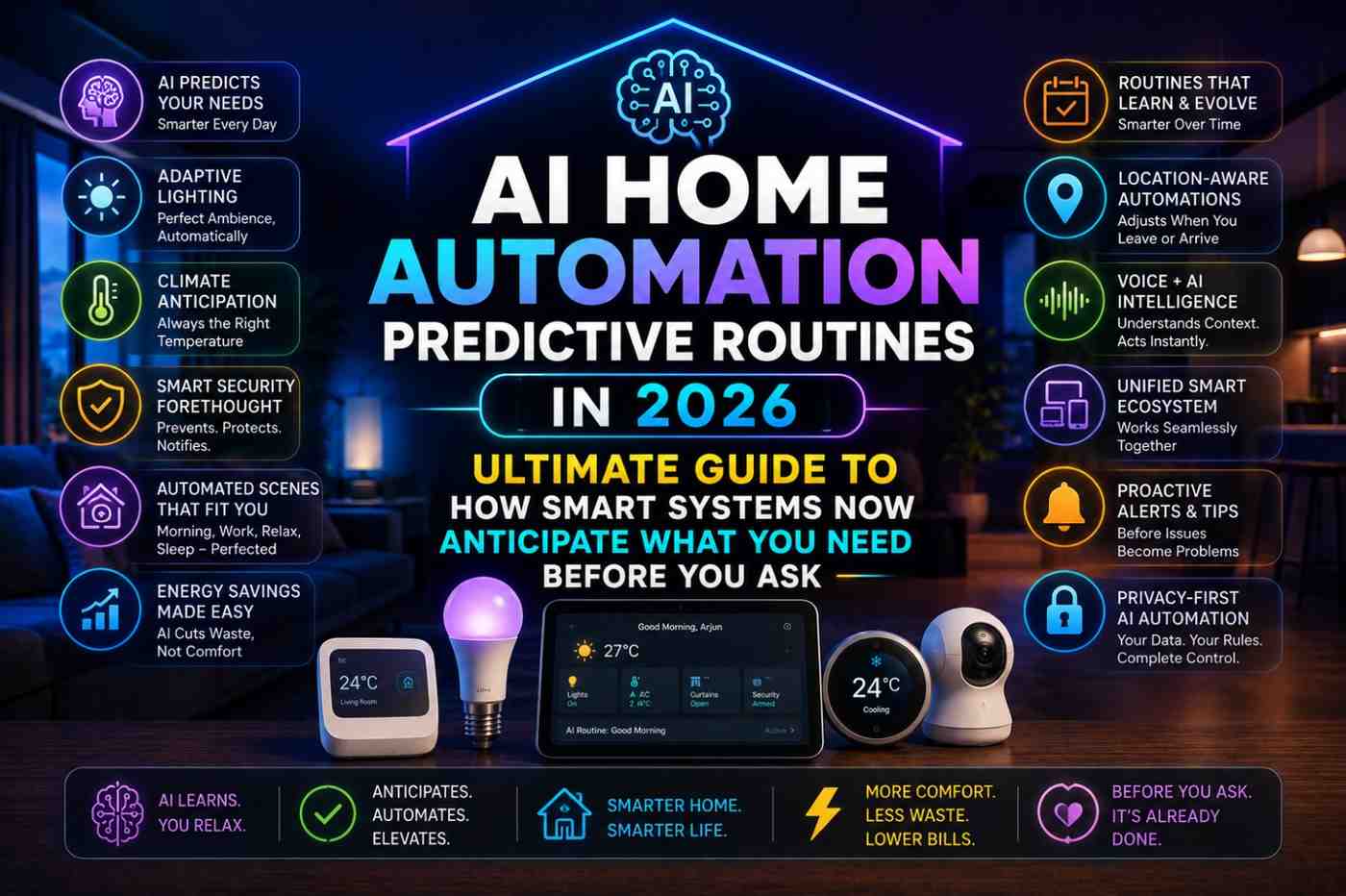
The smart home has crossed a remarkable threshold. AI home automation predictive routines in 2026 represent the moment when your home stops waiting for your commands and starts anticipating your needs. This is no longer science fiction — it is happening right now, in millions of homes, powered by AI systems that learn your patterns, model your preferences, and act on your behalf before you even reach for your phone.
AI home automation predictive routines in 2026 work differently from traditional scheduled routines. Instead of telling your home, “Turn on the lights at 7 AM,” predictive AI watches what you do, when you do it, and under what conditions—then acts accordingly, automatically. It’s the difference between a programmed thermostat and a system that knows you sleep cold on Tuesdays after gym sessions.
In this complete guide, we explore how AI home automation predictive routines in 2026 work across every major platform, what triggers them, how private they are, and how you can set them up and benefit from them in your home today.
https://support.google.com/googlenest/answer/7029585 — Google Home: Routines and AI Suggestions
What Are AI Predictive Routines — And Why 2026 Is the Turning Point
AI home automation predictive routines in 2026 differ fundamentally from traditional time-based or voice-triggered automations in one key way: they are proactive, not reactive.
A traditional routine says: “At 6:30 AM on weekdays, turn on bedroom lights.”
A predictive AI routine says, “This person’s alarm goes off between 6:15 and 6:45 AM on workdays. Their bedroom is dark until they wake up. Their coffee maker draws power around the same time. I’ll preheat their geyser and turn on soft lights 20 minutes before their most likely wake-up time—without being asked.”
Three major developments in 2026 have made AI home automation predictive routines a mainstream reality:
1. On-Device AI Processing Google’s Tensor G5 chips (in Pixel phones and Nest devices) and Apple’s A18 chip now run machine learning models locally. Your habits are learned on-device—not sent to a cloud server—making predictive routines faster and more private.
2. Gemini and Alexa AI Integration Google’s Gemini AI is now deeply embedded in Google Home. It proactively suggests routines, identifies wasteful patterns, and can create complex automations from a single natural language sentence.
3. Home Assistant’s Local AI Revolution Home Assistant’s integration with local LLMs (large language models) running on a home server means power users can have full AI prediction capabilities with zero cloud exposure.
https://www.home-assistant.io/integrations/ollama — Home Assistant Ollama Local AI Integration
How Predictive AI Learns Your Home Behaviour
Understanding the mechanics is central to appreciating AI home automation predictive routines in 2026.
AI prediction in smart homes relies on several data inputs:
- Usage patterns — When lights, appliances, and devices are turned on/off and for how long
- Occupancy signals — Phone location, motion sensor data, door sensor events
- Calendar data — Meeting times, alarm times, scheduled events (Google Home integrates with Google Calendar)
- Environmental data — Temperature, humidity, light levels, time of day, season
- Voice command history — Repeated voice commands become candidates for automation
The AI builds a probabilistic model of your behavior. It doesn’t memorize exact times—it learns that you’re 87% likely to turn on the living room lights within 5 minutes of arriving home between 5 PM and 8 PM on weekdays. When that pattern is strong enough, it becomes a predictive routine.
https://www.amazon.com/b?node=17934671011 — Amazon Alexa Hunches Official
AI Predictive Routines on Google Home (Gemini-Powered)
Google Home’s AI home automation predictive routines for 2026 are powered by Gemini and represent the most accessible implementation for everyday users.
Gemini Suggestions Feature
Google Home now monitors your manual actions and actively suggests converting them into automations. For example:
- After you manually turn off the living room lights every night at approximately 10 PM for two weeks, Google Home suggests, “You often turn off living room lights around 10 PM. Create a routine?”
- One tap creates the automation. No complex setup required.
Natural Language Routine Creation
In 2026, you can create AI home automation predictive routines in Google Home using plain English:
“Create a routine that turns on the bedroom fan 10 minutes before I usually wake up on weekdays and turns off the AC if no one is home.”
Gemini interprets this, pulls your calendar data for your usual wake time, and creates the full multi-action routine automatically.
Proactive Energy Suggestions
Google Home’s AI now analyzes your smart plug and switch data and proactively alerts you:
- “Your geyser has been on for 90 minutes. Want me to turn it off?”
- “Your AC ran for 6 hours today while no one was home. Create an away-mode routine?”
These are the most immediately useful AI home automation predictive routine 2026 features for reducing electricity waste.
[IMAGE 1 — Place after Google Home section]
Suggested Image: A smartphone screenshot illustration showing the Google Home AI suggestion panel offering three predictive routine suggestions based on recent usage patterns, with Accept and Dismiss buttons. ALT Text: “AI home automation predictive routines 2026—Google Home app showing Gemini AI suggesting three predictive routines based on usage patterns.”
AI Predictive Routines on Amazon Alexa (Alexa+ and Hunches)
Amazon’s implementation of AI home automation predictive routines in 2026 takes two forms: the free Hunches feature and the paid Alexa+ advanced AI tier.
Alexa Hunches (Free)
Hunches is Amazon’s longest-running AI prediction feature—and in 2026 it has become significantly more accurate.
How Hunches works:
- Alexa monitors your patterns silently
- When it’s confident enough (typically after 2–3 weeks of consistent behaviour), it begins acting automatically
- Example: “I noticed you always turn off the living room lamp when you say goodnight. I’ll start doing that automatically.”
- You receive a notification: “Alexa turned off your living room lamp as part of a hunch. Was that right?”
The feedback loop improves accuracy over time—making hunches a genuinely self-improving component of AI home automation predictive routines in 2026.
Alexa+ AI Routines (Subscription — $7.99/month)
The Alexa+ subscription tier unlocks generative AI capabilities:
- Create complex routines via conversation with Alexa: “Set up a morning routine for when I have early “meetings”—Alexa checks your calendar and builds the full routine
- Predictive suggestions based on device usage and calendar events
- Proactive multi-device coordination: “Your morning alarm is set for 6 AM tomorrow. Want me to preheat the geyser at 5:45?”
AI Predictive Routines on Home Assistant (Local AI — Privacy First)
For privacy-conscious users, Home Assistant’s approach to AI home automation predictive routines in 2026 is the most compelling—because all AI processing happens locally on your own hardware.
Home Assistant + Local LLM (Ollama)
In 2026, Home Assistant supports running local language models through Ollama—an open-source tool that runs AI models like LLaMA 3, Mistral, or Gemma on a Raspberry Pi 5 or home server.
What this enables:
- Natural language automation creation: type or speak a request to your local AI assistant and it creates the Home Assistant YAML automation
- Pattern analysis without cloud exposure: your behaviour data never leaves your home
- Proactive suggestions based on your Home Assistant logs and history
Home Assistant Statistics Engine
Home Assistant’s built-in statistics engine tracks device usage patterns and can trigger automations based on statistical thresholds.
- “If the average time this light is on today is 40% below the 30-day average, trigger energy-saving mode.”
- “If motion hasn’t been detected in any room for 3 hours during normal wake hours, send a wellness check notification.”
This type of statistical prediction is unique to Home Assistant among all AI home automation predictive routine 2026 platforms.
Real-World Predictive Routines You Can Set Up Today
Here are specific AI home automation predictive routines for 2026 that are active and working in real smart homes:
Predictive Routine 1 — Calendar-Aware Morning Preparation
The system checks your Google Calendar the night before. If you have an early meeting, it automatically adjusts your alarm-time routines—preheating the geyser earlier, starting coffee sooner, and waking lights up 15 minutes earlier than usual.
Predictive Routine 2 — Occupancy-Predicted Climate Control
The AI learns that you arrive home between 5:30 and 6:30 PM on weekdays. It begins cooling or heating the home 30 minutes before your predicted arrival time—so the house is at your preferred temperature when you walk in.
Predictive Routine 3 — Sleep Pattern Detection
Using phone charging data and bedroom motion sensors, the AI detects when you’ve gone to bed without explicitly saying goodnight. It then silently turns off non-essential devices, dims any remaining lights, and activates sleep mode.
Predictive Routine 4 — Forgotten Appliance Prediction
The AI learns your typical geyser usage duration (e.g., usually 35 minutes in the morning). If the geyser is still on after 60 minutes and you’ve already left the house (via phone GPS), it automatically turns it off and sends a notification.
Predictive Routine 5 — Weekend vs Weekday Pattern Differentiation
AI home automation predictive routines in 2026 are sophisticated enough to maintain completely separate behavior models for weekdays and weekends—different wake times, different occupancy patterns, and different lighting and temperature preferences.
Privacy Considerations for AI Predictive Routines
Privacy is the most important concern surrounding AI home automation predictive routines in 2026—and it’s a topic every smart home user should understand.
| Platform | Data Processing Location | Data Used For | Opt-Out Available |
|---|---|---|---|
| Google Home (Gemini) | Google Cloud | Service improvement, ads | Partial |
| Amazon Alexa (Hunches) | Amazon Cloud | Product improvement, shopping | Yes |
| Apple Home | On-device (iPhone/iPad) | Nothing external | N/A — fully local |
| Home Assistant (Local AI) | Your home server | Nothing stays local | N/A |
The privacy hierarchy for AI home automation predictive routines 2026 is clear: Home Assistant and Apple Home process data locally. Google and Amazon use cloud processing, which involves sending some usage data to external servers.
[IMAGE 2 — Place after privacy table]
Suggested Image: A layered diagram showing four platforms stacked from most to least private — Home Assistant (local server, fully private), Apple Home (on-device), Google Home (cloud, partial privacy), Alexa (cloud, data used commercially) — with privacy shields and data flow arrows. ALT Text: “AI home automation predictive routines 2026—privacy comparison diagram showing data processing locations for Home Assistant, Apple Home, Google Home, and Alexa”
Comparison: AI Predictive Capabilities Across Platforms
| Feature | Google Home | Alexa (Free) | Alexa+ | Home Assistant |
|---|---|---|---|---|
| Pattern Learning | ✅ Gemini | ✅ Hunches | ✅ Advanced AI | ✅ Local stats |
| Calendar Integration | ✅ Deep | ⚠️ Limited | ✅ Yes | ✅ Google Cal plugin |
| Natural Language Setup | ✅ Excellent | ⚠️ Basic | ✅ Excellent | ✅ Local LLM |
| Privacy | ⚠️ Cloud | ⚠️ Cloud | ⚠️ Cloud | ✅ Fully local |
| Cost | Free | Free | $7.99/month | Free (hardware only) |
| Offline Prediction | ❌ Limited | ❌ No | ❌ No | ✅ Yes |
FAQs: AI Home Automation Predictive Routines 2026
Q1: How long does it take for AI home automation predictive routines in 2026 to learn my habits? A: Most platforms require 1–3 weeks of consistent usage before making confident predictions. Google Home’s Gemini typically offers first suggestions within 7–10 days. Alexa hunches usually activate after 2 weeks of pattern observation.
Q2: Can AI home automation predictive routines in 2026 be turned off if I don’t want automatic actions? A: Yes. All platforms allow you to switch from “automatic action” to “notification only” mode—where the AI suggests what it would do but waits for your approval before acting. This is the recommended starting mode.
Q3: Are AI home automation predictive routines in 2026 accurate enough to trust with appliances? A: For low-risk actions (turning off lights, adjusting fan speed), yes — they are reliable enough after the learning period. For high-risk actions (locking doors, controlling security systems), always configure them in notification-only mode first.
Q4: Do AI home automation predictive routines in 2026 work for Indian home usage patterns? A: Yes. Google Home’s Gemini and Amazon Hunches both work globally and learn location-agnostic patterns. However, Indian-specific patterns like afternoon nap times, domestic helper schedules, and power cut recovery behaviors may require some manual routine additions.
Q5: What hardware do I need to get started with AI home automation predictive routines? 2026? A: For Google Home — any Android phone and a Google Nest Mini (₹3,499). For Alexa Hunches—any smartphone and an Amazon Echo Dot (₹2,999). For Home Assistant local AI, a Raspberry Pi 5 (₹6,000–₹8,000) or Home Assistant Green device.
Conclusion
AI home automation predictive routines in 2026 mark a genuine inflection point in smart home technology. The home is no longer waiting for your instructions — it is learning, anticipating, and acting. From Gemini-powered suggestions in Google Home to privacy-first local AI in Home Assistant, AI home automation predictive routines in 2026 are available at every price point and every technical skill level.
The homes that feel most magical in 2026 aren’t the ones with the most expensive devices. They’re the ones where AI home automation predictive routines of 2026 have been given enough time, data, and freedom to genuinely learn the lives of the people inside them.
Start your AI prediction journey today — connect two or three devices, let the AI observe your patterns for two weeks, and watch as your home begins to think for itself.