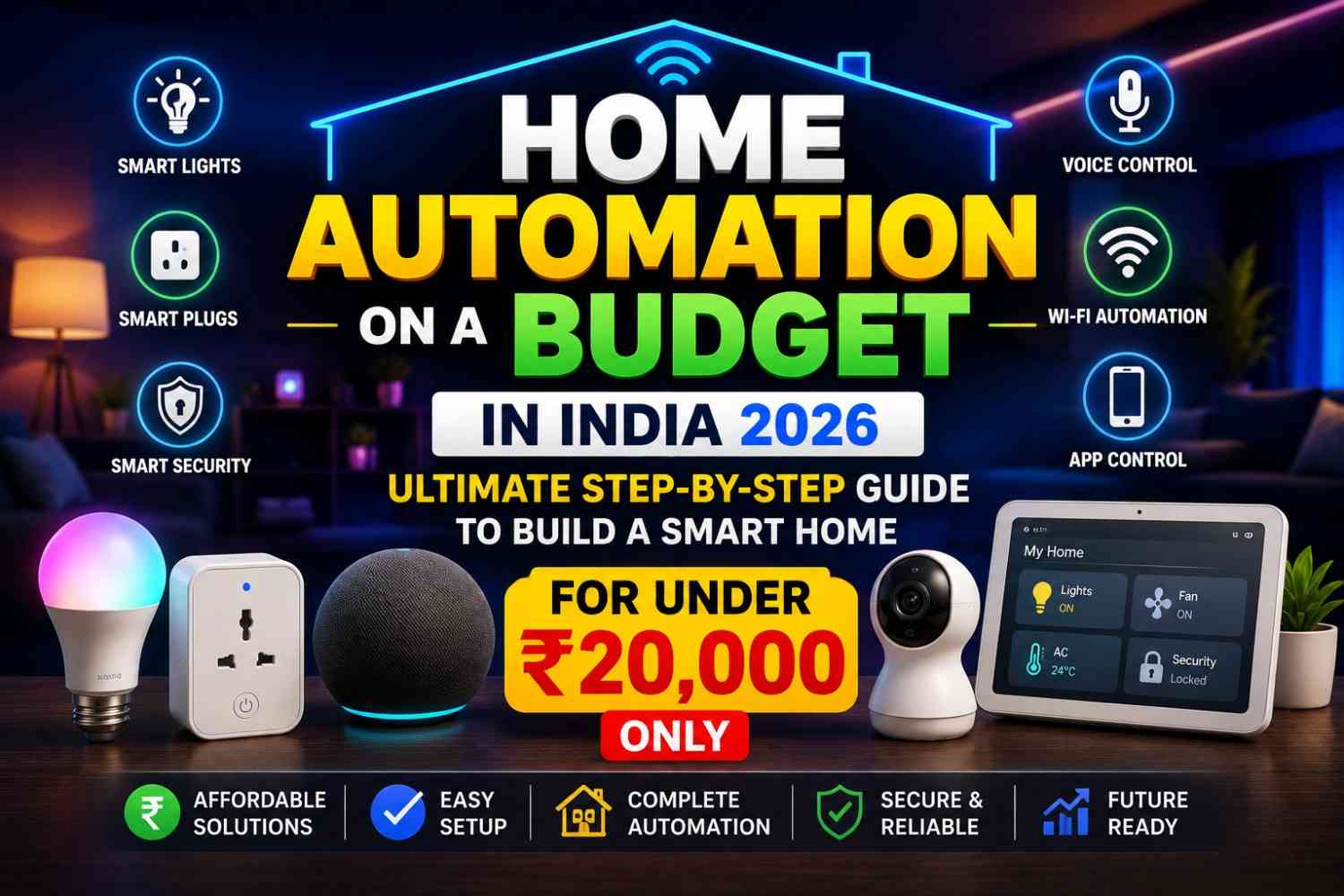
Smart homes aren’t just for the wealthy anymore. Home automation on a budget in India in 2026 has become genuinely achievable for middle-class Indian families, college students in rented apartments, and homeowners who want to start small without committing to an expensive full-house overhaul.
The secret to successful home automation on a budget in India in 2026 is prioritization—knowing which upgrades give you the most value, the most daily utility, and the most electricity savings for the least money. In this complete guide, you’ll find a step-by-step plan to build a working smart home for under ₹20,000 — and optional extras if your budget stretches a little further.
Everything recommended here is available on Amazon India or Flipkart, ships to addresses across India, and is fully compatible with the Indian 220–240V power supply.
Why Budget Smart Homes Are Possible in India in 2026
Home automation on a budget in India in 2026 is more accessible than ever for three key reasons:
1. Indian Brands Have Entered the Market: Brands like Syska, Wipro Smart, Qubo, Atomberg, and Anchor Panasonic now manufacture India-specific smart devices that cost 40–60% less than international equivalents and are designed for Indian wiring, voltage, and Wi-Fi conditions.
2. Amazon and Flipkart Sale Events The Amazon Great Indian Festival and Flipkart Big Billion Days in 2025–2026 have brought smart home device prices to historic lows. Smart plugs available for ₹399. Smart bulbs for ₹299.
3. Free Smart Home Apps Amazon Alexa, Google Home, and many manufacturer apps are completely free. There’s no monthly subscription required for basic home automation on a budget in India’s 2026 features.
The Golden Rules of Home Automation on a Budget India 2026
Before spending a single rupee, follow these rules for smart home automation on a budget in India 2026:
- Start with problems, not gadgets—Identify what annoys you most (forgetting to turn off the geyser, high electricity bills, security concerns) and automate those first.
- Avoid proprietary ecosystems—Stick to devices that work with Google Home or Amazon Alexa so they all connect together. Avoid brands with apps that only control their own products.
- Buy 2.4 GHz compatible devices — Most Indian routers broadcast on 2.4 GHz. Ensure all smart devices support this frequency.
- Check for BIS certification — For safety and quality, always verify Bureau of Indian Standards (BIS) certification on electrical smart devices.
- One ecosystem only—Mixing Google Home and Alexa adds complexity. Pick one and stick with it for your home automation on a budget India 2026 build.
The ₹20,000 Smart Home Build Plan
Here is a complete, prioritized step-by-step home automation on a budget India 2026 build plan:
Step 1 — The Brain: Smart Speaker (₹2,000–₹3,500)
Every home automation on a budget India 2026 setup needs a central voice assistant and hub. This is your first purchase.
Best budget options:
- Amazon Echo Dot (5th Gen, India) — ₹2,999 (frequently on sale for ₹1,499). Alexa-powered, it works with thousands of Indian smart devices.
- Google Nest Mini (2nd Gen) — ₹3,499 (sale price often ₹1,999). Google Home hub: excellent Hindi support.
Why buy this first: Once you have a smart speaker, you can voice-control every other device you add later. It’s the foundation of all home automation on a budget India 2026 builds upon.
Estimated spend: ₹2,000–₹3,500
https://www.amazon.in/smart-home — Amazon India Smart Home Devices
Step 2 — Smart Plugs: Zero-Wiring Automation (₹1,500–₹2,500)
Smart plugs are the most affordable and impactful component of home automation on a budget in India 2026. They give you remote and voice control over any appliance without touching a single wire.
Buy 3 smart plugs for the geyser, table fan, and one other high-use appliance.
Best budget options:
- Syska Smart Plug SSP2.0 — ₹499–₹699 each. BIS certified, Indian socket compatible.
- Amazon Smart Plug (India) — ₹999. Direct Alexa integration, no separate hub needed.
- TP-Link Tapo P105 — ₹899. It’s compact, reliable, and works with Google Home and Alexa.
Key win: Automating your geyser to run only 30 minutes before your bath time saves ₹4,000–₹6,000 per year in electricity—paying for your entire smart plug investment in the first month.
Estimated spend: ₹1,500–₹2,500 for 3 plugs
https://www.flipkart.com/smart-home — Flipkart Smart Home Store
Step 3 — Smart Bulbs: Instant Visual Impact (₹1,500–₹3,000)
Smart LED bulbs are the most visible and satisfying upgrade in any home automation on a budget India 2026 project.
Best budget options:
- Syska Smart LED Bulb 9W — ₹299–₹499 each. 16 million colors, works with Alexa and Google Home.
- Wipro Garnet Smart LED 12W — ₹399–₹599 each. Good color accuracy and schedule features.
- Amazon Basics Smart Bulb — ₹349 each. Simple, reliable, on-sale regularly.
Buy 4 bulbs for the living room (2), bedroom (1), and entrance (1).
Automation ideas: Schedule living room lights to dim at 9 PM. Set the bedroom light to slowly brighten 20 minutes before your alarm. Create a “movie mode” that dims to 20% with a single voice command.
Estimated spend: ₹1,500–₹2,000 for 4 bulbs
https://www.syska.in/smart — Syska Smart Home Official Site
Step 4 — Smart Security Camera (₹1,500–₹2,500)
Safety is a priority in home automation on a budget in India 2026, and a basic smart camera is more affordable than most people expect.
Best budget options:
- Qubo Home Cam 360° — ₹1,699. Made in India. 1080p, night vision, two-way audio, works with Amazon Alexa.
- TP-Link Tapo C200 — ₹1,799. 360° rotation, motion detection, microSD storage, works with Google Home.
- Realme Smart Cam 360° — ₹1,499. Affordable, AI motion detection, clear night vision.
Place one camera in the living room or aimed at the front door for maximum usefulness.
Estimated spend: ₹1,500–₹2,000
https://www.qubo.co.in — Qubo Smart Devices (Hero Group India)
Step 5 — Smart Wi-Fi IR Blaster (₹1,500–₹2,500)
If you have a ceiling fan, AC, TV, or set-top box with a remote control, a smart IR blaster is one of the smartest investments in home automation on a budget in India in 2026.
Best budget options:
- Broadlink RM4 Mini — ₹1,799. Controls AC, TV, fan, and set-top box via a single app. Works with Alexa and Google Home.
- BestCon RM4C Mini — ₹1,499. Compact, easy setup, same Broadlink app.
With an IR blaster, you can voice-control your existing non-smart AC and TV — no need to buy new appliances.
Estimated spend: ₹1,500–₹2,000
https://www.atomberg.com — Atomberg Smart Fans Official Site
[IMAGE 1 — Place after Step 5]
Suggested Image: A flat-lay product photo-style illustration showing all 5 starter kit components: smart speaker, smart plugs, smart bulbs, security camera, and IR blaster with price tags in INR. ALT Text: “Home automation on a budget India 2026—starter kit illustration showing smart speaker, plugs, bulbs, camera, and IR blaster with rupee prices”
Running Total After Steps 1–5
| Step | Device | Estimated Cost |
|---|---|---|
| 1 | Smart Speaker (Echo Dot / Nest Mini) | ₹2,000–₹3,500 |
| 2 | Smart Plugs × 3 | ₹1,500–₹2,500 |
| 3 | Smart LED Bulbs × 4 | ₹1,500–₹2,000 |
| 4 | Smart Security Camera × 1 | ₹1,500–₹2,000 |
| 5 | Smart IR Blaster | ₹1,500–₹2,000 |
| Total | Core Smart Home Kit | ₹8,000–₹12,000 |
You now have a fully functional smart home — voice control, lighting automation, security monitoring, geyser automation, and appliance control — all for under ₹12,000.
Step 6 — Optional Upgrades (₹5,000–₹8,000 More)
If you want to expand your home automation on a budget India 2026 setup, here are the best next investments:
Smart Video Doorbell (₹3,000–₹5,000)
- Qubo Video Doorbell — ₹3,999. See and speak with visitors from your phone anywhere.
Smart Fan Regulator (₹1,500–₹3,000)
- Atomberg Regulator+ Smart — ₹2,099. Turns your existing fan into a smart fan. Voice control, scheduling, and energy saving.
Smart Switch (₹800–₹2,500 per switch)
- Anchor Panasonic Smart Switch — ₹999–₹1,499. Replaces any existing switch; no new wiring needed with a neutral wire.
Smart Door/Window Sensor (₹500–₹1,200)
- Sonoff SNZB-04 — ₹599. Alerts your phone when a door or window opens unexpectedly.
Full ₹20,000 Build Summary
| Component | Device | Cost |
|---|---|---|
| Smart Speaker | Amazon Echo Dot 5th Gen | ₹2,999 |
| Smart Plugs × 3 | Syska SSP2.0 × 3 | ₹1,800 |
| Smart Bulbs × 4 | Syska Smart LED × 4 | ₹1,600 |
| Security Camera | Qubo Home Cam 360° | ₹1,699 |
| IR Blaster | Broadlink RM4 Mini | ₹1,799 |
| Video Doorbell | Qubo Video Doorbell | ₹3,999 |
| Smart Fan Regulator | Atomberg Regulator+ | ₹2,099 |
| Door Sensor × 2 | Sonoff SNZB-04 × 2 | ₹1,198 |
| Smart Switch × 2 | Anchor Smart × 2 | ₹2,998 |
| Grand Total | ₹19,191 |
A complete, working smart home for under ₹20,000.
Money-Saving Tips for Home Automation on a Budget India 2026
Getting the most from home automation on a budget in India in 2026 means shopping smart:
- Buy during sale events — Amazon Great Indian Festival and Flipkart Big Billion Days offer 40–60% off smart home devices. Set price alerts.
- Combo deals — Amazon India often bundles an Echo Dot + smart plug + smart bulb as a starter kit at 30% off individual prices.
- Refurbished devices—Amazon Renewed certified devices come with a warranty and can save 25–35% vs. new prices.
- Start with one room—automate your bedroom first. It’s the most-used room and offers the biggest daily convenience boost.
- Use free apps only — Many Indian smart device brands (Syska, Wipro, Qubo) offer free apps with full-featured control. Avoid brands that charge subscription fees.
[IMAGE 2 — Place before FAQs]
Suggested Image: A bar chart showing electricity savings per year in INR from automating geyser, fan, AC, and lights, with a “payback period” line showing when each device pays for itself. ALT Text: “Home automation on a budget India 2026—a bar chart showing annual electricity savings from smart geyser, ACs, fan, and lights with payback periods.”
FAQs: Home Automation on a Budget India 2026
Q1: What is the cheapest way to start home automation on a budget India? 2026? A: The cheapest start is one smart bulb (₹299) and the free Google Home or Amazon Alexa app. This gets you voice-controlled lighting immediately. Add a smart plug for ₹499 next for geyser automation.
Q2: Is home automation on a budget in India in 2026 possible in a rented apartment? A: Absolutely. Smart plugs, smart bulbs, smart cameras, and IR blasters require zero permanent installation — just plug them in and take them when you move. Only smart switches and locks require wall installation.
Q3: Which single device gives the best return on investment for home automation on a budget in India in 2026? A: A smart plug on your geyser (₹499–₹999) typically saves ₹4,000–₹6,000 per year in electricity, making it the highest-ROI device in home automation on a budget in India in 2026.
Q4: Do I need a fast internet connection for home automation on a budget in India in 2026? A: No. Smart home devices use very little data — a 10 Mbps broadband connection (basic Jio or BSNL plan) is perfectly sufficient for running 20+ smart home devices simultaneously.
Q5: Are cheap smart home devices safe in Indian homes? A: Only buy BIS-certified devices from reputable brands sold on Amazon India or Flipkart. Avoid uncertified no-brand devices from unknown online stores — these may not handle Indian voltage safely.
Conclusion
Home automation on a budget in India 2026 is no longer a dream—it’s a practical reality for any Indian household willing to invest ₹8,000 to ₹20,000 and a few hours of setup time. The combination of affordable Indian brands, free automation apps, and India-specific devices makes home automation on a budget in India 2026 easier, safer, and more rewarding than ever before.
Start with the five core steps—smart speaker, smart plugs, smart bulbs, camera, and IR blaster—and you’ll have a genuinely functional smart home for under ₹12,000. Then expand at your own pace as your budget allows.
Choose your first smart device today and take the first step toward a smarter, more energy-efficient Indian home in 2026!