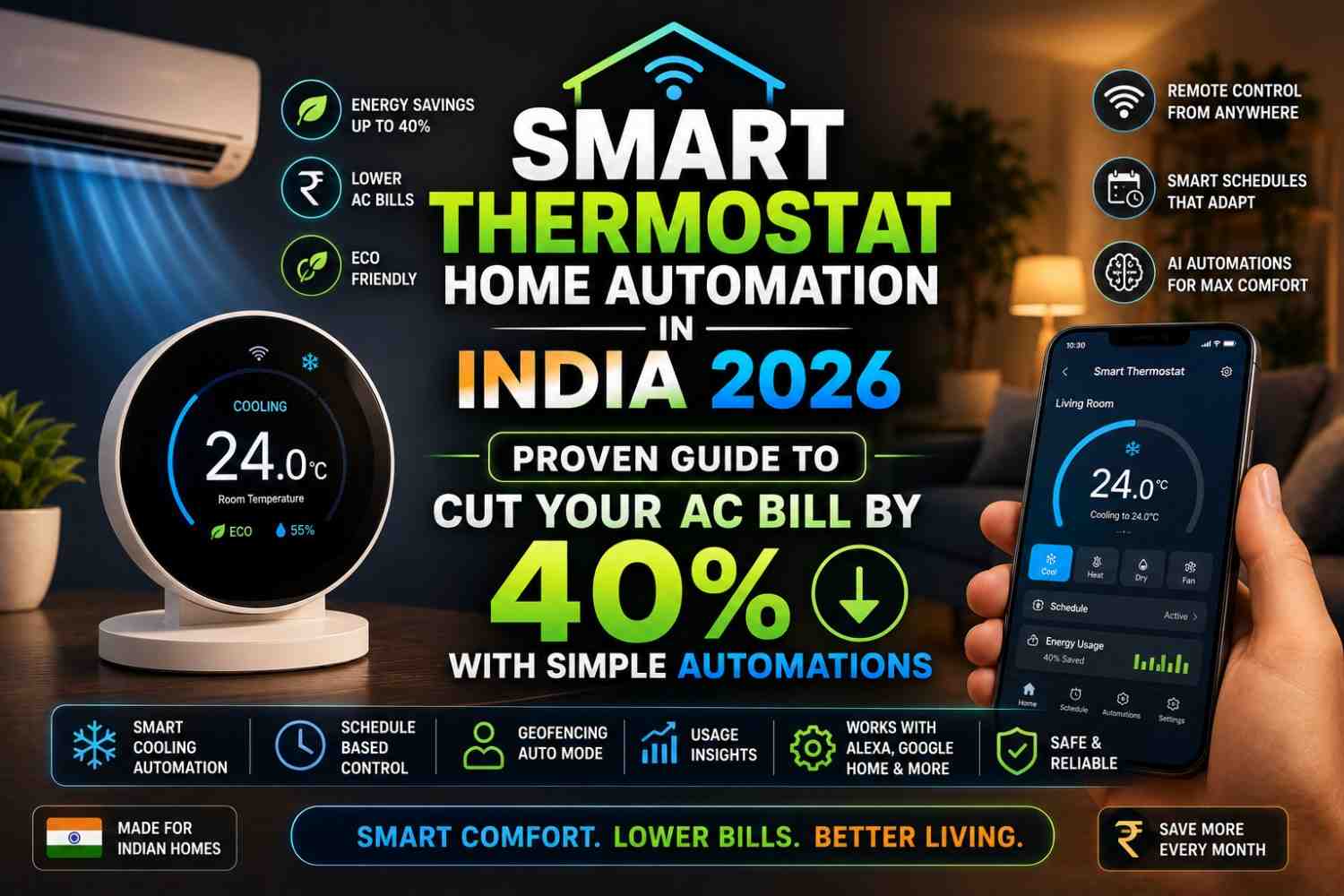
Air conditioning is the single largest electricity consumer in most Indian homes — often accounting for 40–60% of the entire monthly electricity bill. Smart thermostat home automation in India 2026 addresses this directly, using intelligent scheduling, occupancy detection, and predictive cooling to deliver the comfort you want at a fraction of the cost.
The good news about smart thermostat home automation India 2026 is that you don’t necessarily need to replace your existing AC. In 2026, a range of smart controllers — starting from just ₹2,000 — can make your current non-smart air conditioner fully automatable, schedulable, and voice-controllable. And for those buying new ACs, India’s top brands now offer built-in Wi-Fi and app control as standard.
This complete guide covers every aspect of smart thermostat home automation in India 2026—from choosing the right smart AC solution for your home to setting up the specific automations that have been proven to cut electricity bills by up to 40%.
https://sensibo.com/products/sensibo-sky — Sensibo Sky Official Product Page
The AC Electricity Problem in Indian Homes
Before exploring smart thermostat home automation India 2026 solutions, it’s important to understand the scale of the problem.
Average Indian AC electricity consumption facts:
- A 1.5-ton split AC running at 24°C for 8 hours/day uses approximately 7–10 kWh per day
- At ₹8/unit (average Indian electricity rate), that’s ₹56–₹80 per day or ₹1,680–₹2,400 per month per AC unit
- A home with two AC units running through summer = ₹3,360–₹4,800/month in AC costs alone
The waste factors:
- ACs left running in empty rooms (nobody home, guest room occupied temporarily)
- Temperature set too low (18°C feels cooler but costs far more than 24°C)
- ACs running through the night at full power when body temperature drops during sleep
- ACs cooling rooms before occupants arrive
Smart thermostat home automation in India 2026 addresses every one of these waste factors systematically.
https://www.voltas.com/smart-ac — Voltas Smart Air Conditioners India
Smart AC Options in India 2026: What Are Your Choices?
Smart thermostat home automation India 2026 implementations fall into three categories based on your existing setup:
Option A: Smart AC Controller (For Existing Non-Smart ACs)
A smart IR controller retrofits any AC with a remote control into a Wi-Fi-connected smart AC — without any wiring or hardware replacement.
Best smart AC controllers for smart home automation in India, 2026:
- Sensibo Sky — ₹5,999. Best-in-class. The Climate React feature auto-adjusts the AC based on the room temperature sensor. Works with Google Home, Alexa, and Apple Home.
- Cielo Breez Eco — ₹2,799. Excellent value. Supports all major Indian AC brands. Location-based control.
- Broadlink RM4 Mini — ₹1,799. Budget option. Controls AC + other IR devices. Works with Alexa and Google Home.
- Tado Smart AC Control — ₹6,499. Premium option with geofencing and detailed energy reports.
Option B: Wi-Fi-Enabled AC (New Purchase)
If buying a new AC, choose one with built-in Wi-Fi for native smart thermostat home automation in India 2026 capability:
- Daikin FTKF Series (2025–26) — Wi-Fi built-in, works with Daikin app + Google Home
- LG Dual Inverter Wi-Fi Series—ThinQ app, works with Google Home and Alexa
- Voltas Adjust Inverter Wi-Fi — Voltas SmartHome app, India-specific features
- Panasonic NanoeX Wi-Fi — Panasonic Comfort Cloud app, energy monitoring built-in
Option C: Smart Thermostat (For Ducted/Central Systems)
For homes with ducted central air conditioning — more common in premium apartments and villas:
- Honeywell Home T6 Pro — Compatible with Indian systems, supports Google Home
- ecobee SmartThermostat—Best energy savings AI, room sensor included
https://www.bee.gov.in/star-rating-ac — BEE India: AC Star Ratings and Energy Efficienc
10 Automations That Cut AC Bills by Up to 40%
These are the specific smart thermostat home automation India 2026 automations that deliver the biggest electricity savings:
Automation 1 — Geofencing Away Mode
The single most impactful automation in smart thermostat home automation in India in 2026:
How it works:
- When the last household member’s phone leaves a GPS geofence around the home (typically 500m radius), the AC turns off automatically
- When the first household member’s phone enters the geofence on return, AC switches on to pre-cool the home
Savings: Eliminates AC running in an empty home. In a household where the AC was previously left on for 3 hours daily while unoccupied, this saves ₹500–₹700/month per AC unit.
Setup: Sensibo Sky, Cielo Breez, or Tado all have built-in geofencing. In Google Home or Alexa, use location-based routines with a smart plug on the AC.
Automation 2 — Sleep Mode Temperature Ramp
A health and savings combination unique to smart thermostat home automation in India in 2026:
How it works:
- At bedtime, AC is set to 24°C
- After 2 hours (when deep sleep reduces body heat generation), temperature automatically rises to 26°C
- At 5 AM (as body temperature naturally rises before waking), temperature drops back to 24°C
Why it works: Your body temperature drops during deep sleep, meaning you need less cooling. Raising the thermostat by 2°C during peak sleep hours reduces consumption by 12–15%.
Savings: ₹200–₹400/month per bedroom AC
Automation 3—Climate React (Temperature-Sensor Driven)
One of the most intelligent features of smart thermostat home automation in India 2026—available on Sensibo Sky and Cielo Breez:
How it works:
- A built-in or paired room-temperature sensor monitors actual room temperature
- AC turns on when room temperature rises above 28°C (adjustable)
- AC turns off when room temperature drops below 24°C (adjustable)
- The system manages temperature within a comfortable band automatically
Result: The AC runs only when genuinely needed — not continuously. Average daily runtime reduces by 25–35%.
Savings: ₹600–₹1,200/month per AC unit
Automation 4 — Pre-Cooling Before Arrival
A comfort-maximizing automation for smart thermostat home automation in India in 2026 that also saves money:
How it works:
- AC switches on 30 minutes before you’re predicted to arrive home (based on calendar or geofence approach detection)
- This allows the room to pre-cool with the AC at maximum efficiency (AC works most efficiently when cooling a significantly warm room)
- When you arrive, the room is already comfortable
Why it saves money: Starting the AC 30 minutes before arrival at 24°C is cheaper than arriving to a 38°C room and running the AC at 18°C for an hour in a panic.
Automation 5 — Weekend vs Weekday AC Schedule
A simple but effective automation for smart thermostat home automation in India in 2026 that many households don’t think to create:
Weekday schedule:
- AC on in bedroom from 10:30 PM to 6:30 AM
- AC off when everyone leaves for work (8:30 AM)
- AC on in living room from 5:30 PM (pre-arrival) to 10 PM
Weekend schedule:
- AC on in living room from 10 AM to 2 PM and 5 PM to 11 PM
- AC on in bedroom from 11 PM to 7:30 AM
Savings vs always-on: ₹800–₹1,500/month from eliminating unscheduled and unnecessary runtime
Automation 6 — Motion-Based Room Occupancy Control
A powerful but often overlooked component of smart thermostat home automation in India in 2026:
How it works:
- A motion sensor in each AC-equipped room monitors occupancy
- If no motion is detected for 20 minutes, AC temperature rises by 2°C (comfort maintained, consumption reduced)
- If no motion detected for 45 minutes, AC switches off
- When motion is detected again, AC resumes at previous settings
Devices needed: Motion sensor (₹600–₹1,500) + smart AC controller or smart plug
Savings: Eliminates AC running in unoccupied rooms — one of the highest-waste scenarios in Indian homes.
Automation 7 — Window Open Detection Auto-Shutoff
A simple logic-based automation essential to smart thermostat home automation in India in 2026:
How it works:
- A door/window sensor on the AC room’s window detects when the window is opened
- Immediately sends a push notification: “Window open — AC switched off”
- AC turns off (via smart plug or smart controller)
- When window closes, AC resumes after 3-minute delay
Why it matters: Running the AC with windows open wastes 100% of cooling energy. This automation prevents a common but extremely costly habit.
Devices needed: Window sensor (₹599–₹899) + smart AC controller
Automation 8 — AC Electricity Usage Monitoring and Alerts
An awareness-driving component of smart thermostat home automation India 2026:
How it works:
- Smart plug with energy monitoring (TP-Link Tapo P115, ₹1,299) on your AC socket
- Tracks daily, weekly, and monthly kWh consumption
- Sends daily summary: “Your AC used 8.4 kWh today — ₹67. Monthly total: ₹1,240.”
- Alerts when daily usage exceeds a set threshold
Result: Simply knowing the real-time cost of AC usage changes behavior. Most families reduce AC runtime by 15–20% within the first month of monitoring.
Automation 9 — Humidity-Based Comfort Adjustment
An advanced implementation of smart thermostat home automation in India in 2026, especially relevant during the Indian monsoon season:
How it works:
- A smart humidity sensor monitors room humidity
- In high humidity (above 70%), AC switches to Dry Mode automatically — removing moisture efficiently at lower power
- In low humidity (below 40%, common in AC-cooled rooms), a humidifier smart plug is triggered to maintain comfort
Devices needed: Smart temperature/humidity sensor (₹799–₹1,499) + Sensibo Sky or Cielo Breez (supports mode switching)
Automation 10 — Peak Electricity Hour Power Reduction
A bill-conscious automation aligned with smart thermostat home automation India 2026 best practices for TOU (time-of-use) electricity tariffs:
How it works:
- During peak billing hours (6 PM–10 PM in most Indian states), AC temperature automatically rises from 24°C to 26°C
- During off-peak hours (10 PM–6 AM), AC operates at preferred temperature
- Results in lower electricity consumption during the most expensive billing window
Savings: ₹300–₹600/month depending on tariff structure
Total Savings Summary
| Automation | Monthly Saving (Est.) |
|---|---|
| Geofencing Away Mode | ₹500–₹700 |
| Sleep Mode Ramp | ₹200–₹400 |
| Climate Reaction | ₹600–₹1,200 |
| Weekend/Weekday Schedule | ₹800–₹1,500 |
| Motion-Based Occupancy | ₹400–₹800 |
| Window Open Detection | ₹200–₹400 |
| Usage Monitoring (behaviour change) | ₹300–₹600 |
| Total Combined Saving | ₹3,000–₹5,600/month |
On a typical ₹8,000–₹12,000 summer AC bill, this represents 35–45% savings — fully justifying the investment in smart thermostat home automation India 2026 hardware within 1–2 months.
FAQs: Smart Thermostat Home Automation India 2026
Q1: Do I need to replace my AC for smart thermostat home automation in India in 2026? A: No. A smart IR controller like Sensibo Sky (₹5,999) or Cielo Breez Eco (₹2,799) retrofits any existing AC with a remote control into a fully smart, app-controlled, automatable system.
Q2: Which smart AC controller is best for smart thermostat home automation in India 2026? A: Sensibo Sky is the premium recommendation—it has a built-in temperature sensor, Climate React automation, geofencing, and excellent Google Home and Alexa integration. For budget users, Cielo Breez Eco at ₹2,799 is excellent value.
Q3: Can smart thermostat home automation in India in 2026 work with all Indian AC brands? A: Yes. IR-based smart controllers like Broadlink RM4 and Sensibo Sky support virtually all Indian AC brands, including Voltas, Daikin, LG, Samsung, Hitachi, Blue Star, Carrier, and Lloyd—as long as they have a remote control.
Q4: Is 26°C really comfortable enough for sleeping in Indian summers? A: With a ceiling fan running alongside the AC, 26°C feels equivalent to 23–24°C in still air. The fan circulates cool air and creates a wind-chill effect. Using AC at 26°C + fan is one of the most effective smart thermostat home automation India 2026 strategies for combined comfort and savings.
Q5: How long does it take to recover the investment in smart thermostat home automation in India in 2026? A: A Cielo Breez Eco at ₹2,799 with geofencing and scheduling typically saves ₹2,000–₹3,000 in the first summer month alone—paying for itself within 4–6 weeks of purchase.
Conclusion
Smart thermostat home automation India 2026 is the highest-ROI smart home investment available for Indian households. No other category of automation cuts costs as fast, as significantly, or as automatically as intelligent AC control. With devices starting at ₹1,799 and potential monthly savings of ₹3,000–₹5,600, smart thermostat home automation in India in 2026 pays for itself faster than almost any other home improvement investment.
The 10 automations in this guide—from geofencing to climate reaction to sleep mode temperature ramping—can be implemented gradually, one at a time, until your AC operates at maximum efficiency year-round.
Start with one smart AC controller today, set up the geofencing automation this weekend, and watch your electricity bill drop from the very first month!