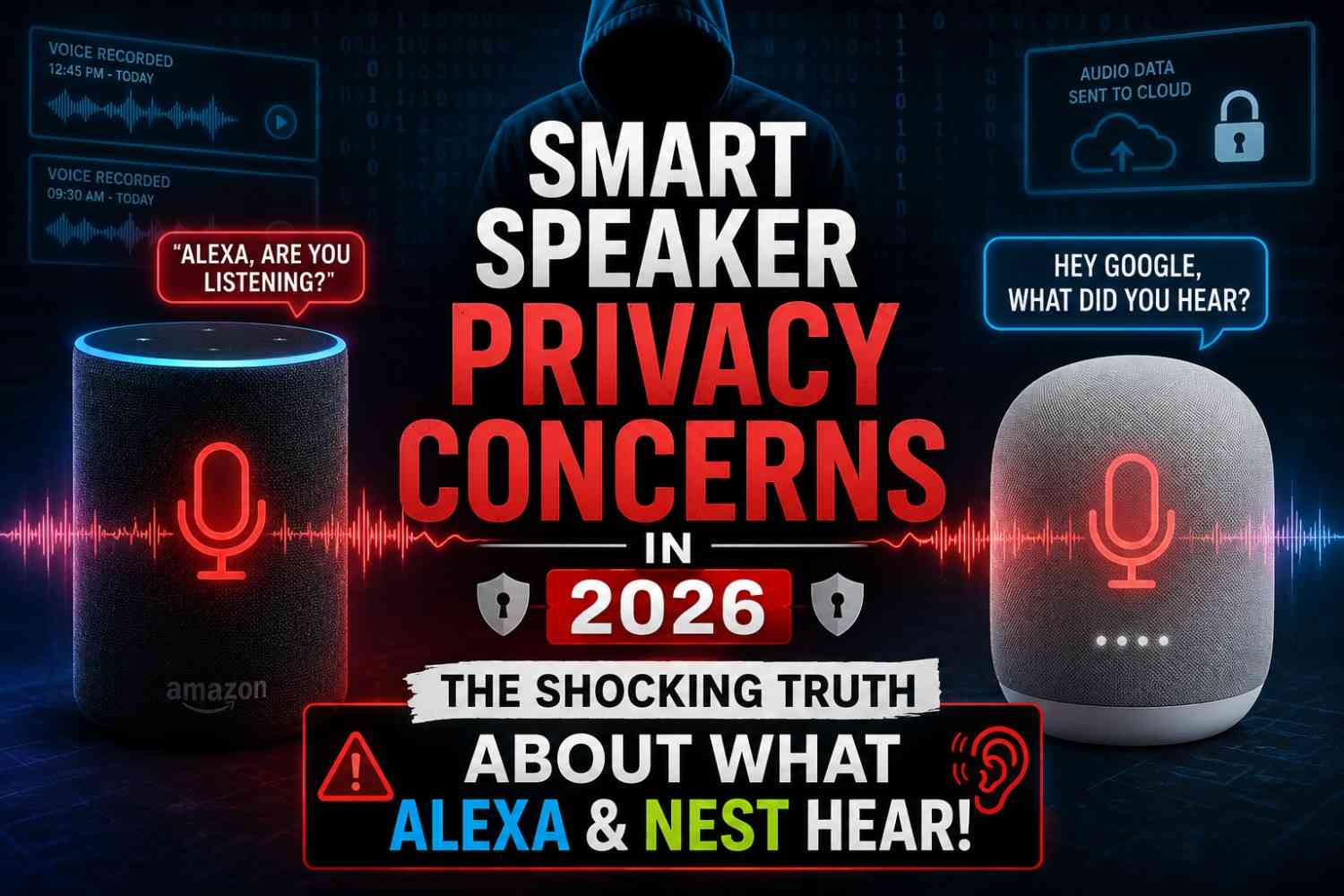
You placed a small, always-powered microphone in your bedroom. In your living room. In your kitchen. And you talk to it every day.
That is what a smart speaker is—and smart speaker privacy concerns in 2026 are not paranoid conspiracy theories. They are legitimate, documented, and increasingly important as these devices become central to modern homes.
This guide gives you the honest, complete, research-backed truth about smart speaker privacy in 2026. What these devices actually hear. What companies do with that data. What the genuine risks are. And—critically—exactly what you can do to protect yourself without throwing your smart speaker in the bin.
The Core Question: Are Smart Speakers Always Listening?
This is the central question in every smart speaker privacy concerns 2026 discussion—and the answer is nuanced.
Technically, yes. Practically: Only for wake words.
All smart speakers—Amazon Echo (Alexa), Google Nest (Google Assistant), and Apple HomePod (Siri)—are designed to continuously process the audio in your room at a local level, listening for their specific wake words (“Alexa,” “Hey Google,” and “Hey Siri”).
This local audio processing happens entirely on the device’s own chip. The audio is NOT sent to the cloud or stored anywhere — it is processed and immediately discarded if no wake word is detected.
When a wake word IS detected:
- The speaker begins recording
- Audio is sent to the company’s cloud servers
- The command is processed and a response is returned
- A brief “wake word confirmation” audio snippet may be retained for quality review
This is the intended design. The smart speaker privacy concerns of 2026 emerge from how well this design actually works in practice—and from what happens to the recordings that ARE sent to the cloud.
Documented Privacy Issues: What Has Actually Happened
These are not hypothetical concerns. These are documented incidents that form the factual basis of smart speaker privacy concerns in 2026:
1. False Wake Word Activations — The “Always Recording” Problem
Multiple independent studies have demonstrated that smart speakers activate on false wake words — words or sounds that the device mistakenly interprets as its wake word.
A 2020 Northeastern University and Imperial College London study found that smart speakers were falsely activated up to 19 times per day on average. Words like “election” can trigger Alexa; “OK Boomer” can activate Google Home.
During these false activations, audio IS recorded and sent to cloud servers—including private conversations that were never intended to be heard.
This is the most significant verified smart speaker privacy concern in 2026.
2. Human Review of Voice Recordings — Confirmed by All Companies
In 2019, Bloomberg reported that Amazon employed thousands of workers worldwide to listen to and annotate Alexa voice recordings to improve the AI’s accuracy. The workers could hear highly personal conversations, including medical discussions, arguments, and intimate moments.
Apple, Google, and Facebook (Portal) were subsequently confirmed to have similar human review programs.
Following public backlash, all major companies introduced opt-out options for human review — but these must be actively enabled by the user. The default setting still allows some form of review.
In 2026, human review programs continue—though companies state they use smaller samples and stricter consent mechanisms.
3. Third-Party Skill/App Data Access
When you enable third-party skills on Alexa (or Actions on Google), those third parties receive the audio data related to their skill’s activation.
A 2019 Security Research Labs study created proof-of-concept malicious Alexa skills and Google Actions that:
- Continued listening after the user thought the interaction had ended
- Phished users for passwords by mimicking the official assistant’s voice
While Amazon and Google removed these specific examples and added safeguards, the vulnerability class persists—and is a legitimate smart speaker privacy concern in 2026 for users who enable many third-party skills.
4. Smart Speaker Data in Legal Proceedings
Amazon Alexa recordings have been subpoenaed as evidence in multiple criminal cases in the United States. In 2017, an Arkansas murder case became the first high-profile instance of prosecutors seeking Alexa recordings from a defendant’s home.
What this means practically: Everything recorded by your smart speaker is potentially accessible by law enforcement with a court order — regardless of what the company’s privacy policy says about your data.
5. Shared Household Data Concerns
Smart speakers in family homes create a specific privacy issue: conversations involving children, guests, and household members who never consented to recording are nonetheless captured.
This is particularly relevant to smart speaker privacy concerns in 2026 in Indian family contexts—large joint families, live-in domestic staff, and multi-generational households mean more unconsenting voices are captured near always-on smart speakers.
What Data Do Smart Speaker Companies Actually Collect?
Amazon Alexa Data Collection (2026):
- Voice command recordings (retained until manually deleted or auto-deletion enabled)
- Device usage patterns and timing
- Smart home device interaction data
- Shopping history and purchasing behaviour (significant for Amazon’s business model)
- Location data
- Associated account data across Amazon ecosystem (Prime, shopping, Fire TV)
Amazon’s business model motivation: Amazon is first and foremost a retail and advertising company. Alexa data informs product recommendations, advertising targeting, and consumption pattern analysis.
Google Assistant / Nest Data Collection (2026):
- Voice command recordings
- Search queries via voice
- Location and home context data
- Routine and scheduling patterns
- Integration with the vast Google data ecosystem (Gmail, Search, Maps, YouTube)
Google’s business model motivation: Google is an advertising company. Voice interaction data feeds into the world’s most comprehensive consumer behavior profile system.
Apple Siri / HomePod Data Collection (2026):
- Voice commands processed with on-device anonymisation
- Requests linked to a random identifier, NOT your Apple ID
- Apple does not use Siri data for advertising
- On-device processing for many commands (reduces cloud transmission)
Apple’s positioning: Apple has consistently and loudly positioned privacy as a core product value. HomePod and Siri have the best privacy track record of the major smart speaker platforms — though they also have the smallest market share and fewest third-party integrations.
The Microphone Mute Button: Your Most Important Control
Every major smart speaker has a physical microphone mute button. When engaged:
- The microphone circuit is physically disconnected (not just software-disabled)
- No audio can be processed or transmitted
- The speaker cannot respond to voice commands
- It CAN still respond to physical button presses
When to use the mute button:
- During sensitive conversations (medical, financial, legal, personal)
- During arguments or emotionally charged discussions
- When hosting guests who haven’t consented to recording
- During intimate moments
- During business calls or sensitive work discussions at home
The physical mute button is the strongest privacy protection available and the single most important recommendation in any smart speaker privacy concerns guide for 2026.
10 Proven Steps to Protect Your Smart Speaker Privacy in 2026
Step 1: Enable Auto-Delete for Voice History
Alexa: Alexa app → Settings → Alexa Privacy → Manage Your Alexa Data → Choose Your History → Set to auto-delete after 3 or 18 months (or delete manually)
Google: Google Home app → Google Account → Data & Privacy → Web & App Activity → Auto-delete (choose 3, 18, or 36 months)
Best practice: Set to 3-month auto-delete and manually delete sensitive recordings immediately after they occur.
Step 2: Opt Out of Human Voice Review
Alexa: Alexa Privacy Settings → “Help improve Alexa” → Turn OFF
Google: Google Account → Data & Privacy → Web & App Activity → “Include voice and audio activity.” → Turn OFF
Step 3: Review and Delete Existing Voice History Regularly
Alexa: alexa.amazon.in → Settings → Alexa Privacy → Review Voice History → Delete all
Google: myactivity.google.com → Filter by “Voice and Audio” → Delete all
Do this monthly as part of your digital hygiene routine.
Step 4: Audit Third-Party Skills and Actions
Alexa: Alexa app → Skills & Games → Manage your skills → Review and disable any you don’t actively use
Google: assistant.google.com → Settings → Assistant → Explore → Linked services → Review
Remove any skills you didn’t intentionally install or no longer use. Be especially cautious with any skill that claims to extend listening for interactive sessions.
Step 5: Disable Personalised Advertising
Amazon: amazon.in → Account → Advertising Preferences → Opt out of interest-based ads
Google: Google Account → Data & Privacy → “Personalise your Google experience” → Turn off ad personalisation
Step 6: Use Guest Mode When Hosting Visitors
Google Nest devices offer a “Guest Mode” that prevents commands from being linked to your account. Alexa has a “Guest Connect” feature. Use these when hosting people who haven’t consented to having their voice recorded.
Step 7: Position Speakers Thoughtfully
Never place smart speakers in:
- Bedrooms (highest risk of intimate conversation capture)
- Home offices (business-sensitive conversations)
- Children’s rooms (heightened protection for minors)
Best positions: Living room or kitchen where conversations are more casual and less sensitive. Keep speakers away from the front door (captures conversations of people entering/leaving who haven’t consented).
Step 8: Create Strong Unique Passwords for Your Smart Speaker Account
If your Amazon or Google account is compromised, an attacker gains access to your entire voice history. Use a strong, unique password and enable two-factor authentication.
Step 9: Keep Firmware Updated
Smart speaker manufacturers regularly release firmware updates that patch security vulnerabilities. Ensure automatic updates are enabled to stay protected against the latest discovered exploits.
Step 10: Consider Local-Processing Alternatives
For users with serious smart speaker privacy concerns in 2026, consider platforms that process voice commands locally without cloud transmission:
Home Assistant with local voice processing: Using tools like Whisper (speech-to-text), Piper (text-to-speech), and OpenWakeWord running locally on a Raspberry Pi or Home Assistant hardware, you can build a fully local voice assistant that sends zero audio to any external server.
This is a more technical solution but is increasingly accessible in 2026 and represents the gold standard of smart speaker privacy.
Smart Speaker Privacy: A Platform Comparison
| Platform | Cloud Recordings | Human Review | Advertising Use | On-Device Processing | Privacy Rating |
|---|---|---|---|---|---|
| Amazon Alexa | Yes | Opt-out | Yes (core business) | Limited | ⭐⭐ |
| Google Assistant | Yes | Opt-out | Yes (core business) | Moderate | ⭐⭐½ |
| Apple Siri / HomePod | Yes (anonymised) | Opt-out | No | Extensive | ⭐⭐⭐⭐ |
| Home Assistant (local) | No | N/A | No | 100% | ⭐⭐⭐⭐⭐ |
The Privacy vs Convenience Trade-Off
The honest truth about smart speaker privacy concerns in 2026 is that these devices involve an inherent trade-off:
You get: Convenience, voice control, smart home integration, information access, music control, reminders, timers, hands-free utility
You give: Some degree of audio monitoring, behavioral data, and interaction history to a large technology corporation
For most users, this trade-off is acceptable when they understand it clearly and implement basic privacy controls. For others—particularly those in high-sensitivity professions (lawyers, doctors, journalists, and government officials)—the risks outweigh the benefits.
The key is informed choice — understanding exactly what the trade-off involves and making the decision consciously, not by default.
📷 Image Suggestion 1:
Placement: After the “False Wake Word” section Description: Close-up of Amazon Echo microphone mute button glowing red—clearly showing the physical mute function engaged. ALT Text: “smart speaker privacy concerns 2026—Echo microphone mute button engaged for privacy protection.”
📷 Image Suggestion 2:
Placement: After the 10-step protection guide Description: Screenshot montage of Alexa Privacy Settings and Google Activity Dashboard showing voice history deletion options ALT Text: “smart speaker privacy concerns 2026—Alexa privacy settings and Google voice history deletion dashboard”
Authority External Resources
- Electronic Frontier Foundation — Smart Speaker Privacy — The world’s leading digital rights organization with comprehensive smart speaker privacy research.
- Security Research Labs — Voice Assistant Vulnerabilities — Independent security research lab that exposed multiple smart speaker vulnerabilities.
- Privacy International — Consumer IoT Privacy — International privacy rights organization with IoT device privacy research.
- ENISA — Smart Home Security Guidelines — European Union Agency for Cybersecurity with smart home device security guidelines.
- Mozilla Foundation — Privacy Not Included Smart Speakers — Independent product privacy analysis including all major smart speaker brands.
FAQs: Smart Speaker Privacy Concerns 2026
Q1. Can smart speakers hear my conversations even when I haven’t said the wake word? By design, no. Smart speakers process audio locally for wake word detection only and do not transmit audio unless triggered. However, false wake word activations (which happen more often than most people realize—up to 19 times daily in independent studies) do cause unintended recording. The physical mute button, when activated, genuinely prevents any audio processing or transmission.
Q2. Can hackers access my smart speaker’s microphone remotely? Documented vulnerabilities have existed—particularly through malicious third-party skills and, historically, through Bluetooth proximity attacks. Keeping firmware updated, using strong account passwords with two-factor authentication, and auditing third-party skills significantly reduces this risk. Unplugging or muting when not in use provides the strongest protection.
Q3. Are children’s conversations recorded by smart speakers? Yes, if children speak near an active smart speaker, their voices may be captured during both intended interactions and false activations. In the US, COPPA (Children’s Online Privacy Protection Act) provides some protection. India lacks equivalent legislation in 2026. Parents concerned about children’s privacy should keep smart speakers out of children’s rooms and use the mute button during family time.
Q4. Which smart speaker platform has the best privacy record? Apple HomePod with Siri has the strongest privacy track record—processing more commands on-device, anonymizing data with random identifiers rather than linking to Apple ID, and having no advertising business model that benefits from detailed behavioral profiling. For complete privacy, Home Assistant with local voice processing (no cloud at all) is the only fully private solution.
Q5. Should I be worried about smart speakers in India specifically? India’s Personal Data Protection Act (DPDPA 2023) provides some framework for data privacy, but enforcement is still evolving. Indian users’ voice data is largely processed on servers in the US and Europe, subject to those jurisdictions’ laws. The practical risks for most Indian users are similar to anywhere—primarily false activation recordings and behavioral data use for advertising. Implementing the privacy steps in this guide provides effective protection.
Conclusion
Smart speaker privacy concerns in 2026 are real, documented, and deserve serious consideration—but they are also manageable.
Your Echo or Nest is not a surveillance device in the sinister sense. It is a convenience device that, like most modern technology, collects more data than most users realize and offers more privacy control than most users utilize.
The answer is not to avoid smart speakers entirely — it is to use them with informed awareness. Enable auto-delete. Opt out of human review. Mute during sensitive conversations. Audit your skills. Position your device thoughtfully.
Privacy and convenience can coexist—but only if you actively choose privacy rather than passively accepting defaults. Take control of your smart speaker today.