
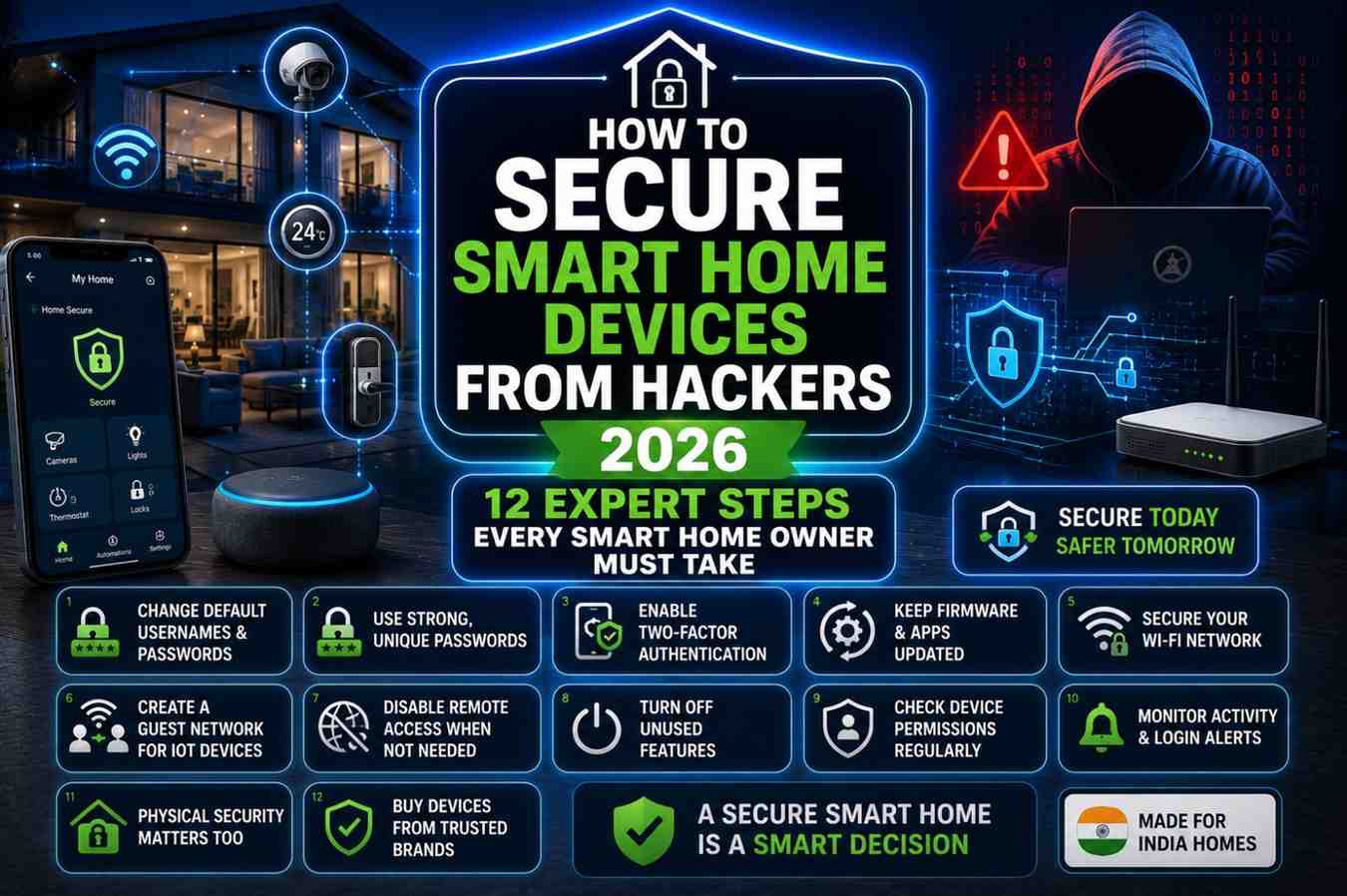
Knowing how to secure smart home devices from hackers in 2026 is no longer optional—it is the digital equivalent of locking your front door. With over 23 billion IoT devices expected to be active globally this year, and India’s smart home market crossing ₹9,000 crore, hackers are targeting home networks with unprecedented sophistication. This guide gives you 12 battle-tested, expert steps to lock them out for good.
The phrase “smart home” has become synonymous with convenience—but without the right protections, it can also become synonymous with vulnerability. From smart TVs and baby monitors to Wi-Fi doorbells and AI speakers, every connected device is a potential entry point. Understanding how to secure smart home devices from hackers in 2026 means understanding that your home network is now as important to protect as your bank account.
According to CERT-In, India’s national cybersecurity agency, IoT-related cyber incidents in Indian households rose by 62% in 2025 alone. The methods hackers use to compromise smart devices—credential stuffing, firmware exploits, man-in-the-middle attacks, and rogue Wi-Fi injection—are growing more accessible every year. The good news: knowing how to secure smart home devices from hackers in 2026, as security professionals teach, means most of these attacks can be defeated with consistent, layered practices.
Why Hackers Target Smart Home Devices in 2026
Before diving into solutions, it helps to understand the threat. Hackers target smart home devices not always to steal your personal data directly — though that happens — but increasingly to enlist your devices into botnets, use your IP address for anonymous criminal activity, access your home camera feeds, or pivot into your phone, laptop, or banking apps through your shared home network. This is why learning how to secure smart home devices from hackers in 2026 means thinking about your network holistically, not device by device.
⚠️ India-Specific Threat Alert 2026 Indian smart home users are disproportionately targeted because many purchase low-cost, unbranded IoT devices from domestic online marketplaces. These devices often ship with hardcoded default credentials, no automatic firmware updates, and zero encryption—making them trivial to compromise. Knowing how to secure smart home devices from hackers in 2026 in India specifically requires addressing this hardware vulnerability first.
12 Expert Steps: How to Secure Smart Home Devices From Hackers 2026
Step 1 — Change Every Default Password Immediately
Factory default credentials like “admin/admin” are published in publicly searchable databases. The very first step in how to secure smart home devices from hackers in 2026 is replacing every default password with a unique, 16+ character passphrase on every single device in your home. Use a password manager like Bitwarden—it is free and generates uncrackable credentials.
Step 2 — Create a Separate IoT Network (VLAN or Guest Wi-Fi)
Never put your smart home devices on the same network as your phone or laptop. Segment your network — your smart bulbs should never be able to “talk” to your banking apps. This network isolation is the most structurally important step in how to secure smart home devices from hackers in 2026 that network architects universally recommend.
Step 3 — Enable Automatic Firmware Updates
Outdated firmware is the number-one exploited vulnerability in IoT attacks. Enable auto-updates on every device and manually check for updates monthly on devices that don’t support auto-patching. This is critical for how to secure smart home devices from hackers in 2026—most major exploits target known, already-patched vulnerabilities that users simply haven’t updated.
Step 4 — Use WPA3 Encryption on Your Router
WPA2 is now considered crackable with modern hardware. Upgrade to a WPA3-capable router and enable it in your router’s wireless settings. This is the network-layer foundation of how to secure smart home devices from hackers in 2026, experts insist upon. WPA3 provides individualized data encryption even on shared networks.
Step 5 — Enable Two-Factor Authentication on All Apps
Every smart home app — from Tuya to Google Home to Amazon Alexa — should have 2FA enabled. This prevents account takeover even if your password is leaked in a data breach. 2FA is non-negotiable in how to secure smart home devices from hackers in 2026 mobile security.
Step 6 — Disable UPnP on Your Router
Universal Plug and Play (UPnP) automatically opens router ports without your knowledge. Hackers exploit these open ports to access devices remotely. Disabling UPnP is a quick win in how to secure smart home devices from hackers in 2026 that takes under 2 minutes in your router admin panel and closes a significant attack surface immediately.
Step 7 — Buy Devices Only from Reputable, Security-Committed Brands
In India’s market, cheap no-name smart plugs and cameras are security nightmares. Brands like TP-Link, Xiaomi (Mi Home), Philips Hue, and Google Nest have dedicated security teams and published CVE response processes. Brand reputation is central to how to secure smart home devices from hackers in 2026 in India.
Step 8 — Regularly Audit Which Devices Are on Your Network
Use your router’s connected device list monthly. Any unrecognized device is a potential breach. Free apps like Fing make this easy with a single tap. Regular auditing is a discipline—not a one-time task—in how to secure smart home devices from hackers in 2026.
Step 9 — Disable Remote Access When Not Needed
Many devices expose remote management ports even when you never use them. Turn off remote access in each device’s settings unless it is actively required. This reduces your attack surface dramatically and is a key pillar of how to secure smart home devices from hackers in 2026.
Step 10—Use a DNS Filtering Service (NextDNS or Cloudflare 1.1.1.3)
DNS-level filtering blocks known malicious domains before your devices can even connect to them. NextDNS offers a generous free tier that is transformative for household IoT security—a powerful and underused layer in how to secure smart home devices from hackers in 2026.
Step 11 — Review App Permissions Aggressively
Your smart home app probably requests access to your contacts, location, and microphone—permissions it doesn’t need. Strip these back to the minimum required. Unnecessary permissions are backdoors hackers exploit. This is essential in how to secure smart home devices from hackers’ 2026 mobile security hygiene.
Step 12 — Physically Secure Your Router
A hacker with physical access to your router can reset it, install malicious firmware, or clone your network. Keep your router in a locked or non-public space, and disable its WPS button, a notorious vulnerability. This is the final physical layer in how to secure smart home devices from hackers in 2026 that is most often overlooked.
The Best Router for Smart Home Security in India, 2026
Choosing the right router is foundational to how to secure smart home devices from hackers in 2026. Look for routers with built-in firewall management, VLAN/guest network support, automatic security patching, and IoT device isolation features. The TP-Link Deco XE75 Pro, ASUS ZenWiFi Pro ET12, and Netgear Orbi RBK863S are the top three picks recommended by Indian cybersecurity professionals for 2026 smart home security builds.
✅ Quick Security Score Card If you can check all 12 steps above, your smart home security posture is in the top 5% of Indian households. How to secure smart home devices from hackers in 2026 doesn’t require being a technologist—it requires being methodical. Even completing steps 1, 2, 4, and 5 puts you dramatically ahead of the average home network in India today.
Frequently Asked Questions
Q1. Can my smart TV be hacked in India? Yes. Smart TVs are among the most commonly compromised devices. Learning how to secure smart home devices from hackers in 2026 means treating your smart TV like a computer—update its firmware, disable its microphone when not in use, and place it on a segmented IoT network separate from your personal devices.
Q2. Is my smart home camera being watched by hackers? If you use default passwords and haven’t updated firmware, the risk is real. How to secure smart home devices from hackers in 2026: camera-specific advice: always change the default password, use end-to-end encrypted cloud storage, and buy cameras from brands with published security response policies.
Q3. Does a VPN protect my smart home? A router-level VPN adds a useful privacy layer, but it is not a complete solution for how to secure smart home devices from hackers in 2026. VPNs don’t fix weak passwords, outdated firmware, or compromised device software. Treat it as one layer of a multi-layer defense strategy.
Q4. Which Indian smart home brands have the best security? For how to secure smart home devices from hackers in 2026 in India, prioritize brands with published CVE response processes: TP-Link, Xiaomi/Mi, Philips, Havells IoT, and Schneider Electric’s Wiser platform all meet this bar and publish security advisories.
Q5. How often should I change my smart home passwords? Every 6–12 months, and immediately after any reported data breach involving your device brand. How to secure smart home devices from hackers: 2026 password hygiene includes using a password manager to generate and store complex, unique passwords for every single device on your network.
Conclusion
Knowing how to secure smart home devices from hackers in 2026 is the most important tech skill a modern Indian homeowner can develop. The threat landscape is evolving rapidly — but so are the tools and techniques available to ordinary users. You don’t need to be a cybersecurity expert. You need to be consistent.
Work through these 12 steps methodically, and you will have a smart home that is genuinely difficult to breach. How to secure smart home devices from hackers in 2026 is ultimately about eliminating the easy wins that hackers depend on—because when your home is no longer the path of least resistance, they move on to easier targets. Start today, and start with Step 1.