If you’re serious about smart home automation, at some point you face the most important decision in the ecosystem: Home Assistant vs. Google Home vs. Alexa 2026—which platform deserves to be the brain of your home?
The Home Assistant vs. Google Home vs. Alexa 2026 debate isn’t new, but in 2026 it has changed significantly. Google has integrated Gemini AI into its routines. Amazon has launched Alexa+, a subscription-based advanced AI tier. And Home Assistant has made its biggest leap toward mainstream accessibility while retaining its legendary power-user depth.
This guide gives you the most honest, detailed Home Assistant vs. Google Home vs. Alexa 2026 comparison available—testing automation depth, device compatibility, offline capability, privacy, AI features, cost, and ease of use. By the end, you’ll have a definitive answer for your specific needs.
Why This Comparison Matters in 2026
The Home Assistant vs. Google Home vs. Alexa 2026 question matters more than ever because:
- The matter protocol has matured—all three platforms now support it, but to different depths
- AI integration has changed automation forever—but the implementations are wildly different
- Privacy concerns have made local control more attractive than ever
- Advanced users now demand multi-condition logic, variables, templates, and device state triggers that basic platforms historically couldn’t provide
- Cost has become a factor as Amazon moves some Alexa features behind a subscription
Understanding the full Home Assistant vs. Google Home vs. Alexa 2026 picture requires evaluating each platform across every dimension that matters.
Platform Overviews
Home Assistant — The Open-Source Powerhouse
In the Home Assistant vs. Google Home vs. Alexa 2026 debate, Home Assistant is the clear choice for technical users who want unlimited control.
Home Assistant is free, open-source software that runs on your local network — on a Raspberry Pi, an old PC, a NAS drive, or a dedicated Home Assistant Green or Yellow device. It has no monthly fee, no cloud dependency (unless you choose it), and no vendor lock-in.
2026 Key Developments:
- Home Assistant 2026 includes a rebuilt onboarding experience, making first-time setup significantly easier
- New local voice assistant (Wyoming Protocol) processes all voice commands on-device
- AI-powered automation suggestions using local LLM models (no data sent to external servers)
- Energy management dashboard integrates with solar systems and smart meters
- Expanded integration library now exceeds 3,200 integrations
Core Strengths in Home Assistant vs. Google Home vs. Alexa 2026:
- 100% local processing — no cloud, no privacy exposure
- Most powerful automation engine of the three
- No subscription fees — ever
- Supports Zigbee, Z-Wave, Wi-Fi, Bluetooth, Thread, Matter, KNX, Modbus — more protocols than any competitor
Home Assistant Official Getting Started Guide
Google Home — The Mainstream AI Leader
In the Home Assistant vs. Google Home vs. Alexa 2026 comparison, Google Home represents the best balance of power and accessibility for mainstream users.
2026 Key Developments:
- Gemini AI integration enables natural language routine creation (“Create a routine that turns on bedroom lights gradually when my alarm goes off on weekdays”)
- Multi-condition AND/OR logic in routines (previously only available in Home Assistant)
- Expanded local processing — more device controls now work without cloud
- Google Home app redesigned with a more intuitive Automations tab
- Matter hub functionality built into all Nest Hub devices
Core Strengths in Home Assistant vs. Google Home vs. Alexa 2026:
- Zero setup complexity — plug in a Nest device, install the app, done
- Best ecosystem for Android and Google service users
- Strongest natural language understanding in voice commands
- 50,000+ certified Works with Google Home devices
- Free — all features included, no subscription
Amazon Alexa — The Voice Control Pioneer
In the Home Assistant vs Google Home vs Alexa 2026 analysis, Alexa remains the undisputed leader in voice interaction breadth and has the largest device ecosystem of the three.
2026 Key Developments:
- Alexa+ subscription ($7.99/month) adds generative AI capabilities to routines and conversations
- “Hunches” AI proactively acts without being asked (auto-turns off forgotten lights)
- New Routines Graph feature visually maps complex automation flows
- Expanded Matter support across all Echo devices
- Alexa now processes basic routines locally on Echo hardware when internet is unavailable
Core Strengths in Home Assistant vs. Google Home vs. Alexa 2026:
- Largest device ecosystem — 100,000+ compatible devices
- Best for households with multiple Echo speakers
- Excellent for shopping, reordering, and Amazon Prime integration
- Strong in multi-room audio automation
Amazon Alexa Smart Home Official
[IMAGE 1 — Place after platform overviews]
Suggested Image: A three-column comparison poster showing Home Assistant, Google Home, and Alexa logos with their key strengths, weaknesses, and ideal user types listed below each. ALT Text: “Home Assistant vs Google Home vs Alexa 2026—comparison poster showing strengths, weaknesses, and ideal user for each platform”
Deep Comparison: Home Assistant vs Google Home vs Alexa 2026
1. Automation Depth
This is the most important battleground in Home Assistant vs Google Home vs Alexa 2026 for advanced users.
| Feature | Home Assistant | Google Home | Alexa |
|---|---|---|---|
| Multi-condition triggers | ✅ Full AND/OR/NOT | ✅ AND/OR (2026) | ⚠️ Limited |
| Custom variables in automations | ✅ Yes | ❌ No | ❌ No |
| Scripting/templates | ✅ Full Jinja2 templates | ❌ No | ❌ No |
| Device state triggers | ✅ Any device state | ✅ Most states | ✅ Most states |
| Time-based granularity | ✅ Second-level precision | ✅ Minute-level | ✅ Minute-level |
| Delay/wait actions in automations | ✅ Yes | ⚠️ Limited | ⚠️ Limited |
| AI-suggested automations | ✅ Local AI | ✅ Gemini | ✅ Hunches/Alexa+ |
Winner: Home Assistant — no contest for advanced automation complexity.
2. Device Compatibility
| Platform | Certified Devices | Protocols Supported |
|---|---|---|
| Home Assistant | 3,200+ integrations | Wi-Fi, Zigbee, Z-Wave, Thread, Matter, BLE, KNX, Modbus, MQTT |
| Google Home | 50,000+ devices | Wi-Fi, Thread, Matter, BLE |
| Amazon Alexa | 100,000+ devices | Wi-Fi, Thread, Matter, BLE, Zigbee (with Echo hub) |
Winner: Alexa for sheer device numbers. Home Assistant for protocol diversity and control depth.
3. Offline / Local Control
This dimension of Home Assistant vs. Google Home vs. Alexa 2026 is increasingly critical for reliability.
| Platform | Offline Capability |
|---|---|
| Home Assistant | ✅ Complete — designed for 100% local operation |
| Google Home | ⚠️ Partial — local Wi-Fi control works, cloud needed for most routines |
| Amazon Alexa | ⚠️ Limited—basic local processing on Echo hardware; most routines need the cloud. |
Winner: Home Assistant — definitively and by a wide margin.
4. Privacy
Home Assistant vs. Google Home vs. Alexa 2026 privacy comparison:
| Platform | Data Processing | Cloud Dependency | Data Monetization |
|---|---|---|---|
| Home Assistant | Local by default | Optional only | None — open source |
| Google Home | Google Cloud | Yes (most features) | Advertising ecosystem |
| Amazon Alexa | Amazon Cloud | Yes (most features) | Commerce ecosystem |
Winner: Home Assistant — no cloud, no data sharing, no monetization.
5. Ease of Use / Setup
| Platform | Setup Time | Technical Knowledge Required | UI Quality |
|---|---|---|---|
| Home Assistant | 2–4 hours | Moderate–High | ★★★★☆ |
| Google Home | 10–30 minutes | Low | ★★★★★ |
| Amazon Alexa | 10–30 minutes | Low | ★★★★☆ |
Winner: Google Home for ease of setup and daily UI.
6. Cost
Home Assistant vs. Google Home vs. Alexa 2026 cost breakdown:
| Platform | Software | Subscription | Hardware Required |
|---|---|---|---|
| Home Assistant | Free (open source) | None | Raspberry Pi (~$35) or HA Green (~$99) |
| Google Home | Free | None | Nest device recommended |
| Amazon Alexa | Free | Alexa+ $7.99/month (advanced AI) | Echo device |
Winner: Home Assistant — completely free software. Google Home second (no subscription required).
7. AI Features 2026
AI is a new battleground in Home Assistant vs. Google Home vs. Alexa 2026:
- Home Assistant: Local AI (LLM running on your own hardware) — private, customizable, free. No internet needed.
- Google Home: Gemini AI — cloud-based, natural language automation creation, excellent suggestions. Free.
- Alexa: Alexa+ AI—subscription-based, generative AI conversations, proactive Hunches. $7.99/month.
Winner: Tie between Home Assistant (best privacy) and Google Home (best accessibility). Alexa lags due to paywall.
Who Should Choose Which Platform?
The answer to Home Assistant vs. Google Home vs. Alexa 2026 depends entirely on your user profile:
Choose Home Assistant if:
- You value privacy and local control above all else
- You want unlimited automation complexity
- You’re technically comfortable with setup and configuration
- You want to integrate unusual protocols (Zigbee, Z-Wave, KNX)
- You refuse to pay subscription fees
Choose Google Home if:
- You want the easiest possible setup and daily use
- You use Android and Google services
- You want AI features without paying extra
- You want excellent Hindi/regional language support
- You’re building a mainstream smart home without advanced scripting needs
Choose Amazon Alexa if:
- You own multiple Echo speakers and love voice-first control
- You’re deeply integrated into the Amazon ecosystem
- You want the largest device compatibility library
- You don’t mind paying for Alexa+ AI features
Can You Use All Three Together?
Yes—and many advanced users in the Home Assistant vs. Google Home vs. Alexa 2026 ecosystem do exactly this:
- Home Assistant as the core automation engine (local, powerful, private)
- Google Home or Alexa as the voice interface layer (easy voice commands, family-friendly)
- Matter protocol as the bridge that allows all three to share device control
This multi-layer approach gives you the full power of Home Assistant’s automation engine with the everyday simplicity of Google or Alexa voice control.
[IMAGE 2 — Place after multi-platform section]
Suggested Image: A layered architecture diagram showing Home Assistant at the local processing core, with Google Home and Alexa as cloud voice layers above it, all connected to smart devices below via Matter/Zigbee/Wi-Fi. ALT Text: “Home Assistant vs Google Home vs Alexa 2026—layered architecture diagram showing Home Assistant as local core with Google Home and Alexa as voice layers”
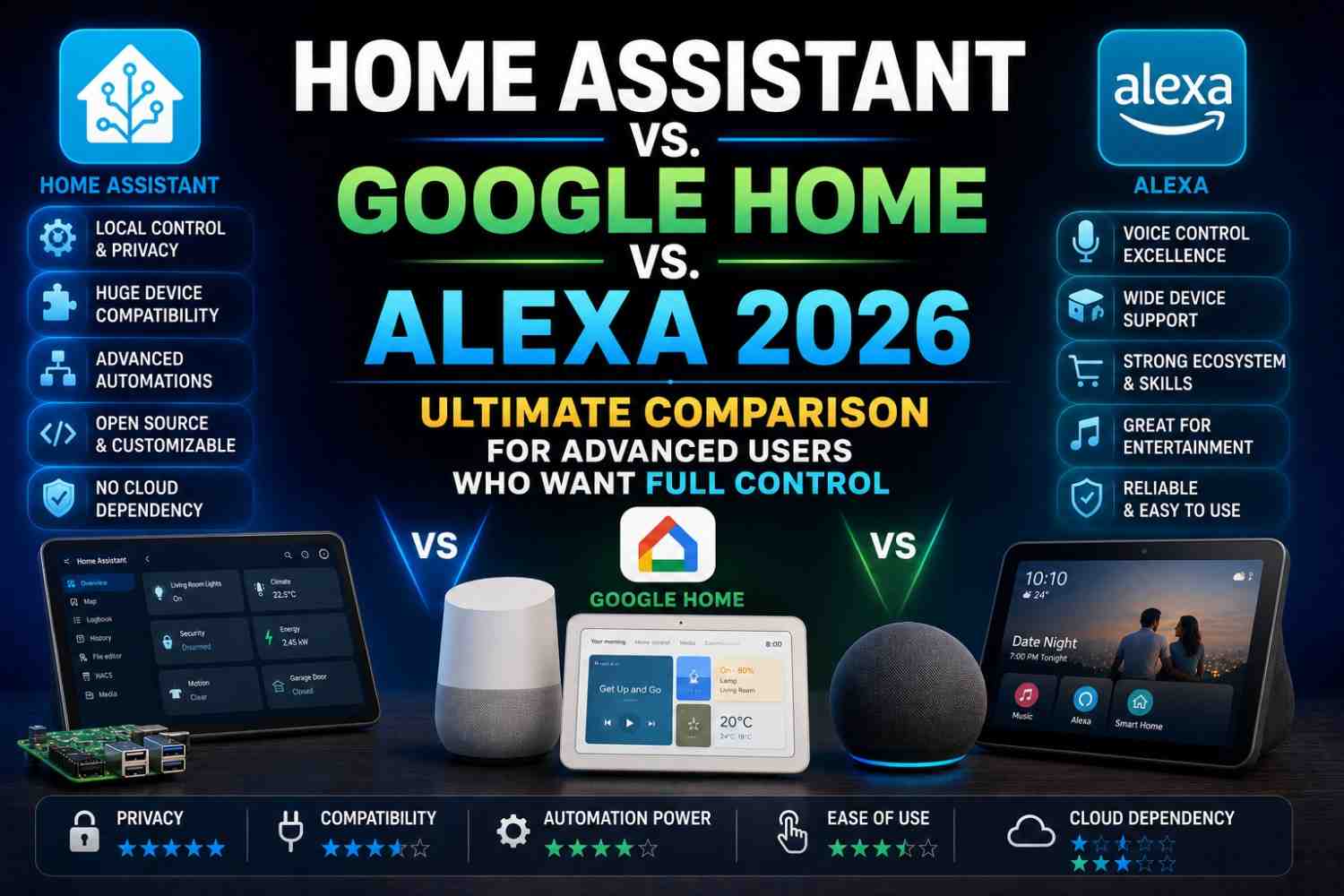
Final Scorecard: Home Assistant vs Google Home vs Alexa 2026
| Category | Home Assistant | Google Home | Amazon Alexa |
|---|---|---|---|
| Automation Depth | ★★★★★ | ★★★★☆ | ★★★☆☆ |
| Device Compatibility | ★★★★★ | ★★★★☆ | ★★★★★ |
| Offline Control | ★★★★★ | ★★★☆☆ | ★★☆☆☆ |
| Privacy | ★★★★★ | ★★★☆☆ | ★★★☆☆ |
| Ease of Use | ★★★☆☆ | ★★★★★ | ★★★★☆ |
| AI Features | ★★★★☆ | ★★★★★ | ★★★★☆ |
| Cost | ★★★★★ | ★★★★★ | ★★★☆☆ |
| Overall (Advanced Users) | ★★★★★ | ★★★★☆ | ★★★★☆ |
FAQs: Home Assistant vs Google Home vs Alexa 2026
Q1: In Home Assistant vs. Google Home vs. Alexa 2026, which is best for complete beginners? A: Google Home is the best starting point — setup takes under 30 minutes, the app is intuitive, and it works immediately with thousands of devices. Begin here and migrate to Home Assistant later if you need more power.
Q2: In Home Assistant vs. Google Home vs. Alexa 2026, which works best without internet? A: Home Assistant is the clear winner — it’s designed from the ground up for local operation. Google Home has growing local capabilities. Alexa has limited local processing on Echo hardware only.
Q3: Is Home Assistant really free in Home Assistant vs. Google Home vs. Alexa 2026? A: Yes — Home Assistant software is completely free and open source. You only pay for the hardware to run it (a Raspberry Pi 4 costs around ₹4,000–₹6,000 in India). There is no subscription, no cloud fees, and no premium tier.
Q4: In Home Assistant vs. Google Home vs. Alexa 2026, which has the best AI? A: Google Home leads in AI accessibility and natural language in 2026 with Gemini integration. Home Assistant leads for AI privacy with its local LLM approach. Alexa’s best AI features are locked behind the Alexa+ subscription.
Q5: Can I migrate from Google Home or Alexa to Home Assistant later? A: Yes. Most smart home devices are compatible with all three platforms simultaneously. You don’t need to replace any hardware to add Home Assistant — you simply add it as an additional control layer alongside your existing setup.
Conclusion
The Home Assistant vs. Google Home vs. Alexa 2026 decision ultimately comes down to one question: how much control do you want, and how much complexity are you willing to manage to get it?
For advanced users who prioritize power, privacy, and unlimited automation depth—Home Assistant wins the Home Assistant vs. Google Home vs. Alexa 2026 debate clearly and convincingly. For everyone else, Google Home offers the best combination of features, AI integration, and ease of use with zero cost.
Don’t view this as a permanent choice. Start wherever your skill level is comfortable, and let your home automation journey evolve naturally. The beauty of 2026’s smart home landscape is that all three platforms increasingly work together through Matter—so you can always add layers of sophistication as you grow.
Decide which platform fits your needs today, set up your first automation this weekend, and experience what it feels like when your home truly thinks for itself!