Choosing a smart home hub is the most consequential decision you will make in building a smart home. Everything else — every bulb, every plug, every lock, every camera — needs to work with this central platform. Get it right, and your smart home runs seamlessly. Get it wrong and you end up with a collection of devices that speak different languages and refuse to work together.
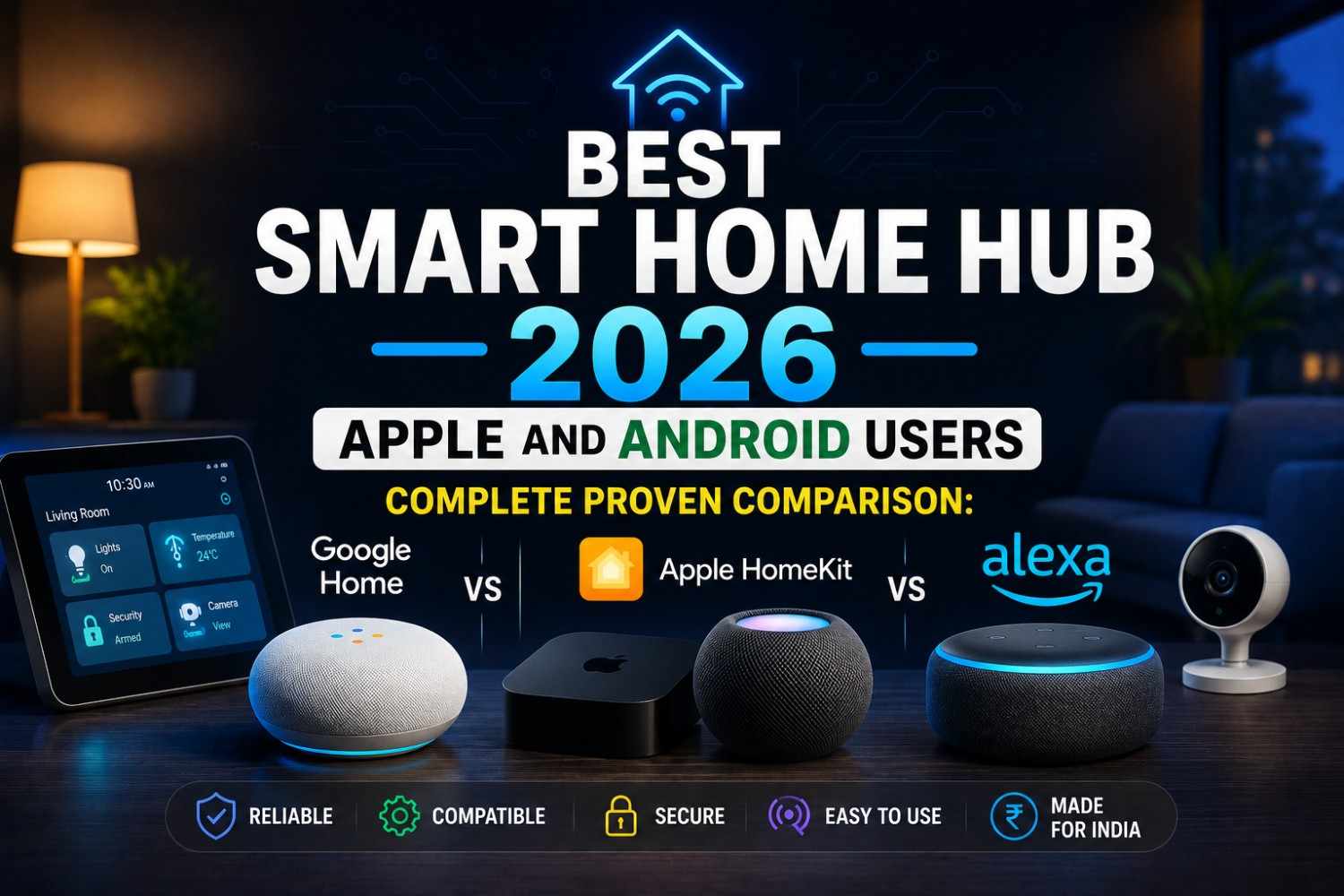
The best smart home hub 2026: Apple and Android users can choose from three major ecosystems: Google Home, Apple HomeKit, and Amazon Alexa. Each has strengths and weaknesses. Each suits a different type of user.
This comprehensive comparison covers every relevant dimension—device compatibility, ease of use, automation capability, India availability, privacy, and long-term ecosystem stability—to help you make the right choice once and build confidently from there.
Why Your Smart Home Hub Choice Matters So Much
A smart home hub is the platform that ties all your smart devices together. It is the system that lets you say “turn off all the lights” or “set the AC to 24 degrees” or “lock the front door when I leave the house.”
Without a hub, every device only works through its own individual app. You need seven apps to control seven devices. A hub unifies all of them under one platform, one app, and one voice assistant.
The best smart home hubs of 2026, Apple and Android options, differ primarily in which devices they support, how their automation engines work, and whether they favor Apple or Android users.
The Three Major Smart Home Ecosystems in 2026
1. Google Home
Google Home is the smart home platform that runs on Google Assistant. It is built into Nest devices (Nest Hub, Nest Mini, Nest Cam, Nest Thermostat) and supports hundreds of third-party devices from brands like TP-Link, Philips Hue, Wipro, Syska, and more.
Best for: Android users, Google services users (Gmail, Google Calendar, YouTube), homes with Nest devices.
Hub Hardware Options:
- Google Nest Hub (2nd Gen) — ₹7,999
- Google Nest Hub Max — ₹9,999–₹12,999
- Google Nest Mini — ₹4,999
Strengths:
- Deep Android integration
- Superior multilingual support (including Hindi)
- Matter and Thread border router support built into Nest Hub
- Free tier includes most automation features
- YouTube and Google Meet integration on smart displays
Weaknesses:
- Automations are less powerful than Alexa routines
- Google has discontinued several past products (Stadia, original Nest Secure), raising ecosystem longevity concerns
- Limited Apple device integration
2. Apple HomeKit
Apple HomeKit is the smart home framework built into iOS, iPadOS, and macOS. It runs through the Apple Home app and is controlled via Siri. A HomePod Mini or Apple TV 4K serves as the hub device that enables remote access and automation.
Best for: iPhone/iPad users, Apple ecosystem households, privacy-focused users.
Hub Hardware Options:
- Apple HomePod Mini — ₹9,900
- Apple HomePod (2nd Gen) — ₹32,900
- Apple TV 4K (3rd Gen) — ₹18,900
Strengths:
- Best-in-class local data processing and privacy
- On-device Siri intelligence since Siri on-device update in 2024
- Thread border router built into HomePod Mini and HomePod
- Native integration with iPhone, iPad, Mac, Apple Watch
- Home app is clean, intuitive, and reliable
Weaknesses:
- Significantly fewer compatible devices than Alexa or Google Home
- Android users cannot use Apple HomeKit at all
- Higher hardware cost to establish the ecosystem
- India pricing for HomePod makes entry expensive
3. Amazon Alexa
Amazon Alexa is the most mature and widely supported smart home platform globally. It has the largest library of compatible devices — over 100,000 certified products — and the most powerful automation engine of the three platforms. The Echo speaker and Echo Show display lines serve as hub devices.
Best for: Users who want maximum device compatibility, Amazon Prime subscribers, households with mixed Android/iOS devices.
Hub Hardware Options:
- Amazon Echo Dot (5th Gen) — ₹3,499
- Amazon Echo (4th Gen) — ₹7,999
- Amazon Echo Show 8 — ₹7,999–₹9,999
Strengths:
- Largest ecosystem of compatible devices in India and globally
- Most powerful automation routines (conditions, triggers, multi-step actions)
- Works with both Android and iOS devices equally well
- Built-in Zigbee hub in Echo Show 10 and Echo Plus
- Wide India availability of Alexa-compatible devices
Weaknesses:
- More cloud-dependent than Google Home or HomeKit
- Privacy concerns around always-on microphone (though hardware mute button available)
- Amazon has discontinued some Alexa features, raising questions about long-term investment
- Less elegant app interface compared to Apple Home
Head-to-Head Comparison Table
| Feature | Google Home | Apple HomeKit | Amazon Alexa |
|---|---|---|---|
| Best Phone Platform | Android | iPhone/iPad | Both equally |
| Compatible Devices | Thousands | Hundreds | 100,000+ |
| Matter Support | Yes (Thread router) | Yes (Thread router) | Yes (Thread router) |
| Hindi Support | Excellent | Basic | Good |
| Automation Power | Moderate | Moderate | Advanced |
| Privacy | Cloud (encrypted) | On-device (best) | Cloud |
| India Device Availability | Good | Limited | Excellent |
| Entry Cost (hub) | ₹4,999 (Nest Mini) | ₹9,900 (HomePod Mini) | ₹3,499 (Echo Dot) |
| Free Tier | Yes | Yes | Yes |
| Local Control | Partial (Matter) | Yes (full) | Partial (Matter) |
Automation Capability: Which Platform Automates Best?
Automation is the most powerful feature of any smart home hub — and the most overlooked by beginners. An automation lets your home respond to conditions without you doing anything.
Examples:
- When you arrive home → unlock door, turn on lights, set AC to 24°C
- At sunset every day → turn on outdoor lights
- If motion detected after midnight → send phone alert and turn on bedroom lamp at 10% brightness
Amazon Alexa has the most flexible and powerful automation engine. Alexa Routines support multiple triggers (voice, time, motion sensor, smart home device state, sunrise/sunset), multiple actions per routine, and conditional logic. For users who want sophisticated automation, Alexa wins decisively.
Google Home automation (called Routines) has improved substantially in 2025–2026. It now supports device state triggers and multi-step actions. It remains slightly simpler than Alexa Routines but covers most everyday automation needs well.
Apple HomeKit automations are reliable and run locally (meaning they work without internet), but the visual automation builder is limited compared to Alexa. Complex multi-condition automations require the Shortcuts app, which adds a learning curve. HomeKit’s local execution is a major advantage for reliability.
Verdict for automation: Alexa for power users. Google Home for everyday users. HomeKit for reliability-focused users who want local execution.
Privacy Comparison
Privacy is increasingly a deciding factor for smart home hub selection.
Apple HomeKit processes as much data as possible on-device, particularly with the HomePod and on-device Siri. Home data is end-to-end encrypted and not used for advertising. Apple’s business model does not depend on user data monetization.
Google Home processes voice commands through Google’s servers. Google does use anonymized data to improve its services, though it offers controls to limit data retention. Google Assistant audio clips can be reviewed and deleted in My Activity.
Amazon Alexa stores voice recordings on Amazon’s servers by default. Amazon has faced more regulatory scrutiny over Alexa data practices than either Apple or Google. However, hardware mute buttons, recording deletion, and privacy dashboards give users meaningful control.
Verdict for privacy: Apple HomeKit is the clear winner. Google Home is mid-tier. Alexa requires the most active privacy management from the user.
Best Smart Home Hub for Android Users in India
For Android users in India — which accounts for over 95% of Indian smartphone users — the practical choice narrows to Google Home or Amazon Alexa.
Google Home is the natural choice for users who live inside Google’s ecosystem. If you use a Gmail account, store photos on Google Photos, watch YouTube daily, and navigate with Google Maps, your smart home will feel like a natural extension of that existing experience.
Amazon Alexa is the better choice for users who want the widest possible device compatibility. If you plan to buy smart home devices from multiple brands over time and want to be sure everything works together, Alexa’s larger certified device library is a significant practical advantage.
The best smart home hub 2026 Apple/Android answer for most Indian Android users is Amazon Alexa for device breadth and Google Home for ecosystem elegance.
Best Smart Home Hub for iPhone/iPad Users in India
For iPhone users, the choice is between Apple HomeKit and Amazon Alexa (Google Home is Android-first and less seamless on iOS).
Apple HomeKit is the obvious choice for users who want deep iPhone integration—Siri shortcuts, a Home widget on the lock screen, Apple Watch control, and privacy-first local processing. The limitation is device availability: HomeKit-certified products in India are fewer and often more expensive.
Amazon Alexa works perfectly well on iPhone via the Alexa app and offers access to a vastly larger selection of India-available smart home devices. If device variety is more important than deep iPhone integration, Alexa is the pragmatic choice even for iPhone users.
The best smart home hub 2026 Apple/Android recommendation for iPhone users: Apple HomeKit if you value privacy and iOS integration, and Amazon Alexa if you value device choice and India availability.
What About Matter? Does It Make the Choice Less Important?
Yes — but only partially. The Matter protocol allows a single device to work with multiple platforms simultaneously. A Matter-certified bulb can be controlled by Google Home, Alexa, and HomeKit at the same time.
This means Matter reduces (but does not eliminate) the importance of choosing an ecosystem. Your automations, your hub hardware, your voice assistant preference, and your existing device investments still depend on which platform you commit to as your primary hub.
Matter makes the walls between ecosystems more porous — it does not tear them down entirely.
Suggested Image Placements
Image 1: Place after the Three Major Ecosystems overview section.
- Description: Three icons side by side—Google Home (colorful G logo), Apple HomeKit (home icon), and Amazon Alexa (smile logo)—with device icons below each representing compatible products.
- ALT text: “Best smart home hub 2026 Apple Android users—Google Home vs Apple HomeKit vs Amazon Alexa comparison”
Image 2: Place after the Head-to-Head Comparison Table.
- Description: A visual flow diagram showing how a smart home hub connects to lights, locks, cameras, thermostats, and voice assistants from a central platform.
- ALT text: “Best smart home hub 2026 Apple Android — how smart home hubs connect devices and platforms”
Authority Outbound Links
- Google Home Official — https://home.google.com — Google’s official smart home platform page with a device compatibility list.
- Apple HomeKit Guide — https://www.apple.com/in/home-app/ — Apple’s official Home app and HomeKit information for India.
- Amazon Alexa Smart Home — https://www.amazon.in/Alexa-Smart-Home — Alexa-compatible smart home devices available in India.
- Matter CSA Product List — https://csa-iot.org/csa-iot_products/ — Search and verify Matter-certified devices before purchase.
- The Verge Smart Home Hub Guide — https://www.theverge.com/smart-home — Independent smart home hub reviews and ecosystem analysis.
FAQs: Best Smart Home Hub 2026 Apple And Android Users
Q1. Can I use Apple HomeKit if I have an Android phone? No. Apple HomeKit requires an Apple device — iPhone, iPad, or Mac — for setup and control. Android users cannot access HomeKit. However, Matter-certified HomeKit devices can sometimes be added to Google Home or Alexa as well.
Q2. Which smart home hub works best in India in 2026? Amazon Alexa has the best India availability, widest device compatibility, and most developed local customer support. For Android users in the Google ecosystem, Google Home is a close second. Apple HomeKit is limited in India due to fewer certified devices and higher hardware costs.
Q3. Do I need a physical hub device, or can I just use an app? You need at least one hub hardware device for remote access and automation to work when you are away from home. For Alexa, an Echo speaker works as the hub. For Google Home, a Nest Hub or Nest Mini. For HomeKit, a HomePod Mini or Apple TV 4K.
Q4. Can I switch ecosystems later without losing my devices? You can switch, but it requires adding devices to a new platform — which may not be possible for non-Matter devices. Matter-certified devices can be moved between platforms more easily. Non-matter proprietary devices may need to be replaced if you switch ecosystems.
Q5. Is it possible to use all three platforms simultaneously? Yes, with Matter. A Matter-certified smart bulb can be added to Google Home, Alexa, and HomeKit at the same time. Each platform controls the same device independently. For non-Matter devices, simultaneous multiplatform control is not possible.
Conclusion
The best smart home hub for 2026 Apple and Android users can choose from is ultimately a reflection of how you use technology in daily life. There is no universally superior platform — there is only the one that fits your phone, your services, your budget, and your priorities.
Android users: start with Google Home for ecosystem elegance or Alexa for device breadth. iPhone users: start with HomeKit for privacy and iOS integration or Alexa for India-specific device availability.
One practical recommendation: start with an Echo Dot if you are undecided. At ₹3,499, it gives you access to the world’s largest smart home ecosystem with the flexibility to explore. You can always add a Nest Hub or HomePod Mini later once you know which direction you want to go.
Your smart home starts with choosing a hub. Make that decision today — and build from there.